Tuesday, December 27, 2011

Veg Talk

Redbor Curly Kale F1 is not only delicious, hardy but decorative too. Just one of a surprising amount we have currently in the veg garden. OK, its a mild winter, we have hardly had a frost yet, but even so, I'm always pleasantly surprised about just how much choice we have at this time. The 'hungry gap' I think of as May and June, after all the last year's stuff has bolted/been eaten/died but before the current year's produce has really got going.  
Leeks are the hardiest winter veg by far, This is Sultan F1, I think. Modern varieties are good as they are more likely to be rust-resistant , and if you like to eat the green bits where most of the vitamins are a rust-resistant variety is essential.
Another good kale is Ragged Jack, but known as Russian Red,and probably a lot more, a good old open pollinated variety, very good when small as well, so arguably a more versatile plant.
Surprisingly good last winter (down to -16C) was Georgia Collard Greens (front), a traditional variety from the American South which are better than any British spring greens variety, but difficult to get here. Oprah Winfrey once mistook Hostas for  them but that's another story. At the back is Mizuna, which survives quite a bit of frost. We have enough of the stuff to feed Tokyo.

 Swiss chard is looking a bit manky, and its not the world's most exciting vegetable, but stays productive through the winter, especially in this mild weather. Far better than spinach at keeping going from one year to another.
Winter is an easy time in the veg garden - very little to do and surprisingly, plenty to harvest. Paradoxically it can be a more productive time than May or June, when last year's crop has finished but before the new year's has come on stream.

Traditional brassicas usually sit out winter well, although in last year's -16C we lost broccoli and cabbage, even famously hardy kale. Softer-leaved oriental stir-fry greens can survive cold well, and in mild weather, like this winter, can carry on growing. Which is not necessarily a  good thing, as they may start to bolt. Which is the curse of these high-speed greens. Once one mizuna pushes up a flower stalk you know that the rest will soon follow. A new winter crop for us is Raab, an Italian hi-speed broccoli, producing small heads a couple of months after flowering, and needless to say going over quickly, but in the winter ours has continued to produce decent little heads for a few months now; leaves have a nice mustardy flavor too. Good stuff, but a bit hard to get hold of - a good reason to save your own seed if you get any.

Only failure has been Chinese cabbage, which is always a nightmare, sow it too early in the summer and it can bolt, sow it too late and it doesn't grow enough to head up - which is what happened to my lot this year - boo hoo!

Still chomping, baking, roasting, souping etc etc our vast pile of Uchiki Kuri squash, the only variety which does here at 500ft (130m) in the Welsh borders, its from Hokkaido which has a very short hot growing season, and it thrives in our long, cool one.


Saturday, December 17, 2011

Wolfgang Oehme RIP

Wolfgang Oehme, one of the most important figures in recent North American landscape, has just died. He was one of those people who achieve great things despite being, well shall we say, very eccentric. Autistic basically. Let's face it, they are not always great company but so often it is the extraordinarily focused and utterly obsessive and anti-social geniuses who have moved human history on, despite being exasperating and maddening to deal with as people.  The worst lecture I have ever been to was given by Wolfgang - it was so bad it was almost performance art.

Wolfgang got his deep understanding of plants  in his native (east) Germany where he trained in the tradition of pioneer plantsman Karl Foerster before emigrating to the US in the late fifties. There after a number of years working as a landscape and garden designer he met James van Sweden. The rest is history. It was an extraordinary partnership - between the extrovert James, trained as an architect and not only a superb designer but also a very good businessman and Wolfgang who knew about plants, and not a lot else. Plants which were reliable and deerproof and everythingelse the Washington DC suburbs could throw at them proof, was just what US landscaping needed back in the 1970s. Without Wolfgang there would have few alternatives to grass, more grass, more grass, and the limited number of boring shrubs which the US landscape industry was using at the time. The fact that the US landscape design profession has broken through to its very dynamic and much more plant-orientated present was given an enormous boost through Wolfgang's knowledge.

The Elysian fields will no doubt be planted up with lots of Rudbeckia 'Goldsturm' and Calamagrostis x acutiflora. One of my favourite stories about him was him going round to a client's garden and noticing that some impatiens had been planted in the middle of one of 'his' borders. Pulling them out with his bare hands the told the client "this is not your garden , this is my garden". I think most of us in the design profession have felt like doing  that occasionally.


Here's a proper obituary


Wednesday, December 7, 2011

Hadspen Garden - The Archive

Part of the Red Border at Hadspen, (c) Clive Nichols Photography

Hadspen House Gardens were, from 1988 to 2005, one of the most talked-about gardens in Britain, and one of the most passionately loved. They had been known before, it was where Penelope Hobhouse started gardening, and after she had left for Tintinhull, when two of the gardeners took it over, keeping it open to the public but letting it sink into a genteel decline, and trying to run a nursery at the same time. Which is when I first discovered it. One of those really romantic secret garden places - go through a door into a sheltered world, of embracing walls, clambering roses and other climbers, sprawling borders, down at heel, a garden taking over the running of itself. It was a kind of a ruin, there had been greenhouses, and vegetable beds and now there were tenderish things taking advantage of the shelter and the south-facing aspect.

The next thing I heard that a Canadian couple, visiting on a tour of English gardens, had heard that it was up for a rent, as a garden+nursery, and stayed, bunked ship, leaving their almost-grown-up children in BC. They had fallen in love with the secret garden, and had taken it on as a business. The next few years saw their reputation grow. They were unusual, clover, skillful, imaginative, disciplined gardeners who worked with color. They were also both so good-looking (which shouldn’t matter, but it does, as we are dealing with something of a myth here, and in myths it always helps if the heroes and heroines are drop-dead gorgeous).

Nori and Sandra had a theory, about how men and women seen color differently, that women have more cones in their retinas. and so see color with more detail, they can see differences that men can’t. I don’t know whether this has ever been tested, but it is certainly true that more men are color-blind. Sandra experimented with color combinations and Nori refined them, specializing in single-color borders. The garden magazines loved them. They were just the right people at the right time. Their work with color was just so thoughtful, so sophisticated. 


Hadspen’s reputation spread. It became one of the most discussed gardens in Britain. Needless to say they did a book, with pictures by Clive Nichols, but it seemed sadly inadequate - it needed to be much longer (Nori had written far more, but it got edited out). Then, in 2005, with grand-children back home and Nori needing a hip replacement they left. The garden was stripped by the local gardening ladies (by invitation of the owner Niall Hobhouse). The rest of the story is well-known. Niall got  a bulldozer in and announced a competition for a gardener/designer. Which nobody really won, and the garden just became a sad empty space. No decision made. Yet. I suppose one day it might be.

Recently though, we have launched ‘The Hadspen Archive’ to try to encourage as many people to send in pictures or other anything else which enables us to do something about documenting this remarkable garden and what the Popes learnt there. Other people will want to carry on from where they left off, and it would be nice if new garden-colorists could have a record of what they
did. If you've ever been and have pictures, we'd love to hear from you.


I am now Tweeting on @noelk57

Sunday, November 20, 2011

Texting the Garden


At a time when the garden is looking rubbish, ‘cos its November and however much we bang on about grasses and seedheads, the garden always does look rubbish now except for when the sun shines, which it has done a little bit lately. Good time to think about garden stuff that doesn’t involve green things.

Like Text

To read more, just click here, and by the way I have now gone on to Twitter (or joined Twitter, or become a Twit, or whatever is the correct grammatical formation), you can follow me on: 
@noelk57

Tuesday, October 25, 2011

Cold n’dry, lean n’mean

Scampston Hall, North Yorkshire, still looking good in early October

Preparing for climate change is an iffy business, driven by media hysteria, and the inability of many people, journalists especially to think beyond their next holiday. One misconception is that it is going to ‘get warmer’, whereas in fact here in Britain, or indeed more widely in north-west Europe, this does not seem to be happening. We have just had the coldest summer in twenty years, as have the Dutch, and I think the Danes too. This might be due to climate change or not - we can never know. As gardeners we have to plan and plant for all sorts of eventualities - so there should really be no need for radically-different plantings.
A historic greenhouse range awaits restoration.


One unfortunate result of a run of a twenty year run of mild winters, and much ill-informed press speculation about climate change, is that the British just got silly with what they were planting. A generation of younger gardeners grew up not knowing what a ‘proper’ winter was. And... I can’t help feeling, cynically perhaps, that there was a certain amount of wishful thinking that global warming was somehow going to make our climate more like that of the Med, that land where the British middle-class like to holiday, the land of olive trees, vineyard-draped pergolas and tomatoes picked effortlessly from the garden. ‘Preparing for climate change in the garden’ for some people meant living out their fantasies about the good life in Provence without having to move from Islington.
Sesleria autumnalis is a grass of infertile moorland type habits, its a useful height and spead.

The last three cold winters and our lousy summer should make them think again. OK, it is less sexy than the Mediterranean look, but the Steppe look might actually be a better look to cultivate. Forget Provence, Tuscany and San Tropez, think Anatolia, Kazakhstan and Colorado. Sorry lotus-eaters.

Steppe climates have cold winters and hot summers and tend to be dry. Anything from a steppe climate will survive drought, extreme heat and extreme cold. My experience of them is actually pretty limited, but I suspect we are all in the same boat. We already have plenty of steppe plants in cultivation: a lot of grasses, bearded irises, perovskia, European-origin Salvias. There is scope for more plant-hunting of course.
Molinia caerulea 'Poul Petersen' in waves - one of the best and most original pieces of contemporary formal planting I know.
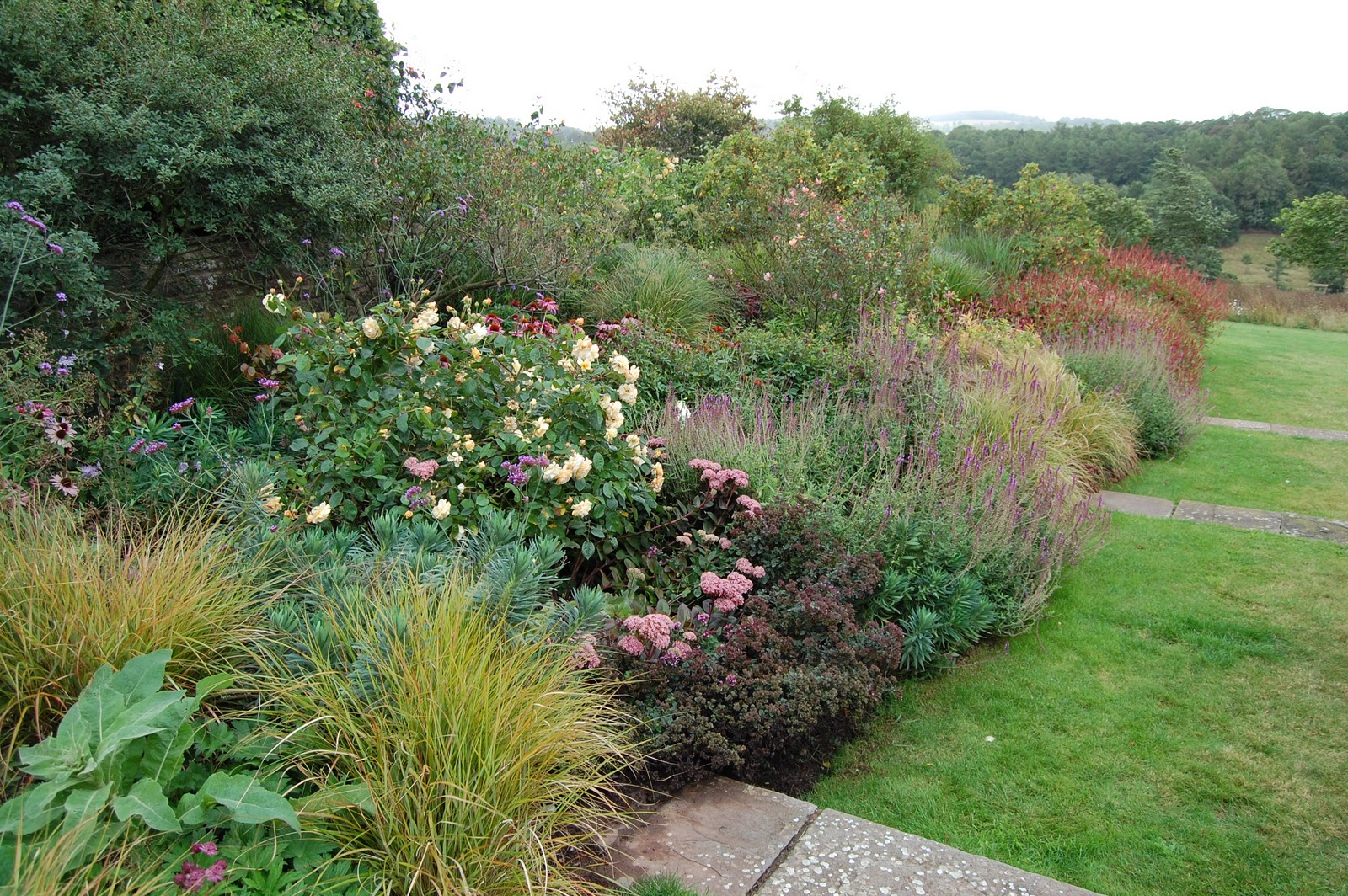
Scampston Hall, Malton, NorthYorkshire, where I recently ran a workshop for the north-east group of the Landscape Institute has a splendid Piet Oudolf designed garden dating from 2001. The soil is sandy and not terribly fertile, the climate is north England cool, and being on the east coast relatively dry. Its a great model for the kind of planting which is very resilient to climatic extremes, and much more useful for indicating what we should be learning from than holiday snaps from southern Europe.

Thursday, September 29, 2011

Dolly Parton meets Lutyens? Roy Strong does not meet us.

 Funny business, acting as a tour guide in your own locality (The Welsh Borders), driving around in a big coach, in places that are really familiar, talking people through who don't know it all. Helps you see the familiar afresh. Also rather funny to roll up at your own garden, show people around and then all get back on the coach again.
Stephen and Judith Anderton's cottge high in the Black Mountains


 Stephen Anderton, garden correspondent for The Times now lives in  a site with fantastic views, which have I think rather unwilling to try to compete with the location by making something so humble as a garden. So, planting is largely restricted to the side of the house away from the view. Its feels like a cottage garden but with more contemporary plants, such as grasses and kniphofias. It actually feels very undesigned, and artless - difficult to know whether this is really the case. I really like it, there is something very unpretentious about it, and the colouring works well, lots of different colours but subtle harmonies everywhere. Lots of succulents and ferns sitting in pots on old stone steps. The garden of someone who loves growing lots of plants and feels under no pressure to make bold statements or impress anybody.


"The slugs are this long" Peter Clay expounds the story of his garden, Sue MacGregor of Boxwood Tours looks on.

 Brockhampton Cottage, near Hereford, went down very well. Home of Peter Clay, who runs Crocus the online garden centre. The fact that he took time out of a busy working schedule to talk to us at length about the garden, how it fits into its wide and very English and very beautiful landscape, and his involvement with designer Tom Stuart-Smith, was much appreciated.


 H.Avray Tipping was a well-known, but now largely forgotten, garden designer of the early 20th century, and a key part of the Arts and Crafts movement which has dominated British garden design ever since (which is a thoroughly bad thing if you believe my colleague Tim Richardson). A&C gardening is a harmless pursuit and it balances order and growth so well, many of us are quite happy to follow in the footsteps of Tipping, Jekyll, Sackville-West et al. Tipping created three gardens in the Monmouthshire area, only one of which has been restored, by the current owners, Hilary and Helena Gerrish. Helena has just written a book about him. So now you have no excuse to say you have never heard of him.
High Glanau vintage Arts and Crafts
The trouble with mounts is that some people just have to stand on top of them and wave their arms about.
                       
We also visited Westonbury Watermill, a modern folly and water garden,  where owner Richard Pim is building an enormous (two storey) water-powered cuckoo clock. Watch this space.

Westonbury Water Mill, at Pembridge, Herefs. features a very impressive gunnera maze. Jo is describing the size of our cabbages this year.


The Pant, near Abergavenny, is a most intriguing landscape-as-garden, created by Jeremy and Camilla Swift. Jeremy is an eminent anthropologist, and much of the garden's content reflects interests from his professional life. It is a garden of great subtlety, making the most of wonderful surroundings.


The loo at The Laskett - strangely austere
 Finally, The Laskett, well-known through the voluminous writings of Roy Strong. It is obsessively formal, with allee upon allee, and everything in sight topiarised to within millimetres of its life. He has clearly had enormous fun making it - which after all is the most important thing. I love the way he bulldozes through so many of the basic rules of garden design. Unfortunately he disgraced himself by failing to keep an appointment to meet us, so we had to wander around by ourselves, getting lost in a kind of Alice in Wonderland world of hedges, hedges, yet more hedges, pleaching and monuments (mostly to himself, and one to a cat).


Roy Strong and I in 1996, or thereabouts. Check the body language. I still have the shirt, I understand he gives all his clothes to the Victoria and Albert Museum. Reminds me, I must make arrangements to do the same. We've both cut our hair by the way.

 You may have gathered that Mr Strong and I don't see eye to eye on gardening matters. I think I once wrote that a garden restoration of his should be bulldozed into the Thames (the Hampton Court Privy Garden). We once had a wonderfully bitchy spat on the radio, which could have been the start of a re-play of Robinson versus Blomfield (a great and rather stylised debate of the A&C era - see above), but I think both of us had rather more important things to do (promoting naturalistic planting design in my case and writing fawning books on the British monarchy in his).

Tour leading is great fun, you get to meet lots of interesting people (even if not Roy Strong), and hear about their lives and interests. Over the days, you learn about what they like in gardens and what they don't like, I always find it interesting getting people's reactions, I also learn a lot too, they always see things i have never noticed, even in places I know well. Seeing familiar places through other people's eyes in this way is actually rather special.

Finally, there was one comment I adored, I'm not saying which garden it was about... "Dolly Parton meets Lutyens".

Well not quite finally, we had Monique and Thierry Dronet, of the wonderful Jardin de Berchigranges, stay with us recently. Lovely people, kindred spirits; Thierry pointed out to us that (unbeknown to us)his  garage was on the front cover of a book on green building in the guest room of our (needless to say eco-build) guest room. They had the idea of digging up half a square metre of our wildflower meadow and planting it in the middle of a new meadow area they are creating. So here it is going in, a little bit of Herefordshire in the Vosges mountains.


Wednesday, September 7, 2011

“Grrrt lush!” – exotic fruit in the west of England.


            Peaches and apricots at 52 degrees north and 167m (547ft) in the English/Welsh borders is pretty good going. Nothing to do with global warming or microclimate, although they are on the south wall of the house, and all to do with good modern plant breeding.
            The peach we’ve had for four years; its fruited for three of those, and we were up to 24 this year. Good juicy flavourful peaches, far better than anything you can buy in the shops. Its name ‘Avalon Pride’ made me think it must have been bred somewhere near Glastonbury in Somerset, which of course would meant that it is a “grrrt lush” variety in the local lingo. But it turns out to be from the Seattle area, and a more or less accidental discovery, a seedling which appeared to be totally resistant to the peach leaf curl disease which devastates peaches, especially in cold wet winter climate zones like ours. It turned out to be very hardy too, although hardiness is not really the issue with peaches, rather that they flower very early, and the young fruit are easily caught by later frosts. They are so pretty in bloom that they are almost worth growing for their flowers alone. 

            The apricot was even more of a surprise. I bought it from DT Brown, a mail-order vegetable seed company. It arrived, very crudely pruned, and it went into soil at the base of our home’s massive mid 18th century chimney stack – its not good soil at all, so we’ll have to try to improve it with compost mulching from now on. No expectations of any apricots. Actually we aren’t great apricot fans, they often seem to taste rather astringent, or maybe that’s just European ones. The best apricots I’ve had are the dry ‘white’ ones you can get in the Hunza valley in northern Pakistan, mysteriously completely unlike the little round balls sold as Hunza apricots in wholefood shops here.
            Apricots are very hardy. Very. Winter in northern Pak at 3000m is very very cold, but once it’s spring it doesn’t freeze. So the locals of the Hunza and neighbouring valleys grew family apricot trees – that’s family as in several different varieties on each tree. Dried on rooftops during the intensely hot and dry summer, they would be eaten as a staple diet for the rest of the year. Imagine living on apricot porridge for breakfast, dinner and tea, with a bit of barley thrown in for excitement.
            Again, the problem for us as apricot growers is that the young fruit gets caught by late frosts. However our variety ‘Flavourcot’ and its sister ‘Tomcot’ have been bred in New Zealand to flower a little later and so reduce the frost risk. To our astonishment this year we harvested thirty fruit, deliciously juicy and without much astringency. Actually they really were the nicest apricots I have ever tasted. Since then I have heard of someone in nearby Gloucestershire planting a commercial orchard of –cot type varieties.
            I wonder what other surprises the future might bring. British bananas are a theoretical possibility. Anyone who knew us at our last house would have been familiar with the vast Musa basjoo in the backgarden. I had planted it when Jo was away teaching for two years in Bratislava (1993) and it just grew and grew in its sheltered inner-city Bristol, cat-shit fed, environment. Every year we would hack bits off for people. Last winter (minus 12) killed it to ground level, but the tenants in the house reported that by May it was sprouting again.
            Musa basjoo is a higher altitude south Chinese species, with inedible fruit full of bullet hard seeds. The fruit is also produced very late as it flowers late in cool British summers. Even with conventional breeding techniques I reckon it might be possible to start on the path to a variety which had small edible fruit by late autumn in southern Britain, or certainly in the warmer summers of central Europe.
            Roll on modern plant breeding!