Sunday, August 5, 2012

Olympic Glory

The North American planting: Echinacea pallida, purpurea and paradoxa. Photo:James Hitchmough

Something of an Olympic sceptic (our government is closing down sports centres all over the country) I'm glad to see a couple of good things have come out of the Olympics. That fantastic, and oh-so cool Britannia opening ceremony and the Olympic Park, with much of the planting designed by my colleagues at Sheffield Uni: James Hitchmough and Nigel Dunnett - it's revolutionary.

See my piece in The Daily Telegraph about the thinking behind the planting.

 
South African planting, designed by James Hitchmough, with white Galtonia candicans,pink-red Gladiolus papilio 'Ruby', pink Dierama pulcherrimum, blue Agapanthus campanulatus, and low-growing pink Diascia integerrima. The grass is Themeda triandra. 
Photo:James Hitchmough


Part of the South African planting, inspired by montane grassland of eastern SA. Photo:James Hitchmough

more from South Africa Photo:James Hitchmough


An area of British natives at the Olympic Park. These are all forbs (i.e. non-grassy species): including white Leucanthemum vulgare, pink Ononis spinosa, yellow Leontodon autumnalis and pale pink Malva moschata. Apart from the ononis, all were sown. Photo and design by James Hitchmough.


James Hitchmough's page is here.

Nigel Dunnett also from Sheffield's Dept. of Landscape has designed a whole series of
plantings based on British, European and east Asian plant communities. Some of these function as swales for absorbing water runnoff - an essential part of the SUDS - sustainable drainage system approach used at the Olympic Park. Photo credits: Nigel Dunnett


One of Nigel's swales, designed to ensure water is held amongst plants tolerant of waterlogging but not actually that moisture dependent. The bright pink is Lythrum salicaria, the white Leucanthemum vulgare.
Nigel Dunnett's website is here

If you aren't already a reader.... try my unique soap opera for gardeners - Dig, Plant and Bitch .........the latest episode is out now...Hellebored!

Tuesday, July 31, 2012

Petunias and democracy.....Travels in Kyrgyzstan Part 3


Bishkek is my first experience of the former Soviet Union (USSR), words drained of real meaning to a younger generation, but for any of us who grew up and were politically aware before 1989 a major part of our consciousness of the world – but now all that seemingly indestructible grey concrete has turned to dust. I’m here for a botanical tour of north-east Kyrgyzstan, the most mountainous and remote of the former USSR’s ‘Soviet Socialist Republics’, up against China’s own remote province of Xinjiang. Amazing to be in a country which was once almost totally closed to outsiders, and about which we knew almost nothing. Now it is developing for tourists, but it feels like virgin territory for visitors.

There are more pictures on a Flickr site here.

Read more............

Sunday, July 22, 2012

Land of the yurt and the gerbil - Travels in Kyrgyzstan Part Two

-->
Deliriously species-rich meadows above Bokumbaevo; pale yellow is Pedicularis littenovii - a semi-parasite.


Friday
our second full day at Chong Kemin, a valley in the north-east. Totally off the beaten track. We're staying in a guesthouse which is the first in the area. a bit like a Nepali trekking guesthouses, all rather improvised, The village is very poor, people seem to have nothing beyond the basics. Poorer than Romania or Bulgaria. Hardly any cars, very battered old Ladas. Boys on horses gallop around.
Linum olgae

Later today we went further up the valley and walked up a side gorge, primed to look for Linum olgae, a perennial flax found only here and only seen in flower by a handful of botanists, “the snow leopard of central Asian botany” as Brian put it. Catherine and I were in the lead, it took her about 2 mins to spot something pink, I got out the binoculars, thought it worth the scramble, so up we went, an incredibly steep hillside. I was sure it was a linum from some metres, shouted down and soon they were all coming up, even the older ones – about 4 are around 70. Catherine, Cassian and I went further up and we found thousands of the flowers, a very pretty pink in fact whole hillside covered with them.
A yurt. We have one in our garden too, but the originals are made of felt over an ingenious collapsable lattice framework. The top crown piece, analagous to a keystone, appears on the national flag.

We nearly lose Catherine when she screams and disappears, having partly fallen into an enormous hole, nearly 25 cms across and a metre deep. Clearly dug by an animal; apparently there are giant marmots in this area.

Tuesday
Extraordinary number of beehives on flatbed trucks below dramatic red rocks reminiscent of Sedona (Arizona). Nomadic Russian beekeepers who live in cabins next to their charges are a real feature here. We fantasize that they are are old USSR hippies of some kind. There doesn't look like so many flowers for them, as there is heavy grazing.

yurt-kitchen at our yurt camp in Song Kyl

Walk started from yurt camp in very picturesque but heavily grazed area, not the first place which feels more like Switzerland than central Asia. The group seems to go at an agonizingly slow pace: it is true that walking with botanists is like walking with a four year old. Much getting down on the ground on all fours to photograph tiny little plants. Eventually three of us decide to break away and just march up the track up the mountain as far as we can. We find some very interesting plants, and look longingly through the binoculars at the other side of the river at the ungrazed vegetation on the other side, I debate whether we should wade the river, but decide it is too dangerous. I understand how the old plant hunters took ridiculous risks sometimes. Luckily we find some little islands with ungrazed plants which we can wade across to: they are like little reserves of incredible plant species density. Its difficult to know how much grazing damages wild plant communities; in the short term it probably doesn't but it makes it very difficult for botanical exploration and associated eco-tourism. In the long-term many taller species may be eliminated. It's only going to get worse here – usual problem of too many people in the world eating too much meat.
-->
Trollius dschungaricus and friends

Wednesday
Health of group generally better, much sharing of bowel-data.  A walk through extraordinarily eroded semi-desert habitat, in rain !! Rest of day typical english summer day crap weather, cold and wet. …. Then we go to town centre and half an hour wandering around an utterly depressing decrepit place. One nice shop, a grocers, everything stacked up on shelves behind counters, with biscuits for sale by the pound and other time-warp eccentricities. I feel a bit like I have walked into one of those museums where everything is made up like it was the 19th century.
All the buildings in an advanced state of disintegration as most of the cars. Toothless old man in local headgear grabs Elly and gestures towards the mountains, presumably saying something like “come to my yurt” .

Little girl, big grass: our redoubtable Kyrgyz fixer Meerim Kozhoshova with Achnatheum splendens, a rather magnif grass we saw in many locations. Great garden and landscape potential.
This country is full of ruins. Most of the industry collapsed after the end of the USSR, and the whole infrastructure is crumbling, though thankfully schools look ok. and the odd house seems to be having money spent on it. Odd bits of dereliction everywhere: strange tanks and pipework rusting by the side of the road, roofless factories, large industrial yards growing weeds, roofless old collective farm buildings, even a sports ground full of weeds and a few sheep. And – by the side of the lake, a vast ?theme park, with concrete yurts and murals along a very extensive wall, goes on for at least 0.5km, turn the corner and the entire site is full of weeds. The only new buildings are the wretched banks. Only the main roads paved, residential areas are gravel and mud.


The Ala Meddin valley, outside the capital Bishkek.
When we get back a sauna is ready for us, so at least we can wash in lovely hot water. Fantastic felt rugs on the floor of our rooms and very nifty home-made beds.
Before supper some of us wander around the streets, admiring local building techniques, almost entirely based on adobe bricks, rammed earth or cob, as indeed they appear to be everywhere. The new eco-builders' paradise?
Catherine Janson discovers that Allium caeruleum greatly improves mobile phone reception. A highly distinctive species, widespread but never found in quaniity. Cassian Schmidt looks longingly up the Ala Meddin valley.

Thursday
Took a long time to get anywhere but unbelievably worth it when we did. About 2000m+. Few paths as such so a lot of walking across fields and gerbil-chewed steppe. Someone says that DNA analysis has shown that Black Death started amongst gerbils here. Fantastic views. Landscape on a truly massive scale. Eventually we get to some very good patches of wildflowers. And another. And another. In fact they keep on getting better, a truly incredible mix of species, every patch you look at you see something else. Then we spot some pink in some rose scrub– it is Linum olgae again, 200 kms south-west of its only known location to date! We end down the bottom of the hill along a stream where the flowers are even better – in visual terms, an amazing dense mix: Codonopsis clematidiea, Veronica sp. Pedicularis littinovii, Galium boreale, G. verum, Aster alpinus, Onobrychnis sp., Artemisia spp. (several), Astragalus sp., Scabiosa ochroleuca, Dracocephalum sp.,
Achnatherum splendens, Phlomis pratensis, Geranium collinum., Leontopodium sp.
Linum olgae - again! in the most species rich meadow i have ever seen. Blue is Codonopsis clematidea

Everyone snaps away furiously. We are in a kind of dream; everything is so perfect, so fresh, the light is soft enough for good photographs, indeed a thunderstorm rumbles away down the bottom of the valley. The range of truly incredible plant communities we have seen today is quite unbelievable.

Ligularia macrophylla was the theme plant of the trip for me. We saw it in so many locations, a real damp soil indicator. It an east-Asian element in a basically Eurasian flora.
Further meadows down in the valley are visually even better. Hallucinogenic. Oddly much of the visual impact is down to species native to Britain: two Galium, the vetch Vicia cracca, the little umbellifer Pimpinella saxifraga, an Origanum and a Hypericum almost identical to our O. vulgare and  H.perforatum. There is almost no grass though, and the unfamiliar species such as codonopsis, pedicularis and ligularia add an exotic touch. Makes me think we could achieve something similar at home.


Bokumbaevo in the sunlight is not so bad. Groups of young men hang around Ladas and Moskovitchs and other products of the USSR's half-hearted domestic car programme. Many have various bits missing (the cars not the young men). Entire families disgorge from the front seats of others, with goods stuffed in the back. A Lada 4x4 pulls a trailor with one cow entirely occupying it.
A group of elderly men in traditional felt hats play cards on a car bonnet. Meanwhile a distinguished looking old man walks by; he is wearing a jacket with all his war medals, including a big red star with a hammer and sickle.
The Song Kul plateau, a kind of mini-Tibet, at 3000m and surrounded by snow-capped peaks. Very heavily grazed but the route to the loos in the yurt camp was through drifts of Edelweiss.

Saturday
We came down from the Song Kul plateau partly by foot, being dropped at the pass and then walking down the road, botanizing as we went. According to Brian it took us 5 hours to go 3.5kms! A lot of alpine rarities at the top, things under the height of my ankle don't interest me so much so I spent a lot of time watching marmots through the binoculars. They clearly do not like eating Phlomis pratensis, so the hillsides are full of them. I spot a white one, the first we have seen amongst millions of the plants. A shout sends the rest of them scrambling up the slope. Marmots have to retreat for some peace and quiet.
Below the alpine belt is an area of meadows totally dominated by two geranium species: G. collinum and G. pseudosibiricum. I would say they comprise >80% of the biomass, with some alchemilla and a few other, and only the occasional grass. The hillsides are literally pink with them, for a belt of around several hundred metres high on this western side. I can honestly say I have now seen more geraniums than all the others I have ever seen in my life put together and that is saying something. There's another belt below this which is dominated by a pale yellow semi-parasite plant growing in grass, so whole hillsides are pale yellow: Pedicularis littinovii. Some discussion about how such an enormous biomass of parasite can survive without eliminating its host – the grass. Like the familiar yellow rattle on a mega scale.
"Its the next ledge up Bettina! Don't step back though!" The pass up to the Song Kul plateau had a very interesting range of alpine zone plants, much grazed by marmots in places.

Cassian, Bettina and Brian scramble up some very steep slopes to look at interesting alpine rock/scree merging into meadow flora. I spot something blue through the binoculars and direct her, “left a bit, then up a bit, right, watch the cliff edge”. Its just another Dracocephalum, of which we have seen a lot. Such attractive plants, but ungrowable in Herefordshire.

Geranium collinum, G. pseudosibircum with Phlomis pratense and Persicaria nitens - by the million.

There are more pictures on a Flickr site here.

Sunday, July 15, 2012

Botanical Paradise - Travels in Kyrgyrzstan - part one

The All-Archa valley national park is only 30mins from Bishkek the capital.

Two and a half weeks with no mobile phone or internet contact! -->
Kyrgyzstan has an amazingly rich flora spread over its extremely varied and rugged terrain. Dominated by the Tien Shan mountain range changes in altitude, geology and rainfall create many different habitats. Dutch nurseryman Brian Kabbes and his Kyrgyz partner Meerim have started to run trips here to look at plant life. In just over a year Brian has built up an extraordinary knowledge of the plants here, in a country with virtually no botanists, and almost no published information on its plants. We're a group of 12: assorted plant people, including Cassian Schmidt from Sichtungsgarten Hermannshof in Weinheim, Germany, his wife the garden designer Bettina Jaugstetter, Dutch garden history expert and editor of Onze Eigene Tuin Leo den Dulk, and another garden designer friend, Catherine Jansen.
I'm very happy here!

The flora is basically Eurasian with odd east Asian species. The mountainous areas look like central Europe; we could be in Switzerland! and the plant life is largely made up of very familiar genera, but with very different species and enormous numbers of them. Ligularias hail from further east, while more drought-tolerant plants like Eremurus, Ephedra and Perovskia dominate in the very large areas of dry steppe, reminding us that we are on part of that vast complex of plain and mountain that make up central Asia and link us to Iran, Afghanistan and China's province of Xinjiang.
Cassian with Fleur and Eric from De Kleine Plantage nursery examine Salvia stepposa


Meadows in the Chong Kemin valley are particularly spectacular. We joke that Piet Oudolf designed them. Oceans of Salvia! Deep violet-purple, Salvia stepposa with yellow Hypericum, some yellow clover things (which looks just like yellow clover things back home) red clover and pink Origanum dominate. But there are hosts of other plants, including the exquisite pale yellow Centaurea rupestris, some other centaurea, blue Echium vulgare, Phlomis pratense, Nepeta nuda, many Artemisia and in the damp bits towers Ligularia macrophylla. Cassian remarks how similar in structure it is to the Silphium of the American prairie. Of course we are an exact climatic and geographic equivalent of the prairies, on the same latitude as Missouri I think, and as far from the sea as it is possible to be.
Brian Kabbes has developed an incredible knowledge of Kyrgyz flora in just over a year


Frustratingly difficult to photograph wildflower meadows at the best of times, here the strong light makes it almost impossible. I end up discarding most of what I take, especially so of a tall herb flora area we had visited earlier in the All-Archa valley. Pictures just look like green porridge.
Tall herb flora in All-Archa. Aconitum leucostomum.
Phlomis oreophila. Herbaceous phlomis spp. were some of the most seen plants of the trip. Good foliage and structure as well as colour.


Tall herb flora develops on the wet but very well-drained slopes of mountains, mineral nutrients are at a high level and a kind of giant flora develops, almost all perennials with no grasses, like a vast garden border on a kind of overdrive. I find it the most exciting flora of all, with most of its elements very garden-worthy. Unfortunately it is often very difficult or dangerous to access. Steep slopes overlooking the valley were full of giant monkshood Aconitum leucostomum, a Polemonium caucasicum Geranium gracile and several species of herbaceous Phlomis. The latter are a major and visually very prominent part of the flora here. Occasional Eremurus fuscus too, more of the vast Ligularia, and Rheum wittrockii – a rhubarb whose flowers are collected by locals; they are indeed delicious, a culinary treat I can see us applying to our own garden rhubarb next year.
Meerim points out rhubarb flower stalk as a local delicacy.
Catherine and Bettina are not so sure? Flavour is amazing mix of sweet and sour.


Much of the tall herb flora is on very steep slopes, and you have to crawl up and if you fall you have to make sure you fall into the slope. I prefer to do it barefoot as you get a better grip but you then risk impaling yourself on any bits of old branch which lie half buried. Every now and again you slip and slither down and you grab onto the nearest Aconitum or Ligularia for support. We look across at vast rivers of tall herb flora snaking their way down wet scree slopes on the mountains opposite and then see the boulders at the bottom – getting up there would be practically impossible.
Another species in cultivation! Seed collecting was not a major aim of the trip but if it came our way in the bag it goes.

Cassian Schmidt is in seventh heaven and collecting what seed he can (it is far too early for most that we see). “This would look so good in the Hermannshof” and “this would grow in our roadside plantings” are frequently shouted from slopes, thickets and meadows; he looks always at the potential of these plants for gardens and public situations. Catherine is like a mountain goat, ready to run up a slope to check out some little splash of pink or blue we think might be interesting. I have just got myself a decent set of binoculars which are very useful for scanning these steep slopes and deciding whether or not to risk our necks charging up them.
Needless to say we photographed endlessly

It is interesting to see the level of genetic variation in the plants we look at. If we had a proper base here in the country (some babushka with a garden who would grow stuff in her garden for us, for example) we would already have got quite a few good cultivars by now. Aconitum leucostomum we have seen in pearly white, subtle two-tone pink (the first pink monkshood?) and deep purple. There is a lot of variation in Salvia stepposa too; Cassian ecstatically points out different bract sizes (bigger bracts mean a longer season of colour as they outlive the flowers) and plants with darker stems. One morning we find two plants with the most exquisite ethereal pale blue flowers. It would sell by the thousand if only we could get it back home! We stand in the middle of a track looking at some stems, and then look up and see that we are in front of a parked truck, with four men squeezed in the cab, who regard us with great amusement.


Three variants of Aconitum leucostomum, from Jeti Ögüz area.


Echium vulgare - a very common arable weed, often alongside hemp and henbane.
Every day Leo den Dulk's hat would sport a different selection of the local flora.

There are more pictures on a Flickr site here.

Tuesday, June 26, 2012

Bristol street life

 
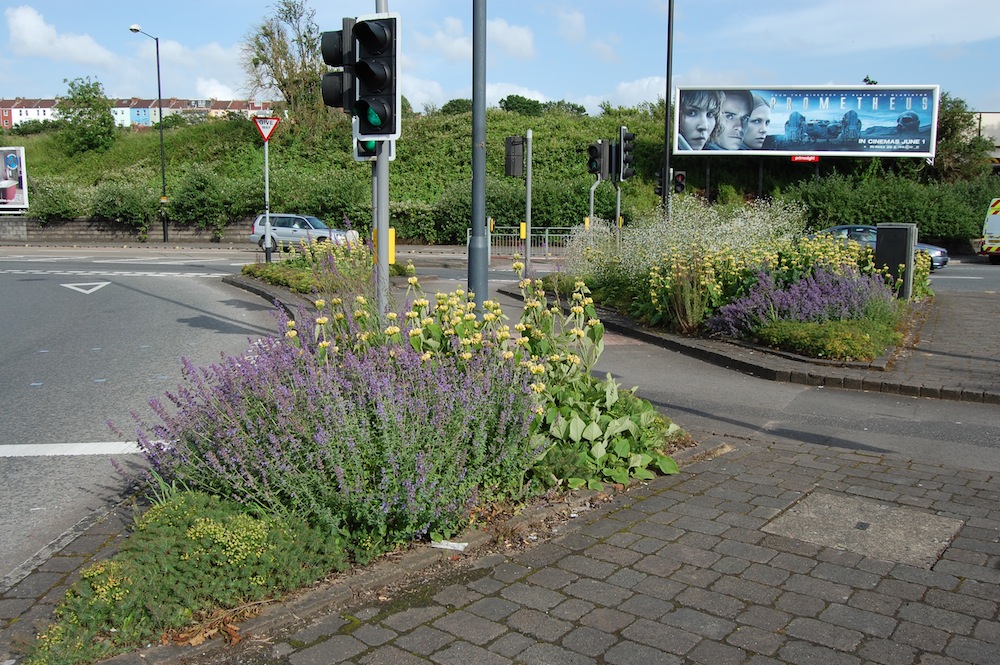
Between 2001 and 2009 I worked on a series of plantings for Bristol City Council, some perennial borders in parks, but mostly roundabouts, traffic islands and junctions. The sort of places which thousands of people drive or are driven past every day. Traditionally these were planted up with bedding or with shrubs and mown grass.
People moved on, budget cuts bit, etc, so I haven't done anything in the city for few years now, although in fact council staff had told me that I had saved them a lot of money, one even telling me “we've not done any maintenance, and it still looks all right”. It was never the idea to do 'no maintenance' but I designed some very robust plant mixes, which have in fact coped pretty well.

Last week I was in Bristol over night and went out and photographed some of my work. I was amazed at just how much had not just survived but done really well. I felt very vindicated. Bristol offers fertile soils with a long growing season so weed competition can be severe. In most cases this was not a problem, with 'my' plants able to out-compete most weeds.

Levels of maintenance by council contractors varies. Smaller plantings in small parks are more likely to have a higher standard of care. Roadside plantings tend to have less. In some instances community groups have taken over and looked after plantings or in one case completely taken over to make a community-run area (Snuff Mills).
Phlomis russeliana at Three Lamps junction. Totterdown. Planted 2003/2006
Three Lamps junction of the Bath and Wells roads
Very successful coverage by the plants chosen, but not a huge amount of colour. Partly perhaps because I just didn't photograph it at the right time, but also the stronger coloured Achillea definitely dies out whereas the paler survives. And there is a huge plant mix in here, so there's a long season of interest. What was good though was how complete the vegetation coverage over the soil is – denying space to weeds (and hiding the rubbish).
Oxford St. 2006

Oxford St – visible from the Wells Rd. just up from Three Lamps
This was intended as coppiced shrubs and perennials. No coppicing ever happened, and for some reason Geranium 'Claridge Druce' has taken over with a vengeance.Planting was done into a very thick layer of green waste, which over time has either degraded or been washed off, which did perhaps have a negative impact on some plants. This does show however just how well these pink geraniums do in the west of England climate. Long flowering season too. Few more of these and Bristol could be 'pink city'.
St.Johns Cres. 2007

St. John's Crescent, Bedminster
A pocket park. Pretty well looked after this one.
Malago Lane, 2006

Malago Lane, Bedminster
A triumph over adversity this. Nasty place to be a plant: salt, poor soil. A limited selection of toughies were planted, ALL species have survived. Rudbeckia fulgida greatly reduced but Euphorbia cyparissias does a fantastic job of filling spaces. Crambe cordifolia makes impact.

All very encouraging. The socialist in me loves doing this. Beautify the city. There are so many silly little patches of green all over Bristol, which all need mowing. They could all be planted up. It doesn't cost much. For a fraction of the money spent on the new gardens that our kleptocratic financier class seem to be busy making you could 'do' the whole city.

**********
Have you read the unique soap opera for gardeners – Dig, Plant and Bitch. Recently described by a colleague as 'Jilly Cooper meets Geoff Hamilton' (translation for non-Brits: sharp-nailed chicklit crossed with gardening advice from favourite uncle).

Saturday, June 9, 2012

Colourful thoughts about German gardening and art history


Hermannshof (in Weinheim) in late September


Just had a piece in The Daily Telegraph about my long-standing love of the German gardening scene. Rather funny for a rather Euro-sceptic paper, they published it on the Queen's Jubilee Weekend - nicely subversive.

This year it doesn't look like I'll be going, as so many other things on, but usually I look forward to meeting colleagues, seeing plants and new places. What I like about garden-visiting in Germany is the kind of disjuncture of seeing the familiar used in unfamiliar ways, often on a larger scale, which is a reflection of the emphasis on public horticulture I talk about in the article. Its like having the same set of ingredients but a different recipe for cooking them.

Of course, it being the Telegraph, I had to put in a dig - so the German love of the gnome (Gartenzwerg) seemed the obvious one. Yes, there are a lot of them. And you can even buy a murdered gnome (knife in back). Kitsch is a German word you understand.


I got an email back from my friend the landscape architect Anita Fischer who organizes the lovely Freising Garden Days, same time as Chelsea so consequently invisible to us. Anyway, she slightly ticks me off for suggesting that German gardens are untouched by modern garden design. Not true she says, as she thinks garden design is taking off. To be honest I am a bit out of touch so I'm sure she's right.


What started me off on writing the piece was a new book, by the new Prof of Planting Design and Plant Use at Weihenstephan- Swantje Duthweiler. It's historical, looking in extraordinary detail at the first half of the 20th century's perennials, the nurseries which grew them, the connections with garden designers, the use of plants in public space etc. Fascinating stuff and such a lavishly illustrated book with lots of old postcards, plans, nursery catalogues etc. Rather embarrassing that no-one has done this kind of research for Britain.What i found most interesting was the connections between early 20 century 'alternative' movements and flower colour. Lebensreform (life reform) was an important part of German cultural life in the first decades of the 20th century, mostly to do with diet and exercise, we in Britain had a similar although weaker movement, and of course the Steiner movement came over here; anyone who knows kids who have been to Steiner school will know about the emphasis place on colour in their teaching (and those rather wishy-washy paintings they all seem to bring home). There was an emphasis on pure colour  as an almost spiritual value as part of a healthy lifestyle, which influenced many artists, this also drove variety selection in perennials. Blue was seen as being a particularly spiritual colour by many artists; German breeders certainly produced lots of wonderful blue blue delphiniums.


All this talk of spirituality and colours seems a bit weird to us hard-headed Brits, but that's just one of the things which rather sets apart from German culture. Never underestimate the German ability to philosophize - which probably explains why none of the books of the great Karl Foerster, who dominated German gardening in the 20th century has ever been translated.  Our UK nursery trade did a lot of toing and froing with Germany in the 1900-1930 period, but we tended to be interested only in the colour as an end in itself. It might make a fascinating study to look at the differences between German garden designers and Gertrude Jekyll's theories of colour.

Phlox were a particular passion in the 1920s - so many variations on the theme of pink.


What was most fascinating was the level of connection between leading figures in the art world and gardening - and the consequent status this gave gardening and the nursery trade. I remember visiting the garden of the artist Max Liebermann (1847-1935) some years ago on the Wannsee (lake) on the edge of Berlin. His love of gardening and the artistic use he made of his garden reminds me of Monet and Giverny. Liebermann was involved with the Secession (Art Nouveau) movement and in reading Swantje's book, I realized he was associated with influential art historian Alfred Lichtwark (1852-1914), who wrote about gardens and colour theory in planting design

Those who can relate only to the horrors of 20th century German history will inevitably ask "what about the Nazi period?". Karl Foerster (a pacifist) ended up fleeing to Sweden, and returned to live in the communist east. Swantje points out that there was no specifically Nazi garden aesthetic, beyond a stress on native species, but that had little impact on the all-important public park plantings. The really interesting thing about the Nazi period is the links with the organic movement. I recommend Radical Gardening by George McKay if you want to follow this up. We tend to think of organic growers as being rather cuddly nice people - you won't do after reading this!


*****************

If you fancy some lighter reading why not try Dig, Plant and Bitch, the world's first soap opera for gardeners
Find out more here
Will Bonzo the gardener survive his fall off the Charles Jencks inspired mound?