Monday, December 24, 2012

Bolivia.....


No gardening this post, but instead our impressions of traveling in Bolivia.
 Which we are truly enjoying. Traveling between places is difficult, as the geography is so extreme, but once somewhere, truly a place to sit back and enjoy - one of the most colourful, idiosyncratic and interesting places we have ever been. With Evo Morales as radical president, there is the feeling of a cultural renaissance.
 First impressions are not always good.....

We (Jo and I) get our only sight, and that only a very brief glimpse, of the Andes, as we land at La Paz. Visiting in the rainy season means that the scenery remains concealed. The view is dominated by El Alto, which is actually where most people in the LP conurbation live – one of those vast third world sprawls. It's no slum, nor favela, but a proper settlement (1m+) although very spontaneous in character. Like most third world cities, at ground level it looks like a version of hell, if hell is somewhere where no-one has any visual sense. Depressing, especially for a confirmed believer in progress, that so many traditional poor people's housing looks attractive, but the reinforced concrete and brick look of modern poverty not only looks awful, but seems the same the world over. Except that El Alto actually does look worse – the reason being that 90% of the buildings look unfinished. As we discover, unfinished buildings seem to be the curse of Boliva. 


As with much of Latin America, murals are very popular and often political.
 
The drive down into La Paz is spectacular, but alarming. The core of the city lies some 500m below El Alto's 4000m, and is like many Spanish colonial cities, a mix of old and new. The backdrop though is of the newer city, a growth of (mostly unfinished) brick which spreads up, right up to the lip of the valley. Blink and you might imagine that this is a Middle Eastern, or African, city of mud brick. Every surface is covered apart from a few slopes with the inevitable eucalyptus (more in a blog about that later) and every now and again the most extraordinary patch of badlands where building is impossible. It is as if a mad USAID programme had distributed chunks of some spectacular area of south-west USA national park around the city, so that the inhabitants can marvel at the wonders of geology from the windows of their unfinished houses.


La Paz has its inevitable travellers area, a barrio of security to which one can retreat. The similarity with similar places in India and Nepal is so close, shop after shop selling a similar range of clothes, artworks, textiles, jewellery, toys, souvenirs, anything remotely 'artisanal'. Most of it is actually very good, and it is also incredibly colourful. Bolivian sensibilities rate bright as beautiful and bright pink as most beautiful of all, so another similarity with India. But, again as with India, I just wonder at the economics of all this; so many practically identical shops selling almost identical stuff; ok, it is the low season, and customers are actually quite thin on the ground, but even if the streets were heaving with gringo travellers, I find it hard to believe everyone can make a living. As for the sheer boredom of running one of these shops, it must be torture. Especially since it is not in the Bolivian way to do what happens in Rajasthan and charge out and grab every potential customer. After a couple of days we discover that various entrances are in fact entrances to courtyards (mostly of old colonial buildings) each one of which is home to another 4 or 5 shop – it is like a nightmare of mall-madness, where every way you go leads to further retail outlets, all identical.

La Paz is clean, and feels very safe – in the manner of Spanish-speaking countries, there is a bewildering array of police (apart from Buenos Aires, where the murder rate has just gone up dramatically – draw your own conclusions, lovers of law-and-order and job-creation-policing). Apparently, as part of an anti-corruption drive, they are not allowed to patrol separately. Consequently, they hang around in gangs, chatting, ignoring their surroundings. Then there are the zebra-patrols, who I suspect from their theatrical behaviour are not police, but perhaps students or school leavers, but you cannot get any idea, because all you see are zebra suits, with only a glimpse of a face poking out of the open mouth. They hang around in a gang around major road crossings, to ensure safe crossing of pedestrians, with much gesticulating and waving of black and white flags.
The zebra patrols are an example of the kind of low cost imaginative attitude to transport issues in which South American countries are global innovators.
A war memorial which neither forgives nor forgets - the country lost its coast to Chile in c1905.

 The buses of LP are another example. I would guess that 80% of all vehicles on the road are buses of some kind: micro buses, mini buses and nano buses. The system is clearly official (each one has a route number), but I suspect that private enterprise provides everything else. Each one has its destinations on pieces of card stuck to the inside of the windscreen, sometimes to the extent of seriously inhibiting driver visibility, and an assistant (usually someone who should be at school) shouting the destinations from the side door. It is an incredibly dense network ('fine-textured' to use the language of ecology) and appears to do a very good job. It is a squash inside, but cheap – you pay the driver as you exit. I haven't looked, but I bet there is an app for the system.

In terms of public services – La Paz must be the best place we have ever seen for the frequency of public toilets.


An odd mix of the developed and developing world, which I suppose, is increasingly typical World-class museums on streets with third-world holes and disintegrating pavements. Suited executives brushing shoulders with peasants. A country whose 'informal economy' (street traders) hides a large part of its GDP. The figure you inevitably focus on is the chola women – indigenous or mestizo women who wear that extraordinary dress: short brightly-coloured, and often satin-look multi-layer skirts, woolly tights (whatever the weather) fringed shawls and hats – with about half wearing the bowler hat which the London gent stopped wearing decades ago. As we discover in one of the city's excellent museums, this is the look which elite women adopted in the 1920s. For some reason it was taken up by country women, so that today it a core part of the culture. Another part of the costume is the multi-colour square of fabric on the back, which may contain a baby, shopping and merchandise, a gas canister, or in one case, a potted rose bush. Many of these women sit all day on the street, with a small patch of items for sale in front of them, a baby (usually a grandchild we reckon, and sometimes in a cardboard box) and something else to keep them busy (knitting, crocheting, or parcelling up more merchandise). It is the bowler hat which looks so incongruous, especially as it appears to be perched on top of the head. It often features a needle and thread tucked into the hat band, sometimes along with a small knife or other useful tool. When it rains, the bowler is protected with a black plastic bag.

They look jolly, but the Chola women are even more reserved than most Bolivians, to the point of being impassive. Travelling, there are often situations, where the exotic foreigner buying something ordinary or somehow engaging with people outside the standard tourist interaction sparks an interest, or amusement. Not here. It is all absolutely deadpan. In this way, it is the total opposite of India – not once have we been accosted by anything like India's “hello, what country you coming from, what is your good name, how much money you earn”. Jo is frustrated by not even being able to get the babies to smile.
Stuff to festoon your car with during car blessing ceremonies at Copacobana, in which priests pour champagne over your vehicle (no doubt for a fee). 
Thanks to Jo for some of the pictures.

Monday, December 17, 2012

Salta Province - Argentina's California?


Neomarica caerulea
Argentina's northern provinces of Salta and Jujuy are very different to the rest of the country. The north-west ('El Norte') seem to be an up-and-coming place, the sort of place you move to to get away from the rat race, or be a hippy, or plant a vineyard, and generally live the good life. A bit like West Coast USA. The geography has similarities too, mountain ranges which go north-south means that climate changes dramatically in short spaces, in this case from 'jungas' - cloud forest, where trees drip with epiphytes, through 'chaco' (scrub) to cactusy desert. It's warm without being humid, and there is plentiful irrigation water, so it's a good place to be comfortable and to garden.


Shannon Iturrieta and Laura Smolko at Paisajismo Nativo entertained me for an afternoon with a hike into some cloud forest above their home in San Lorenzo, outside Salta. They are landscape and garden designers who are trying to use locally native plants as well as non-natives (such as the Neomarica above, which is a Brazilian species). They have a little nursery where they grow trees, shrubs, perennials and grasses from seed and other propagating material found in the region.


This is Puya mirabilis, a surprise for those of us who thought all Puya  were enormous and terrifyingly spiky. A good plant for garden detail.
Trismeria trifoliata
The fern above is very unusual, unique in fact amongst ferns for the way its fronds are arranged, so it looks oddly lily like. Can grow to 2m apparently. Plant Delights in NC appear to sell it. As for the Oncidium orchid - these grow wild in the woods above San Lorenzo. We rescued a few from a fallen tree, one of the luxuries of living in this part of the world is being able to just stick these wonderful plants up on a tree branch in the knowledge that the weather will look after them.

Veronica Saguier is a pioneer garden designer in the area. She used to teach at the John Brookes garden school in Buenos Aires. Her own garden very much reflects the strong spatial sense one might expect from a JB graduate. There are plenty of familiar plants but quite a few unfamiliar ones as well. Veronica too has a small nursery area where she grows locally-native plants unavailable commercially.

One of the nice things about Veronica's garden is the way that it is not too tidy, with odd seedlings appearing in the paving. She is also letting Tillandsia (air plant) bromeliads take root in the rough plaster of the house walls, and even let a self-sown Bignonia climber begin to grow up the house wall too. Over-maintenance is one of the curses of gardens in countries where it is possible to employ staff relatively cheaply, linked to a strong cultural presumption that a garden has to be 'tidy'. Veronica is clearly trying to break this.


Self-seeding Nasella tenuifolia grass and Erigeron karvinskianus.
Some nice interplanting, or pehaps I should say, letting plants find their own places to grow. Here a small polygonum species and an agave.


Here, more plant intermingling: Persicaria amplexicaule and Neomarica caerulea. I asked about how the persicaria does, as in the US Midwest where it suffers terribly from fungal diseases in the humid summers. Not here apparently - summer air is dry here, so providing very healthy growing conditions.It can be cold here, when a cold air mass descends from the Andes, down to -9C for short periods. Clearly not enough to kill bromeliads, orchids and other sub-tropical species.

Finally, a really good grass, we saw a lot of, Lamprothyrsus hieronymi. But only on wet cliffs, never anywhere else, so often along a roadside, where there was an embankment cut in. According to Shannon though, it is very adaptable in cultivation - taking some shade or full sun and various soil types. According to the Plant Finder, it is in cultivation in Britain, but I have never seen it. Anyone grown it?

For more about my current South America trip see Gardening Gone Wild.

The latest episode of my gardening soap opera - Dig, Plant and Bitch, is now up. See the Amazon Noel Kingsbury page for more details. 
The (wrong kind of) Garden PartyNurseryman James Treasby has a repeat visit from a mysterious new customer, gardener Johnny Dalton is in the balmy surroundings of Mere Castle’s south-facing borders recovering from what could have been a disastrous falling-out with his employers. Meanwhile, rival gardeners Petunia and Wayne Martin are planning their own, artistic intervention for the start of their open gardens season while continuing to deal with the fall-out from their previous gardener. Johnny’s troubles are not over though, as his dealings with several of the village’s less salubrious characters are about to be exposed, as the completion of the Japanese Garden restoration is celebrated with an impromptu party.


Wednesday, December 12, 2012

Uruguay gardening

Trachelospermum jasminoides is one of the classic Argentinian/Uruguayan plants, it clearly flourishes here, but then its east Asian home has a similar climate to the area around the Rio de la Plata - hot and sticky summers. After a while though you get a bit fed up with seeing it again and again and again. The range of plants in nurseries here is very limited - the subject coming up again and again. Agapanthus are the kind of ur-plant for landscaping - I teased local colleagues by asking them to list all the varieties available - five I think was the highest; the RHS Plant Finder (UK) lists an incredible 566!

There are a lot of little neighbourhood nurseries, of the kind which we have sadly lost in the UK. Many of them are very good, but again, the same old familiar faces. I met one enterprising nurseryman (Vivero Pilar, outside Buenos Aires, AR) who had imported some plants from the USA and from Brazil, to propagate. Given how there is something of a gardening boom here, this situation must surely change.

The climate here is a good one for growing - if you choose the right plants that is! Hot humid summers with plentiful rain, and cool summers, just touching freezing - so it is a very long growing season.

The trouble is that a lot of the plants that nurseries sell aren't really suited to the climate -the plant selection is based on what might work in Spain or Italy. Maybe this is part of the Argentine condition, to be ever looking over the seas to Europe. (Let's not take this too far, I am a European on a lecture tour!). Lavenders for example rot in the humidity, lasting about two years. In some ways there is a real similarity with the hot humid summers of the American Midwest, with a similar problem with fungal etc, diseases. However what grows well, grows very well. There are so many plants that would thrive here. One group which everyone says does well, and which offer so much, are Salvia, any of the Mexican species for example, and Argentina has several natives. There is the well-known S.guarantica, and one which I had never seen before S. procurrens, which runs by means of stems rooting in, like a strawberry. 
There are so many fantastic plants in the wild here, just waiting to be developed commercially. Amalia and I found a striking scarlet perennial, which obviously ran underground amongst rocks on her uncle's property, just south of the Brazilian border. We had no idea what it was, but the leaves looked strangely familiar. I broke one in half and out came white sap, so my intuition said "Apocynaceae". Later on we checked online, and ID'd it as Mandevillea coccinea. In the conservatory at home we have a 20 year old Mandevillea splendens in the conservatory, so no wonder the leaves looked so familiar.
Amalia's uncle, Martin Braun, is preserving this fascinating habitat, a rocky island of biodiversity in a vast plain where everything is given over to grassland for feeding cattle. Cattle are now (I read somewhere) the dominant biomass on the planet. They are very inefficient converters of plant protein to meat. A big reason why I don't eat them!

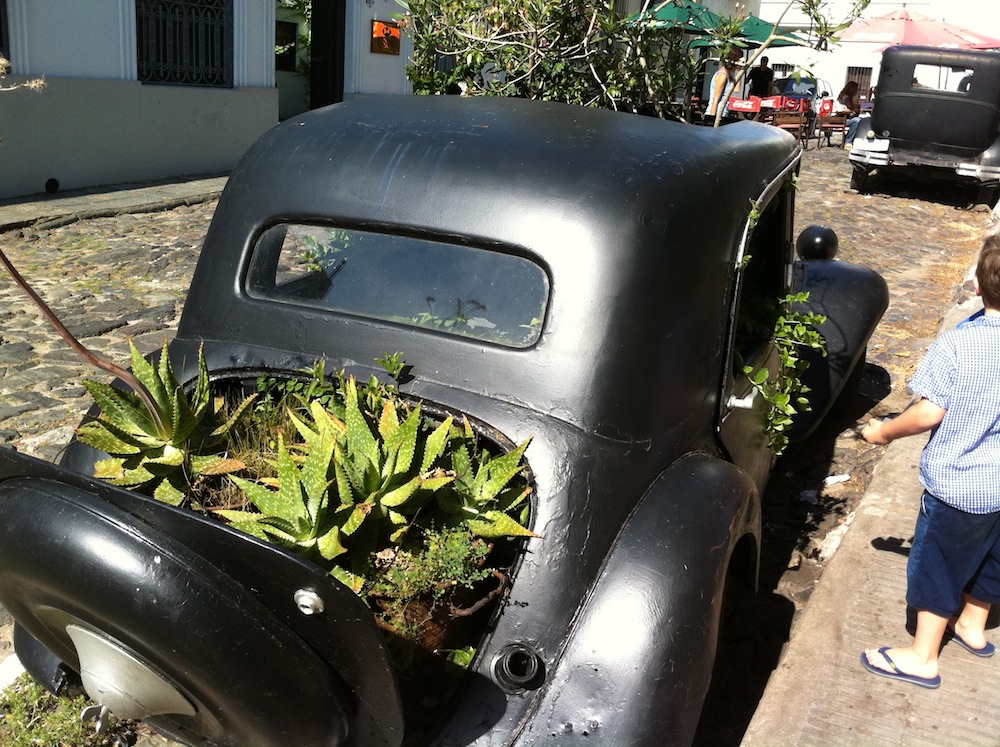
Colonia del Sacramento is a rather pretty little place in Uruguay, with an interesting line in planting up and otherwise making artistic use of elderly cars.

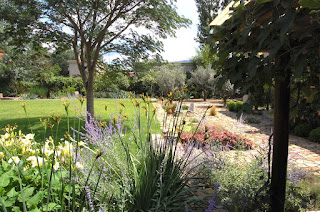
What North Americans call the 'hellstrip' between pavement/sidewalk and road. Someone has planted up what really does thrive here, a selection of mostly tropicals, very densely, so every space taken. There is a tree as well, planted up with epiphytes. The only time i have seen this done before is in Singapore, by local government. At a rough guess there were twenty species here, in about six metres , but there could be more.

A cactus pokes up from amongst the rest of the greenery. Some cacti grow as part of many well-watered forest habitats, and cope with summer humidity better than we might think.

This is actually from later on, when we got to Bolivia, the convent of Santa Teresa, in Potosí, Bolivia. A garden at 4000m.

Read more about my trip to South America below and on Gardening gone Wild.

Thursday, November 29, 2012

Tango at La Pasionaria

-->
 

Finally - a visit to La Pasionaria in Uruguay.
I first met Amalia Robredo in 2007, on a Gardens Illustrated trip to Germany. She was about as pregnant as it was possible to be before being forbidden to fly – which I think illustrates something about her determination. We talked about her interest in using the wild plants of the region where she lives in her garden design work. Over the next couple of years I have acted as mentor, offering advice by email and blog, and she just went on to follow it all and take lots of initiatives of her own. She even got grants to publish the first ever illustrated guide to the flowers of the Maldonado Coast, and support further research. So finally, I get to see how my 'student' is getting on.


-->
Amalia and her husband Marcelo bought the five hectare property some ten years ago, as part of a move out of the city into the country; the city being Buenos Aires and the country the coastline of Uruguay north of the über-fashionable Punta del Este. Amalia and Marcelo were pioneers, just outside what was once the quiet fishing village of José Ignacio (but which is now one of those places where incredibly cool people eye up other incredibly cool people in shops full of artificially distressed furniture). They have now been joined by many more, and the entire coastline between here and Punta (half an hour's drive) is steadily getting built up. Almost all natural habitat has been lost. There is not much in eastern Uruguay anyway - several centuries of cattle rearing and eucalyptus planting have seen to that. Amalia does very good conventional garden design, but has always wanted to use locally native plants and preserve or re-create as much of the natural wild plant communities as possible.

-->
Amalia and Marcelo's house says something about their respect for the landscape. Unlike most houses round here which stick out like, well … like the fantasies of macho architects which many of them are, La Pasionaria is almost hidden, its granite-block construction making it look like an old fort. Just peeping above thick woodland its windows give it a fantastic view over a nearby marshland and lagoon. The woodland in question is a piece of the local monte.
A 'mousehole' into the monte, note the cactus poking up as part of the woodland community
Montewas the first new word and concept Amalia introduced me to, back in Piet Oudolf's barn in 2007 when she gave us a short presentation about her work. It means a kind of dwarf woodland, much sculpted by wind, almost impenetrable, and in conventional terms, with no economic value whatever – which accounts for there being not very much of it left. It includes relatively few species (a berberis is the only one whose name meant anything to me) but shelters many more, including ferns and other ground floor species.

 
-->
Amalia has learnt how to sculpt the monte, without damaging it. The Maldonado coast does wind big time, all year round, so once you cut into the monte you open it up to the wind which can then cause a lot damage. So she cuts what she calls 'mouse holes' to minimize damage in the outer skin of the monte where it faces open areas. This skin is an interesting plant community in its own right: an incredibly dense mesh of interwoven branches, including some pioneer species such as various Baccharisand the incredibly vicious-looking Colletia paradoxa. The lower level is a thicket of ferns escaping from the monte understorey and very dense grass, with a few flowering forbs poking out. 'Inside' are a number of areas where she has removed the understorey to create shaded seating areas beneath the intriguing forms of the tree branches.
Prado grassland
-->
The surviving monte is set amongst grassland, which we would call meadow – indeed from the distance it could be British meadow grass; get closer to though and it is clear the grass flora is different and really very interesting. There are a lot of very attractive grass species here, which look good not just as border elements but make quite a show as part of a meadow grass type community. There's a lot more than just pampas grass!

Deyeuxia alba, formerly regarded as a Calmagrostis
-->
Looking at Amalia's grassland, it's time to learn some more new words: prado and pradera. In fact so useful are these words and the concepts they clothe that I am seriously considering trying to get them used in English. By prado she means grassland which gets cut short through the summer, but is allowed to grow through the (virtually frostfree) winters to flower in spring and early summer. The result is a tidy meadow-like grassland with a rich variety of grasses and about the same proportion of forbs as might be expected in Britain – mostly yellow daisy family. The forb (flowering perennial) component of the flora here is quite limited – beach sand habitats support quite a number but there is relatively little which consorts with grass. In early summer, the two most showy and interesting are Vernonia flexuosa, a short-growing relative of North America's mighty ironweeds (although very similar to V. lettermannii, an Ozark limestone plateau plant recently launched into commercial horticulture), and the terrestrial bromeliad Dyckia remotiflora var. remotiflora, with its bright orange flowers. Not showy but a great favourite of Amalia's is Eryngium sanguisorba, which has a large but sparse panicle of tight little dark red buttons, just like, you've guessed, a Sanguisorba. In the strong sunlight of this latitude its hard shape stands out very well against the grasses.
-->
As at home, the lower fertility areas of soil support thinner grass and (possibly) more species. Different grass species dominate different areas, just as at home, but make considerably more visual impact. High fertility areas tend to get dominated by European ryegrass monoculture. The native grasses are mostly of genera familiar to North Americans, while Melica brasilensis would go unnoticed on an Austrian Trockenrasen (dry meadow) to all but the dedicated grass lover.

-->
I did not get to really appreciate Amalia's pradera, which is a late summer community. Pradera is cut only once a year, or even less. In fact, Amalia reckons cutting every two years is better because it allows grasses to build up some good tussocks. The community which results is much coarser in appearance but includes some good late flowering perennials, such as several species of Eupatorium, which can make a real impact. There is one goldenrod here too – Solidago chilensis.

Senecio brasilensis in the unmanaged marshland at the bottom of the property - here be snakes, armadillos and incredibly noisy frogs.
-->
The remaining naturalistic habitat at La Pasionaria is essentially unmanaged, much of it marshland. Cortaderia (yes! at last pampas grass!) and Eryngium pandanifoliumdominates – big rosettes which look a bit like an attenuated agave which later on produce impressive 2m+ flower spikes. There are a lot of Eryngiumspecies here – possibly this is the genus's centre of diversity? Some are aggressive thistle look-alikes – the aptly named E. horridum appears everywhere; most however are garden-worthy. If I were doing serious plant hunting here, especially focussing on variety selection, I think I'd start with them (apart from the grasses that is).
Elionurus muticus - a very variable local grass, well worthy of a place in the garden.
-->
Education is a big part of what Amalia does here. Increasingly people are wanting to come and visit. On this trip we agreed to run a workshop together, which got oversubscribed very quickly, so we put on another one a week later. In the workshops I like to think that we are dancing a tango, except that she (despite being Argentine) is no more capable of dancing a tango than Jo or I am. I take the lead and she translates into Spanish, and often adds her own thoughts, so it is a kind of tango. During a presentation she does on her own work, before taking around her property, there are constant interruptions of incredibly lively discussion – people here are more forthright in their opinions than back home and there is a great deal of curiosity.
Erygnium serra
The workshop was in her garage, improvised screen for the projector from an old sheet, and an ingenous home-made flipchart, at times we lean against her car to do our double act. It goes down incredibly well, the linking of plant ecology science to gardening is a completely new message. People are so enthusiastic. Most of the audiences are professionals – unlike home, almost no 'ladies who lunch'. I feel very proud, and deeply moved, to have played a part in pioneering a new approach to garden making here – and so far from home!
Eryngium sanguisorba (in the wild)
Stipa filifolia - another very good potential garden grass
Vernonia flexuosa
Amalia's website: www.amaliarobredo.com
and more on her work on The View From Federal Twist blog


Friday, November 23, 2012

View from the welcoming south - Argentina

A figure who was part of an exhibition at Villa Ocampo, at San Isidro, Argentina, last week.
-->
I am almost overwhelmed! So much enthusiasm, interest and passion here, in Argentina and Uruguay. Several people say that there is something of a gardening boom going on. There is certainly an incredible thirst for ideas and knowledge in a small but tightly-knit garden and landscape community. It is a fantastic experience being amongst such enthusiastic and receptive people, but also the feeling that I have so much to learn – every time I open my mouth I am aware that I am about to say something which does not apply to this part of the world.
Martinq Barzi, me, Josefina Casares and John Brookes.
Jo and I are here primarily to visit Amalia Robredo, a garden designer who works on the Maldonado coast (that's the bit which goes up from the deep cut on the right hand side of the southern cone of South America). More about her in a later blog. She introduced me to Josefina Casares and Martina Barzi, who run Pampa Infinita, a garden design school they set up some years ago with the support of John Brookes. Josefina and Martina are clearly one of those very effective partnerships where the whole is greater than the sum of the (very capable) parts. Working primarily as designers (throughout the southern cone), they have a determination to share their knowledge and skills and involve others in doing likewise.
A wonderful courtyard space at Josefina's.
An ingeneous 'screen' in the garden of Gracie Ullman, one of the Pampa Infinita graduates. The idea is that some interestingly painted poles will distract the eye from the view behind, without going to the trouble of building something more substantial.

Dear old John Brookes, now in his early eighties, I think. I hope I am as energetic as he is when I get to that age. Russia, USA, Argentina, he seems to be constantly on the move. One evening I watch him as he sits with Josefina and Martina, like a genial buddha with his top disciples, gently radiating wisdom. His garden design methodology has proved enormously successful at getting people to think creatively, and is the core of the teaching here. Not everyone finds it useful, but then those who don't, probably have their own strong design sense. I suppose I have a similar kind of core methodology – about plant selection, which I am trying to get across to people here in a series of lectures and workshops.
Plectranthus neochilus - plant selection is not great here, but several nice members of this mint family genus which we never see back home. Not hardy but very good for summer displays.

Nearly all of what I do has to be interpreted. Thank you Josefina, Amalia and Mariana Hogg. You've done a great job. Being interpreted rather cramps your style but it is an incredibly effective way of focussing the mind. Everything you say is like a haiku poem – it has to be self-contained, and coherent …. and simple. Different interpreters force you to work in different ways: Josefina is very experienced and I can pitch her several complex sentences. Amalia has never done this before, and I have to half the number of sentences – which makes the need to concentrate information into little nuggets even more important. 
Landscapers in a landscape - Amalia Robredo at La Pasionaria with colleagues.

Ideally I run workshops in gardens so we can look at plants. Getting people to look at the leaf/stem/root relationship is very important, hence the name 'Rabbit's eye view' for what is currently my most popular workshop. Except I was told this did not translate well into Spanish - or more likely would be read as "what is this mad Englishman on about?". Plant selection here is limited, although there are plenty of little nurseries. We've had to borrow plants from them in containers so these can be passed around. At Villa Ocampo we had to stage a breakfast time raid on a nursery to get plants, croissants and coffee in hand.
 On to Uruguay - so more later!