Thursday, July 9, 2015

Is Naturalistic Planting almost Mainstream now? !

Intermingling as a planting strategy works well at Little Ash Bungalow with things like Knautia macedonica, which often needs support for its rangy stems.
A few days in Devon leading a tour group for Gardens Illustrated magazine was a good opportunity to drop into some gardens I like, but in some cases haven't managed to get to for years. Reflecting on what we saw, I think its fair to say that naturalistic planting is really making an impact. One place we went to was the Garden House, well known for this approach, and now with a new head gardener in charge who is very much a follower of Keith Wiley, who made the garden what it is. However it is two other gardens I'd like to talk about here, all the more important for their being more low-key, and in terms of what most people can do in their gardens, realisable.

Here I'd like to look at the planting in these two gardens, concentrating on some key aspects of naturalistic planting: density, intermingling, self-sowing, spontaneous native plants and integration with nature.

Little Ash Bungalow, is a Yellow Book garden, which Helen Brown has made into a new-style plantsman's garden. It illustrates well just how effective the higher density of planting that is so crucial to naturalistic planting can be when used with good plant combinations - for which this garden is an excellent example.

 Conventional planting with its separation of plant from plant and bare soil now seems so much a thing of the past. Whilst we are still a long way from the density of natural plant habitats, the modern planting style has a kind of voluptuous freedom about it, which is a joy to see.
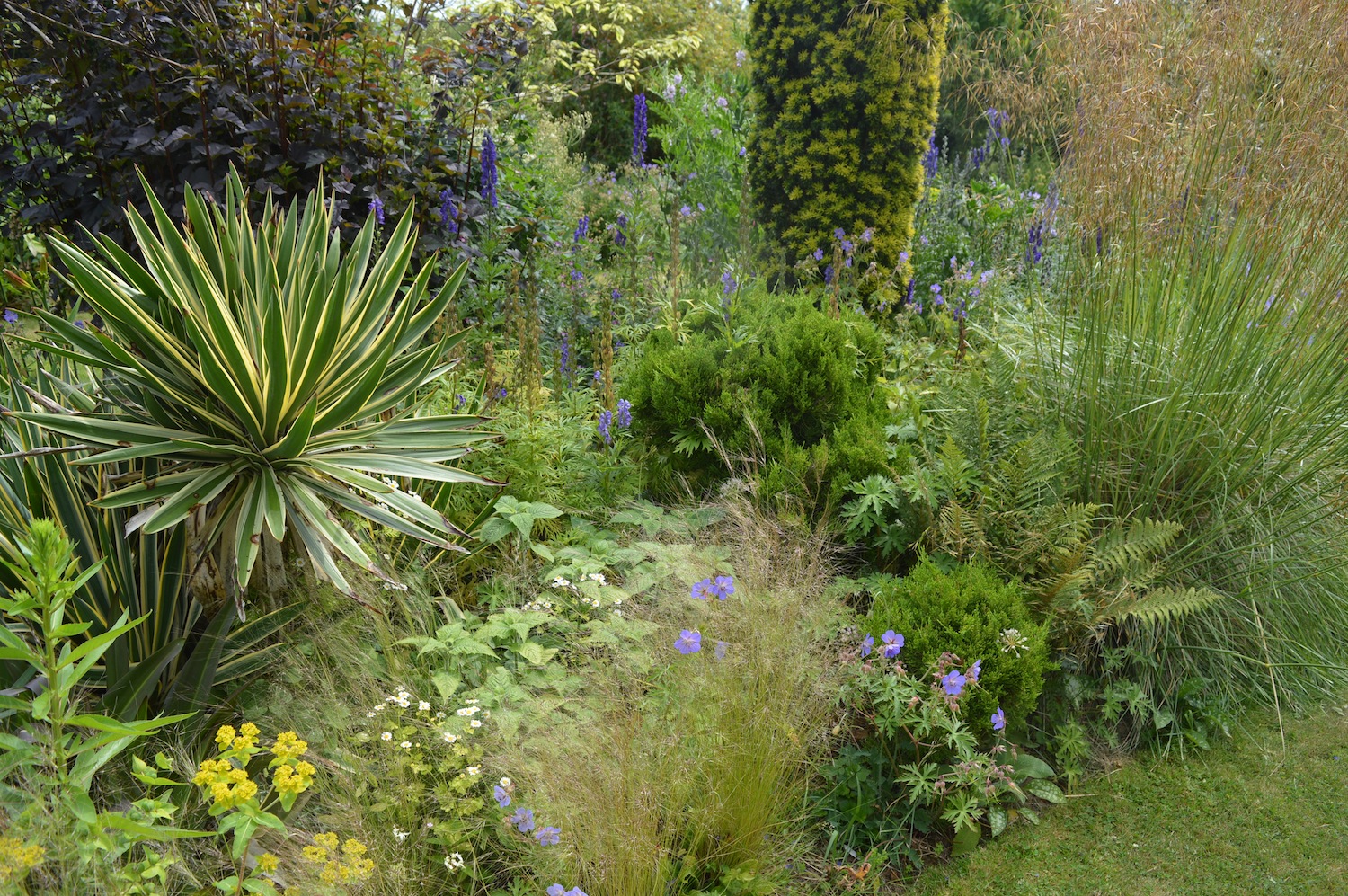
 Helen's garden is mostly herbaceous but some strongly structural stuff as well. Grasses make good space fillers.

Whilst here there is not much of the conscious repetition with the true intermingled planting style aims at, dense naturalistic planting is such a good way of managing and making the most of the wide range of plant forms which herbaceous perennials take, and which people like Helen like to cram into their borders. NONE OF WHICH are to be found growing on their own in splendid isolation in nature - ok, there are exceptions but they are very few; Meadowsweet (Filipendula ulmaria) is one which does, but that is another story. The overwhelming majority of perennials grow cheek by jowl with many others, and physically intermesh and hold each other up, interpenetrate each other, so there is often a visual intermingling from a limited number of plants. The planting at Little Ash illustrates this extremely well.
 Self-sowing, self-seeding, whatever you would like to call it, is a crucial part of the new naturalism. Although progressive gardeners from Margery Fish onwards have promoted it, it is now really only coming into its own. Burrow Farm garden is a good place to appreciate it. This expansive and ambitious garden has been made over many years by Mary Benger on land which has presumably been gradually acquired from her husband's farm - a successful example of agricultural diversification, and one which, because it is open to the public as a business means it is a very accessible place to get to, to see how traditional English mixed planting style is morphing into a distinctly naturalistic one. Self-sowing is a big part of what makes Burrow Farm successful visually.

The sheer scale of Burrow Farm and its very subtle transitions from one area to another is quite something, and of course it illustrates well that naturalistic planting is the obvious way to manage such extensive areas. I would love to see Mary being put in charge of Wisley for a few years.

 Scenes like this which counterpoint very conventional and almost cliched English garden features like bird baths with seeding perennials would once have been seen as a sign of neglect. How far we have come!

The partial acceptance and management of what turns up in the borders on its own is another crucial aspect of naturalistic planting. Here is hemlock! Yes! The stuff that killed Socrates. There is even some giant hogweed lurking down by a pond.
 Finally, there is the integration of cultivated plants with more fully semi-natural habitat like these Iris ensata matching the colours of some wild orchids - common spotted (Dactylorhiza fuchsii) but which seems to hybridising with some garden ones (D. foliosa) with their deeper colours. Managing the boundaries and borderlines between what a naturalist would unhesitatingly call 'habitat' and the gardener 'border' is one of the ecological-artistic skills of the new naturalistic gardener.

It is very heartening to visit these two gardens, both created by people who are not perhaps self-consciously part of the 'new perennial' movement, but whose work illustrates so well what the more noisily evangelical ones amongst us in planting design have been banging on about for years.

Of course doing good naturalistic planting does depend greatly on understanding plants. In collaboration with My Garden School I have published the first of what is intended to be a series on planting design. It is very much a textbook, written with a global audience of non-English speakers in mind, for anyone and everyone who is involved with planning or planting vegetation, from amateurs to landscape architects. This first book is aimed at understanding the basics of plants through their ecology.
Here it is on the amazon site.


* * * * *


If you like this blog, why not check out my e-books, which are round-ups of some writing I did for Hortus magazine back in the early 2000s, along with an interview with the amazing Beth Chatto. You can read them on Kindle, or Kindle packages for smartphones or the computer. You can find them on my Amazon page here. You will also find my soap opera for gardeners - currently running at eight episodes.
SUPPORT THIS BLOG
I write this blog unpaid (of course) and try to do two postings a month, to try to provide the garden, wildflower and plant-loving community with information, inspiration and ideas. Keeping it coming is not always easy to fit into a busy working life. I would very much appreciate it if readers would 'chip in' (as we say in England) and provide a little financial support. After all, you pay for magazines and books, and it is only for historical reasons that the internet is free. Some money coming in will help me to improve quality and frequency, and to start to provide more coherent access to hard information, which I know is what a lot of you really want. So – please donate now!! You can do this through PayPal using email address: noelk57@gmail.com
Thank you!
And thank you too to the folk who have contributed so far.
********


Friday, June 12, 2015

The Garden at Montpelier Cottage in May

The garden in May. I'm pretty happy with it now. We have been here ten years and things are coming along nicely. This May in particular has been good, and to a large extent I feel the plants have done the work for me. I have seen a couple of public projects lately by colleagues and been astonished how little there is in flower in them, which strikes me as odd when there are so many perennials which flower at this time; many are quite physically insubstantial, which means that they can then disappear amongst taller bulkier later-flowering plants. Or they are semi-summer-dormant, which is neat as they can then literally be left to disappear beneath later-developing plants.

Actually, before I go on, the pictures here do not come across well, so I have uploaded them on to flickr as well - they give you a much better idea.

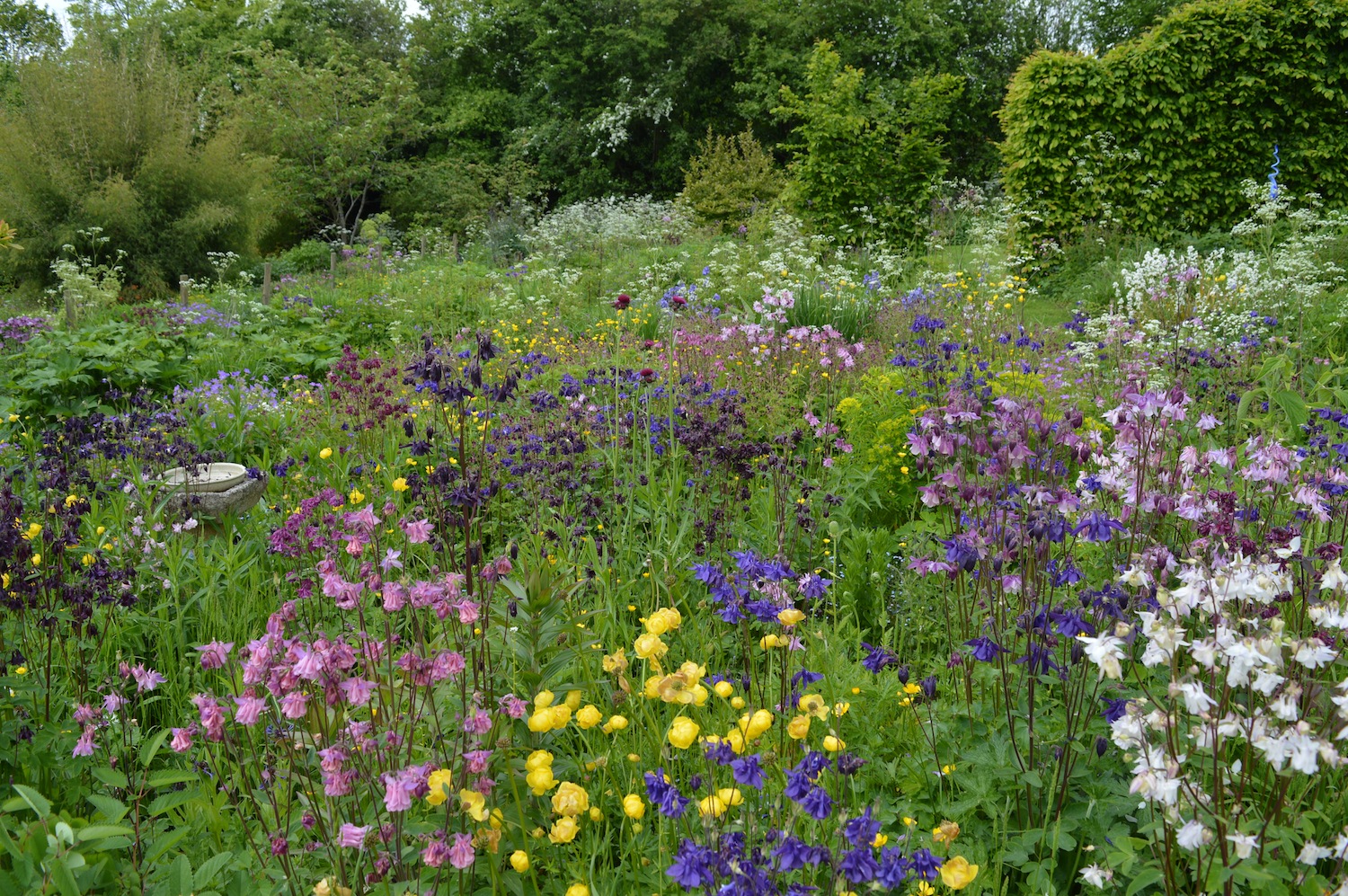
This is the view down from the house, towards our yurt which always makes a good focal point for photographs. A lot of what you see in terms of visual impact now is stuff that has put itself there, notably the wild Anthriscus sylvestris and forms of Aquilegia vulgaris. Increasingly this garden is about managing self-sowing. The visual impact is also about having a limited number of species widely distributed, which is also one of the advantages of seeding - as the plants do the work for you.

The big leaves in front are Filipendula camtschatica, which does very well for us on our moist soil. The foliage makes a good graphic counterpoint to all the fine textured species. It is good at all times, so much so that we left this clump standing after we had cut everything else back in the winter. It seeds a little bit, and since it forms very solid clumps, definitely something to keep an eye on in the future.


Aquilegias with Cirsium rivulare atrosanguineum to the lower left and right and our hornbeam hedge, which is trimmed to look vaguely like it might be a ruined wall. I like minimal bits of architectural shaping, just enough to give some substance to the garden.
The yellow is Trollius europaeus, which has proved one of our most successful species; we are in the region where it does grow wild, and these are all grown from wild-collected seed. It is the kind of thing which simply does not flourish in many places as it gets too dry but here flowers for weeks with great big fat flowers, vaguely reminiscent of buttercups; it as the great advantage of completing most of its growth now so it does not mind being swamped by other things later on.

The aquilegias are remarkable. Originally from seed from Jelitto, they continually seed and spread, and with a continued ability to produce a very wide range of colours, as well as occasional doubles. So often a seed strain ends up going back to a murky version of the wild plant, but not these, they almost get better and better in terms of genetic variation.

The cow parsley (the Anthriscus) is a wild species which is basically a winter annual, flowering May/June and then seeding, so we pull most of it out to stop it seeding too much. It makes a great visual linking plant, separating brighter colours and preventing 'clashes'. The blue is mostly Geranium sylvaticum, which seeds modestly. The wild buttercup (Ranunculus acris) is a good ingredient too, although it can seed too much. Also some Polemonium caeruleum which hopefully will spread with time.

 Geranium x monacense in front, one of the G. phaeum hybrids - all good plants for this time of year, murky colours but fascinating and a good complement to stronger colours. Unlike the slightly later pink G. endressii types they do not form enormous clumps which collapse after flowering, which is an advantage, making it easier to mix them in with other plants.
Our native red campion (Silene dioica) here as well, on the left, a short-lived perennial, which seeds strongly once established, and another winter annual, which is semi-dormant after it seeds in June. Again this is something which can just be left to get covered over by later-developing plants. The yellow here is Primula helodoxa, one of the Himalayan candelabra primulas. It does ok but has not started seeding yet as it has in many moist soil gardens. Thalictrum aquilegifolium too, in the background, which is good for height, as there is little else which flowers at this height at this time; it too can be forgotten about after flowering as it has so little bulk.

Symphytum caucasicum. A very aggressive spreader which is in its own bed, which gets mown around. It is a fantastic bee plant, for wild bumble bees rather than honey bees. In less fertile soils it struggles.

 Euphorbia palustris with some of its last-year dead growth left, which we do deliberately, as it forms a kind of stiff cage inside which the very soft new growth develops and is supported - one of those things which makes you say "isn't nature clever?". This is a seriously large plant but appears not to spread, it is not actually clonal but seems very long-lived. It can seed and since it gets so big this is something which has to be watched.
Persicaria bistorta 'Superba' in the background here.  Between clumps of bamboo, which are almost the only evergreens here. They have a softness so often lacking in evergreen shrubs and fit into the landscape better.

Euphorbia griffithii on the left and in the centre, Silene fimbriata, which has fascinating fringed flowers and is a surprisingly good perennial for a silene (they are usually short-lived like our wild campion species), forming big clumps with time. A good plant for back-lighting.


* * * * *
If you like this blog, why not check out my e-books, which are round-ups of some writing I did for Hortus magazine back in the early 2000s, along with an interview with the amazing Beth Chatto. You can read them on Kindle, or Kindle packages for smartphones or the computer. You can find them on my Amazon page here. You will also find my soap opera for gardeners - currently running at eight episodes.
SUPPORT THIS BLOG
I write this blog unpaid (of course) and try to do two postings a month, to try to provide the garden, wildflower and plant-loving community with information, inspiration and ideas. Keeping it coming is not always easy to fit into a busy working life. I would very much appreciate it if readers would 'chip in' (as we say in England) and provide a little financial support. After all, you pay for magazines and books, and it is only for historical reasons that the internet is free. Some money coming in will help me to improve quality and frequency, and to start to provide more coherent access to hard information, which I know is what a lot of you really want. So – please donate now!! You can do this through PayPal using email address: noelk57@gmail.com
Thank you!
And thank you too to the folk who have contributed so far.
********

Saturday, May 16, 2015

The Piet Oudolf story, and many


A lot of regular readers of this blog will probably be aware of the 'Oudolf Hummelo' book being 'out'. I've been meaning to write something about it for some time but been very busy.
In the introduction I make a joke (which I have repeated ad nauseam and will stop doing so now) made by Piet that “only footballers have biographies written about them in Holland”. It is more than a biography anyway. I intended it to be a story about a group of people, of whom I am one, so in some ways it became a personal memoir, but also a social and cultural commentary. I wanted to place what Piet does in his planting in a bigger context; he would not have done what he did or be successful at another time in history. It was a great opportunity to write about a whole circle of people, from different walks of life, but who were all passionate about plants and gardening.

Writing the book was also an opportunity to get under the skin of the Dutch a bit more. I find this a fascinating country. I love it. The Dutch are the most civilised people in the world. But I would never live there. Too flat. And when push comes to shove, I think it is a more conformist culture than at first appears.

I visit The Netherlands a lot. In particular I'm fascinated by the way the whole landscape has been sculpted, created, physically made by the ancestors of the people who live there. The more I visited the more I realised that this place used to be lake, that one a vast wetland, and this place is several metres below sea level. I ended up reading a couple of books about the creation of the country's landscape, and realised it was a lot more to it than how it is often presented – that of the Dutch heroically building dykes and keeping the sea out.

For one thing, the story of the Dutch landscape is actually one of self-inflicted near-disaster, but rescue through technological innovation and communal effort. Rising sea levels were rising naturally (they have been rising since the last ice age, which is why climate change is frightening), but digging channels through peat land to drain them was made things far worse. As the peat dried out it shrank, so the sea and flooding rivers made their advance; by the late Medieval period there were vast areas which were either inundated or were on the point of being swallowed up. Windmills and an increasingly complex systems of dykes, drains and sluices kept the sea back, together with a unique system of management which revolved around communities having to consult with each other about their plans (as all too often one village's attempts to get rid of its flood waters would result in another being placed at risk). With the 19th century invention of the steam pump, the Dutch could be proactive and not just keep the waters back but actually drain what had been lost centuries before. I like to see a parallel with humanity and the threat of climate change – except that the Dutch have never had the equivalent of US Republicans bellowing that the flooding wasn't actually happening.

Much of the Dutch landscape is incredibly highly managed, with little room for nature. Historically, natural habitats were ruthlessly cleared out of the way. One of the side-stories in the book is of Jac Thijsse, naturalist who was born at around the time (the 1860s) that the last Dutch natural forest was felled. What has been remarkable about the latter part of the 20th century however is how the Dutch have actually held back, and begin to re-wild, create new habitat, and establish a nature-culture balance in the landscape. And this, I believe, is where the gardening comes in.

There were big political battles over the future of the landscape in the latter part of the 20th century and the areas being set aside for wildlife are very much the compromise that came out of disputes between conservationists and the agriculture and water management lobby. Wildlife-friendly and naturalistic gardening were part of the outcome as well. It was as if certain people saw what was being done to the landscape – its total rationalisation, and stepped back, determined to leave a space for nature.

This is also the land of the well-planned public housing estate. Dutch urban landscape planning is, along with Scandinavian, the most advanced anywhere. Everything is on a very human scale and there is always plenty of nature, albeit often heavily managed. One way of looking at the Oudolf planting style is to see it as a kind of 'enhanced nature', which parallels the way the larger landscape is managed, a model of a kind of planting design that satisfies the aesthetic needs of humanity but which also has a sustainable and wildlife-friendly aspect.

I have often thought that the garden is a microcosm of a wider world and that gardening can be seen as metaphor for our management of the planet as a whole. If so, the Dutch experience is one of the most valuable guides to our common future.

One further little funny story, which illustrates the tolerance the Dutch are famous for. At a launch party for the book in Haarlem back in March, towards the end of the event, a friend sidled up to me and mentioned to me that "the old whores are here" and 2 old ladies (well into their 70s), identical twins dressed identically, had turned up and had monopolised the canape tray (clearly their intended supper). They were both trying to sell their own book "Our lives in the Red Light District at (sic) Amsterdam". Apparently they roll up at any event of cultural significance, so I supposed they were a kind of seal of approval. Your truly had his photo taken with them, Piet maintained his usual Olympian distance.

* * * * *
If you like this blog, why not check out my e-books, which are round-ups of some writing I did for Hortus magazine back in the early 2000s, along with an interview with the amazing Beth Chatto. You can read them on Kindle, or Kindle packages for smartphones or the computer. You can find them on my Amazon page here. You will also find my soap opera for gardeners - currently running at eight episodes.
SUPPORT THIS BLOG
I write this blog unpaid (of course) and try to do two postings a month, to try to provide the garden, wildflower and plant-loving community with information, inspiration and ideas. Keeping it coming is not always easy to fit into a busy working life. I would very much appreciate it if readers would 'chip in' (as we say in England) and provide a little financial support. After all, you pay for magazines and books, and it is only for historical reasons that the internet is free. Some money coming in will help me to improve quality and frequency, and to start to provide more coherent access to hard information, which I know is what a lot of you really want. So – please donate now!! You can do this through PayPal using email address: noelk57@gmail.com
Thank you!
And thank you too to the folk who have contributed so far.
********

Thursday, May 14, 2015

The Eden Project - a review

We visited the Eden Project for the first time in years the other week. So interesting to see how this fantastically imaginative project is coming on. I thought it would be interesting to 'review' it. So here are my thoughts, and its interesting to read others' comments too ....... read on.......

Friday, April 24, 2015

New Garden Festival - up and running!


It's a funny feeling doing something and feeling that what you are doing might be the start of something really major. I had that feeling on Saturday at the first Gardens Illustrated Festival, in Malmesbury, a small and very picturesque town in southern England. It was an event we had been planning for over a year, and dreaming about much longer. When it finally happened there was that wonderful feeling that perhaps this was the start of something.

A few years ago I had spoken at the Swarthmore Convention, an annual get-together just outside Philadelphia. It was a great experience – 750 plus people, from all aspects of the garden world and indeed beyond – I was much impressed by all the folk from the landscape profession, who could be used as 'plant users' rather than gardeners as such, plus nursery people, amateurs and people from the community garden network. The US however does have a much stronger tradition of people getting together to learn, network and share experience.


So, early last year, the designer Annie Guilfoyle and I sat down over a bottle of wine, and about halfway through we had decided that we should try and organise something similar. She had been to an event for garden design professionals which had been run by Chris Marchant of Orchard Dene Nurseries – the number one stop for contemporary perennials in Britain. Annie, unlike most Britsh garden people, was also getting into going to conferences in mainland Europe: I Maestri del Paesaggio at Bergamo and ISU (Hardy Plant Union) in Germany.


Gardening can be a very solitary occupation, particularly for those professional involved. The opportunities to meet others, or to do professional development, are quite limited. Amateur gardeners are perhaps a more sociable lot - indeed many garden clubs feel more social than horticultural. Garden clubs however tend to operate on quite a local basis, and the opportunities to hear or meet top-notch people in the profession are limited.

We in Britain have a tradition of short-duration flower shows, which to some extent have added on a lecture or workshop component, but not usually very successfully - I have had two awful experiences lecturing at the otherwise very good Malvern show. Apart from anything else, people are not in a sitting down and listening mode, they are too distracted by what we call in English 'all the fun of the fair'. If they sit down they do so to eat their sandwiches, discuss things they have seen with the people they have come with, or fall asleep; anyone who does a presentation at one of these shows will be familiar with these behaviours.

No, Annie and I wanted to create a forum where the listening and communicating came first. We talked over various options and in the end, as neither of us fancied taking on the logistics, took it to Juliet Roberts, editor of Gardens Illustrated, who almost immediately said that she'd like us to work together, as it was something that she had been thinking of for sometime herself. The company who own the magazine took on the logistics and a year later, it all happened, thanks to the enthusiasm of Marie Davies, the publisher herself. The gods smiled and poured sunshine onto southern England. People came, listened, talked, bought and went away happy, informed and inspired.


What we were aiming for, and I think achieved, was something of the character of a literary festival, one which was accessible in its location, pricing and outreach. People pay for the events they want to go to, wander about the town, visit the marquee where a small selection of stands sold their wares, visit the famous and rather relentlessly colouful Abbey Gardens, hang out in the cafe – etc. And we had a team of garden staff from Sissinghurst who camped out locally (brrrrr) and ran a garden advice clinic, and a garden design clinic run by Rosie Nottage.

We need however, to think about next year. We want suggestions as to who and what we include. There is a fundamental need to 'play safe' and have big names to achieve the proverbial 'bums on seats' but we have to provide opportunities for less well-known people in the garden world to be heard as well, and to create spaces for discussion and debate (after all, we don't all agree on everything all the time do we?) and perhaps most importantly learning opportunities. I would like to see workshops – where people could learn new skills off experts, panel discussions where issues could be aired and events that linked gardening to the wider world of the arts, philosophy and society. So we'd like to hear from you.

Missed it! 
Come to Gardens in the Wild in lovely Herefordshire. June 20-21.

Interested in learning opportunitities with me in Herefordshire and Devon too - check out my diary left. There are some workshops coming up.


Wednesday, April 15, 2015

Historical or Wild Garden Plant Image search


I'm currently getting towards the end of writing a book provisionally called A Garden Flora, the Origins, Ecology and History of Garden Plants, to be published by Timber Press, 2016. The book is an introduction to garden plants - not how to grow them, but the ecology of their wild ancestors, traditional uses and their history in cultivation. The idea is to fill in on the context and background of familiar genera, so gardeners have a better sense of where a plant is from, geographically and historically. It's intended as reference, for dipping in, and hopefully as a way in for those who want to go and on and do further research into particular plants.

BUT – I need help with pictures. We have a limited budget and that we need to spend on getting some very good quality historical images from libraries. So, I'm asking for help. What I'd like is:
  • pictures of garden plants or ancestors of garden plants in the wild,
  • images from out-of-copyright books, which have a period feel,
  • images from old (pre 1950) nursery catalogues, preferably from businesses no longer in existence (to avoid permission issues),
  • vintage images which clearly show garden plants in some sort of interesting historical context,
  • vintage publicity material for plants, seed companies, nurseries, where particular plants are a clear part of the image.
Unless really exceptional, images need to be in colour.

So, if you think you might be able to help, then do send me an email (noelk57@gmail.com), and I will send you a list of the genera I am looking for, and the specifications. We can't pay for images but will of course credit you. 

Thank you.


Saturday, March 28, 2015

and the Cyclamen gets the prize!


Mega-magnolias. They really stole the show.
Its a long time since I have been asked to judge anything at a flower show. The last time was in Seattle years ago, when we (the late Wayne Winterowd and Barbara Ashmun) gave top prize in the show gardens category to a community organisation that worked with disadvantaged youth and a couple of the flash landscape companies who had pored money into all-singing, all-dancing gardens were none too pleased.
Magnolia 'Shiraz'

The Cornwall Spring Garden Show is an early one, and a really lovely one. Modestly sized, very high quality with little of the tat that lets down so many shows, lots of very good little nurseries, and a wonderful setting at Boconnoc, one of those secret estate landscapes which you feel privileged to visit. I have been surprised by the number of people who have said to me over the last week “isn't it a bit early” - which indicates that they can't come down here that much. Spring happens early here. There is so much to see in March: magnolias, camellias, rhododendrons of course, but drop your eyes and there are primroses and daffodils everywhere.


Competitive showing of plants and cut flowers is a long-established part of the British flower show tradition. Its always thought that it encourages quality gardening, although in actual fact most of the entries seem to come from a fairly limited number of people, who one imagines vie with each other every year. At least in the rather miscellaneous classes I was co-judging (Herbaceous, Pot Plants and Alpines). In some classes, however, such as daffodils, success for new varieties in shows is of considerable importance in deciding whether or not they get to be successful. And a really good showing of a plant can help draw attention to something which deserves it.
We gave these hellebores 1st prize.

What gets shown very much reflects what is currently fashionable. Hardly any tulips. Lots of hellebores, which are difficult to show as many are by this time going over. Some very nice primroses/polyanthus, including some new cultivars I have not seen before. Rosemary, my fellow judge, and I make our decisions quickly and we are almost entirely in agreement, and we fill each other's knowledge gaps nicely. Plant condition is vital, presentation important but not as much as the condition and quality. We reward more unusual or new varieties, and we try to reward evidence of dedication - which means that the perfect bunch of (say) tulips that could have been grown from a packet of bulbs bought last autumn won't necessarily get marked above something less visually impressive but which we know must have been cared for for years.

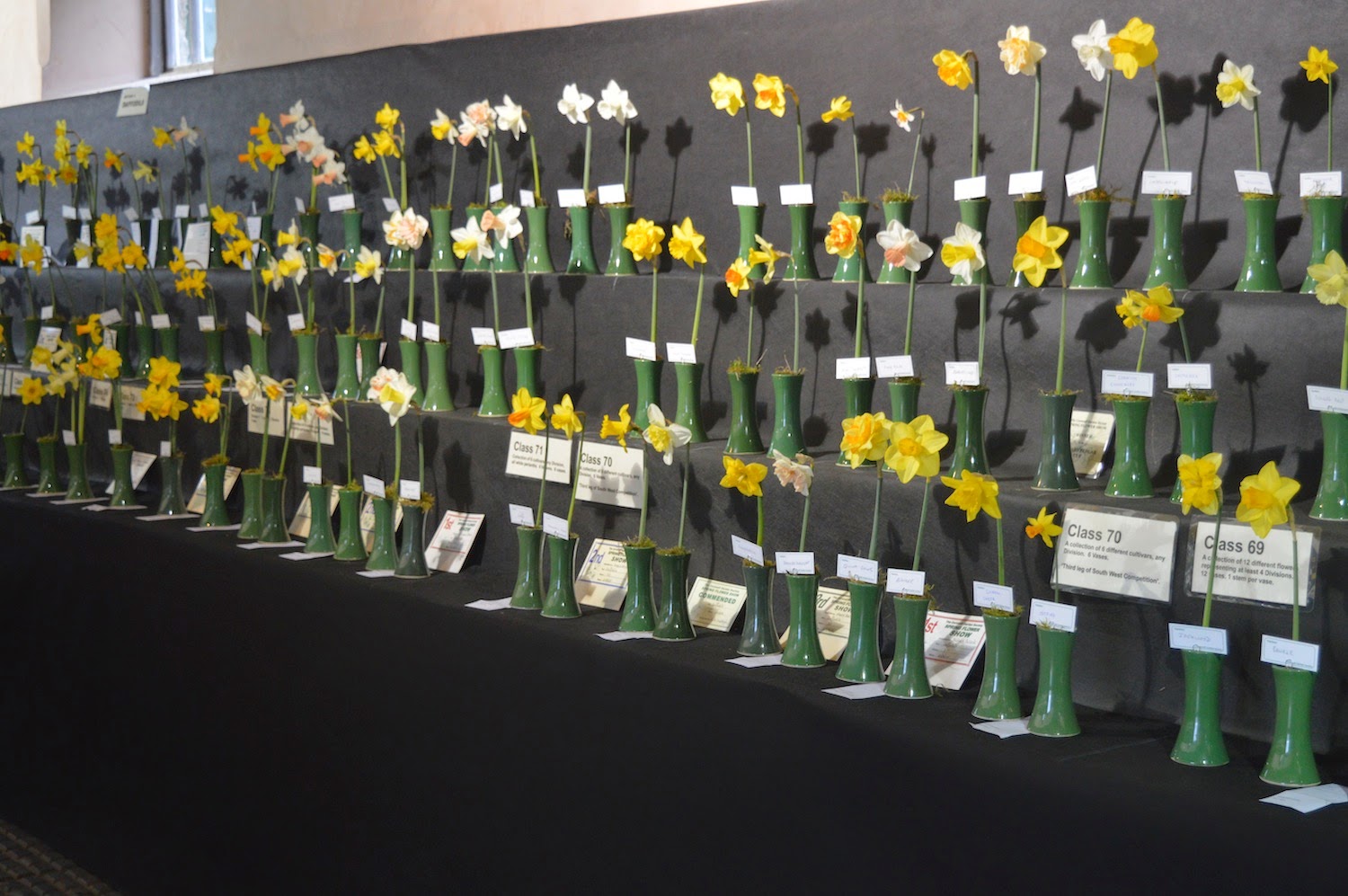
We got our judging done relatively smoothly and then had to decide on what would be put forward as 'best in show'. A wild form of Cyclamen persicum really stood out. Someone had obviously grown it for years, and it had wonderful silver foliage (and this is a species whose foliage tends to be fairly predictable). But, it had to go head-to-head with the best daffodil prize. The daffodil judges were taking ages, and from our peek into their exhibition room were agonising over over every bloom, and doing a lot of grumbling, or at least petal-by-petal critiquing. When they had finished we had to agree between us on a 'best of show', but comparing twelve nearly perfect daffs with one wild cyclamen seemed like comparing chalk and cheese. I rather determined I would fight the corner for our cyclamen. The twelve nearly perfect daffodils I actually rather took against; they were all relatively modern division ones and twos: big, full-petalled flowers – silicon-enhanced porn star daffodils, not the smaller, subtler, more airy varieties I (and indeed many others of the gardening public) now tend to go for.
'Sabrosa', one of the increasingly popular miniature daffodils.

So, the two daffodil judges, Rosemary and myself stood in front of the daffs, with the cyclamen brought in for comparison. I gave a bit of an impassioned speech about the cyclamen, and then the daffodil folk began to admit that one or two of their flowers were actually less than perfect, and in no time at they crumbled and admitted that the 'best in show' award should go to the cyclamen.
The big blowsy dozen

The winning Cycalmen persicum - wild form.

* * * * *
If you like this blog, why not check out my e-books, which are round-ups of some writing I did for Hortus magazine back in the early 2000s, along with an interview with the amazing Beth Chatto. You can read them on Kindle, or Kindle packages for smartphones or the computer. You can find them on my Amazon page here. You will also find my soap opera for gardeners - currently running at eight episodes.
SUPPORT THIS BLOG
I write this blog unpaid (of course) and try to do two postings a month, to try to provide the garden, wildflower and plant-loving community with information, inspiration and ideas. Keeping it coming is not always easy to fit into a busy working life. I would very much appreciate it if readers would 'chip in' (as we say in England) and provide a little financial support. After all, you pay for magazines and books, and it is only for historical reasons that the internet is free. Some money coming in will help me to improve quality and frequency, and to start to provide more coherent access to hard information, which I know is what a lot of you really want. So – please donate now!! You can do this through PayPal using email address: noelk57@gmail.com
Thank you!
And thank you too to the folk who have contributed so far.
********