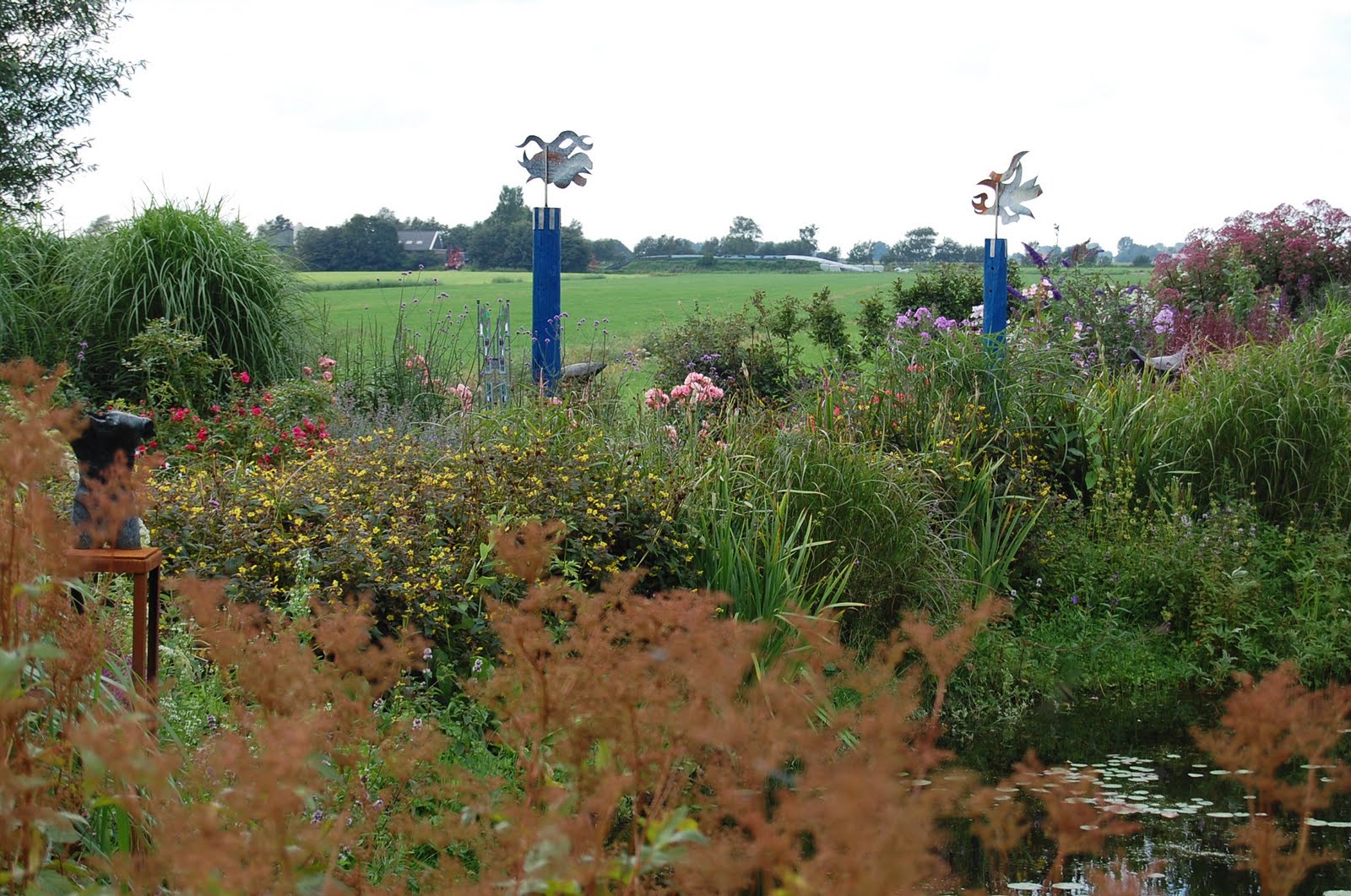
Thursday, September 29, 2011

Dolly Parton meets Lutyens? Roy Strong does not meet us.

 Funny business, acting as a tour guide in your own locality (The Welsh Borders), driving around in a big coach, in places that are really familiar, talking people through who don't know it all. Helps you see the familiar afresh. Also rather funny to roll up at your own garden, show people around and then all get back on the coach again.
Stephen and Judith Anderton's cottge high in the Black Mountains


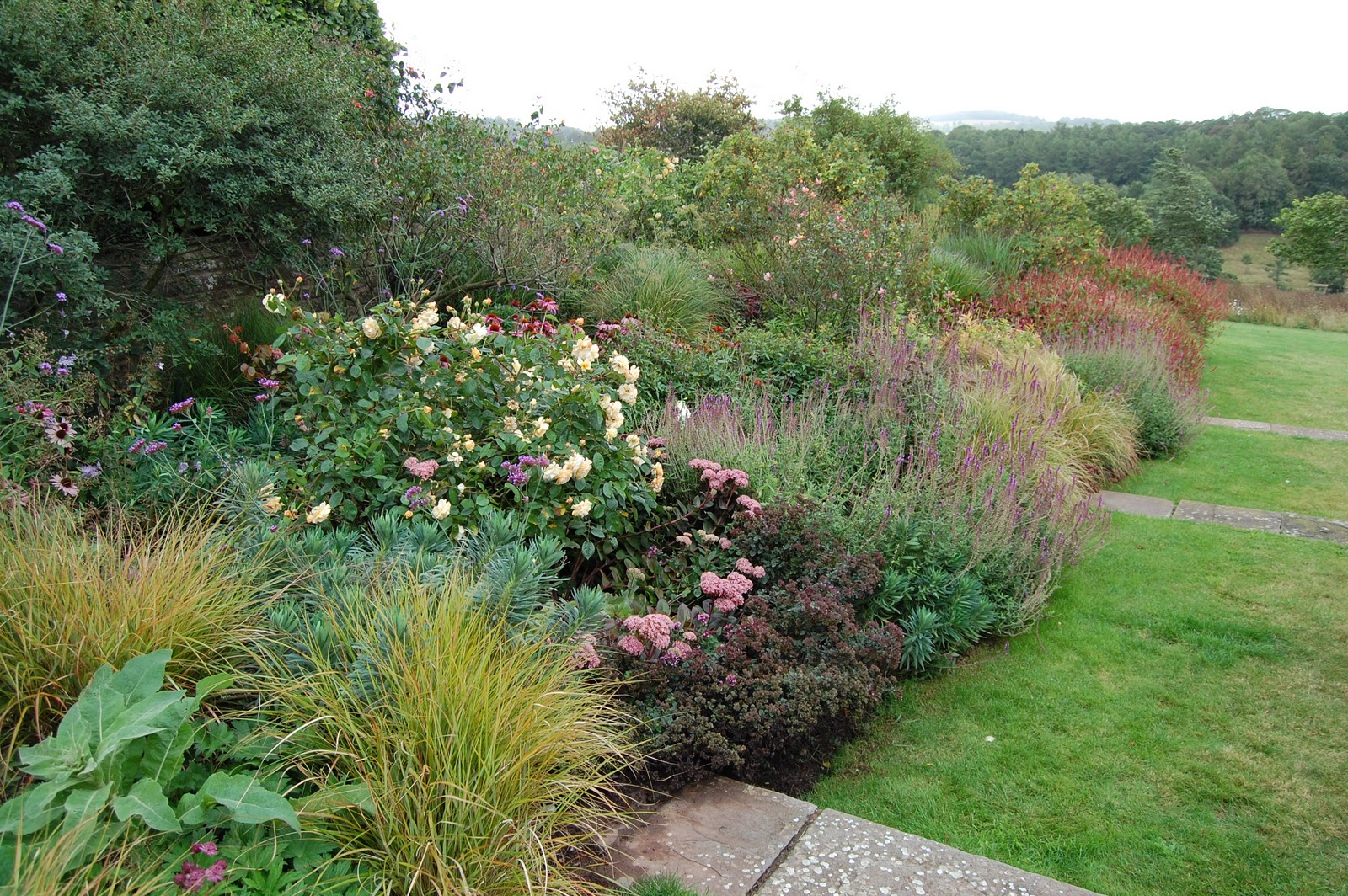
 Stephen Anderton, garden correspondent for The Times now lives in  a site with fantastic views, which have I think rather unwilling to try to compete with the location by making something so humble as a garden. So, planting is largely restricted to the side of the house away from the view. Its feels like a cottage garden but with more contemporary plants, such as grasses and kniphofias. It actually feels very undesigned, and artless - difficult to know whether this is really the case. I really like it, there is something very unpretentious about it, and the colouring works well, lots of different colours but subtle harmonies everywhere. Lots of succulents and ferns sitting in pots on old stone steps. The garden of someone who loves growing lots of plants and feels under no pressure to make bold statements or impress anybody.


"The slugs are this long" Peter Clay expounds the story of his garden, Sue MacGregor of Boxwood Tours looks on.

 Brockhampton Cottage, near Hereford, went down very well. Home of Peter Clay, who runs Crocus the online garden centre. The fact that he took time out of a busy working schedule to talk to us at length about the garden, how it fits into its wide and very English and very beautiful landscape, and his involvement with designer Tom Stuart-Smith, was much appreciated.


 H.Avray Tipping was a well-known, but now largely forgotten, garden designer of the early 20th century, and a key part of the Arts and Crafts movement which has dominated British garden design ever since (which is a thoroughly bad thing if you believe my colleague Tim Richardson). A&C gardening is a harmless pursuit and it balances order and growth so well, many of us are quite happy to follow in the footsteps of Tipping, Jekyll, Sackville-West et al. Tipping created three gardens in the Monmouthshire area, only one of which has been restored, by the current owners, Hilary and Helena Gerrish. Helena has just written a book about him. So now you have no excuse to say you have never heard of him.
High Glanau vintage Arts and Crafts
The trouble with mounts is that some people just have to stand on top of them and wave their arms about.
                       
We also visited Westonbury Watermill, a modern folly and water garden,  where owner Richard Pim is building an enormous (two storey) water-powered cuckoo clock. Watch this space.

Westonbury Water Mill, at Pembridge, Herefs. features a very impressive gunnera maze. Jo is describing the size of our cabbages this year.


The Pant, near Abergavenny, is a most intriguing landscape-as-garden, created by Jeremy and Camilla Swift. Jeremy is an eminent anthropologist, and much of the garden's content reflects interests from his professional life. It is a garden of great subtlety, making the most of wonderful surroundings.


The loo at The Laskett - strangely austere
 Finally, The Laskett, well-known through the voluminous writings of Roy Strong. It is obsessively formal, with allee upon allee, and everything in sight topiarised to within millimetres of its life. He has clearly had enormous fun making it - which after all is the most important thing. I love the way he bulldozes through so many of the basic rules of garden design. Unfortunately he disgraced himself by failing to keep an appointment to meet us, so we had to wander around by ourselves, getting lost in a kind of Alice in Wonderland world of hedges, hedges, yet more hedges, pleaching and monuments (mostly to himself, and one to a cat).


Roy Strong and I in 1996, or thereabouts. Check the body language. I still have the shirt, I understand he gives all his clothes to the Victoria and Albert Museum. Reminds me, I must make arrangements to do the same. We've both cut our hair by the way.

 You may have gathered that Mr Strong and I don't see eye to eye on gardening matters. I think I once wrote that a garden restoration of his should be bulldozed into the Thames (the Hampton Court Privy Garden). We once had a wonderfully bitchy spat on the radio, which could have been the start of a re-play of Robinson versus Blomfield (a great and rather stylised debate of the A&C era - see above), but I think both of us had rather more important things to do (promoting naturalistic planting design in my case and writing fawning books on the British monarchy in his).

Tour leading is great fun, you get to meet lots of interesting people (even if not Roy Strong), and hear about their lives and interests. Over the days, you learn about what they like in gardens and what they don't like, I always find it interesting getting people's reactions, I also learn a lot too, they always see things i have never noticed, even in places I know well. Seeing familiar places through other people's eyes in this way is actually rather special.

Finally, there was one comment I adored, I'm not saying which garden it was about... "Dolly Parton meets Lutyens".

Well not quite finally, we had Monique and Thierry Dronet, of the wonderful Jardin de Berchigranges, stay with us recently. Lovely people, kindred spirits; Thierry pointed out to us that (unbeknown to us)his  garage was on the front cover of a book on green building in the guest room of our (needless to say eco-build) guest room. They had the idea of digging up half a square metre of our wildflower meadow and planting it in the middle of a new meadow area they are creating. So here it is going in, a little bit of Herefordshire in the Vosges mountains.


Wednesday, September 7, 2011

“Grrrt lush!” – exotic fruit in the west of England.


            Peaches and apricots at 52 degrees north and 167m (547ft) in the English/Welsh borders is pretty good going. Nothing to do with global warming or microclimate, although they are on the south wall of the house, and all to do with good modern plant breeding.
            The peach we’ve had for four years; its fruited for three of those, and we were up to 24 this year. Good juicy flavourful peaches, far better than anything you can buy in the shops. Its name ‘Avalon Pride’ made me think it must have been bred somewhere near Glastonbury in Somerset, which of course would meant that it is a “grrrt lush” variety in the local lingo. But it turns out to be from the Seattle area, and a more or less accidental discovery, a seedling which appeared to be totally resistant to the peach leaf curl disease which devastates peaches, especially in cold wet winter climate zones like ours. It turned out to be very hardy too, although hardiness is not really the issue with peaches, rather that they flower very early, and the young fruit are easily caught by later frosts. They are so pretty in bloom that they are almost worth growing for their flowers alone. 

            The apricot was even more of a surprise. I bought it from DT Brown, a mail-order vegetable seed company. It arrived, very crudely pruned, and it went into soil at the base of our home’s massive mid 18th century chimney stack – its not good soil at all, so we’ll have to try to improve it with compost mulching from now on. No expectations of any apricots. Actually we aren’t great apricot fans, they often seem to taste rather astringent, or maybe that’s just European ones. The best apricots I’ve had are the dry ‘white’ ones you can get in the Hunza valley in northern Pakistan, mysteriously completely unlike the little round balls sold as Hunza apricots in wholefood shops here.
            Apricots are very hardy. Very. Winter in northern Pak at 3000m is very very cold, but once it’s spring it doesn’t freeze. So the locals of the Hunza and neighbouring valleys grew family apricot trees – that’s family as in several different varieties on each tree. Dried on rooftops during the intensely hot and dry summer, they would be eaten as a staple diet for the rest of the year. Imagine living on apricot porridge for breakfast, dinner and tea, with a bit of barley thrown in for excitement.
            Again, the problem for us as apricot growers is that the young fruit gets caught by late frosts. However our variety ‘Flavourcot’ and its sister ‘Tomcot’ have been bred in New Zealand to flower a little later and so reduce the frost risk. To our astonishment this year we harvested thirty fruit, deliciously juicy and without much astringency. Actually they really were the nicest apricots I have ever tasted. Since then I have heard of someone in nearby Gloucestershire planting a commercial orchard of –cot type varieties.
            I wonder what other surprises the future might bring. British bananas are a theoretical possibility. Anyone who knew us at our last house would have been familiar with the vast Musa basjoo in the backgarden. I had planted it when Jo was away teaching for two years in Bratislava (1993) and it just grew and grew in its sheltered inner-city Bristol, cat-shit fed, environment. Every year we would hack bits off for people. Last winter (minus 12) killed it to ground level, but the tenants in the house reported that by May it was sprouting again.
            Musa basjoo is a higher altitude south Chinese species, with inedible fruit full of bullet hard seeds. The fruit is also produced very late as it flowers late in cool British summers. Even with conventional breeding techniques I reckon it might be possible to start on the path to a variety which had small edible fruit by late autumn in southern Britain, or certainly in the warmer summers of central Europe.
            Roll on modern plant breeding!


Saturday, August 27, 2011

A kindred spirit


Ton ter Linden is famous for his garden-making in Holland, and for his art - mostly still-lifes. Time spent weeding or planting is as important to him as his painting, it’s a kind of partnership with time spent at the easel.

I’m glad to be here at last. I first came across his garden through photographs taken in the mid 1990s by Marijke Heuff, an incredibly gifted Dutch photographer, who at the time was busy with gardens by Piet Oudolf and Henk Gerritsen - indeed her ability to capture the misty faded glory feel of Henk’s Priona Garden helped launched ‘The New Perennial’ look. We used several pictures of his garden in eastern Holland for my book The New Perennial Garden. But I never got round to visiting. He moved with his partner Geert to South Limburg, that salient of Dutchness that shoves itself down between Belgium and Germany in an attempt to plant the flag on a decent hill or two. But it turned out not to be so restuful so they came up here – to the empty fields of Friesland.

I’d come with Dani Coray (whose wonderful really plantygarden so deservedly won a gold at Tatton Park recently) and a friend, Zoe Weston. Clutching our googlemap printout and a very basic £4 Dutch satnav app on my iPhone we bumped down concrete slab roads, where every slab was pointing in a different direction. It’s remote, but it sounds like Ton and Geert get lots of visitors. They run a studio, with work by other artists as well as Ton’s work. Some wonderful sculpture in the garden too.

Ton doesn’t speak English, so wir sprechen ein Bisschen auf Deutsch, but Geert is used to speaking for Ton, and he soon got back to his studio. Geert explained that the garden may look carefree but it involves a lot of emotional as well as physical effort – and that the sound of Ton shouting and swearing as he gardened was not uncommon. I know the feeling. I also knew almost before I waded out into it, that it was my kind of garden. I’ll let the pictures speak for themselves.


Ton ter Linden's website is here.
We went to lots of other good gardens and nurseries on the trip too... you can read about them on Gardening Gone Wild.

Sunday, August 14, 2011

Historic Andrew Chatto archives now published online!


Dry meadow above Mikulov in Czech Republic, on a rather grey day last autumn. Knowledge of what grows in rather difficult places like this can be a guide to what will thrive in similar conditions at home.

             
             Beth Chatto’s position as a leading garden guru of the latter half of the 20thcentury rests on the realisation of something which we now think of as obvious – that garden plants should be selected on the basis of habitat. Her garden consists of a series of gardens situated in dry, spring-fed and dry shade areas using combinations of plants adapted by nature to these difficult conditions. But finding out natural plant associations involved a close collaboration with her late husband, Andrew. Indeed the entire Beth Chatto planting philosophy was very much a joint effort.       
            Garden reference books, then and now, have never said very much about where plants come from, or their habitat. The only way to find out is to comb through journals and scholarly works. This is what Andrew Chatto did, over many years, from around 1940 until his death in 1990. He read the scientific literature in  German and French, and in order to be able to read the extensive material on the plant life of the Soviet Union, he learned Russian. The result of his researches is twelve binders of closely typewritten text, probably a little short of a million words. Each collection of notes covers a different part of the world’s temperate zones, and covers most of the regions from which our garden plants come from. There are lyrically descriptive passages of local geography and vegetation, and extensive lists of species of each habitat and region.
             So, when Beth was creating her marvellous garden, from 1960 onwards, and came across a new plant, or found herself with a particularly inhospitable problem area, it was to Andrew she turned for advice. During his researches he compiled indices which enabled him to find many plants relatively quickly. The result is a garden where plants are at least approximately matched to conditions similar to their homes.    
           For many years Beth worried about what to do with Andrew's papers. She approached me several years ago, and after a while it occurred to me that we should get them all put online.  A note in the newsletter of the Hardy Plant Society brought forward 55 responses, from which I selected eight to type up the notes into a digital format– mostly retired people, skilled copy-typists, all familiar with scientific plant naming. The next stage was to put the text online, so that anyone can read it.AND HERE IT IS!!
Seeing familiar plants in their natural habitat gives the gardener a particular thrill – and as more of us travel, further and further, it is something that is becoming a more widely shared experience. But what can we learn? Sometimes it seems, seeing a plant in the wild offers real insight, at others it seems to contradict our experience. One factor which muddies the waters is that the British climate is so different to that experienced by the ancestors of many of our garden plants. Plants are also often very tolerant  of a wide range of conditions , but are associated with a particular habit, not because they particularly like growing there, but because the fierce level of competition between plants in the wild means that may be the only place where they are can establish as seedlings or can escape from more aggressive species.
            The bottom line is that seeing a plant in the wild can show you the worst it can deal with. I remember having a holiday in  northern Pakistan, an area with a climate of enormous extremes of heat and cold, and finding  Perovskia atriplicifolia growing in the dry stone walls of farmer’s fields. In the garden this perennial with its attractive mid-summer mauve-blue flowers seems to grow anywhere, as does another familiar plant growing in the same place, Clematis orientalis, a robust late-flowering species with thick yellow petals. But both were scrawny and much reduced in size compared to their appearance in our gardens. The lesson seems to be that these plants are great survivors but really prefer the bounty of good soil and adequate moisture.
Knowledge of wild conditions often surprises. Many of us grow Verbena bonariensis, often as a gravel garden plant, its seedlings popping up between stones or paving slabs, seeming to thrive in hot, dry places. So I was astonished to meet a Uruguayan garden designer (Amalia Robredo) who told me that back home on the pampas it is a marshland plant – she even showed me a photo with Dan Pearson standing in front of a mass of the plant to prove it. The reason for its success in our gravel gardens is probably due to favourable conditions  for germination, and lack of competition.
            It is often possible to tell what sort of environment a plant comes from by its appearance – dry habitat species tend to be compact and have tough, often grey, leaves, wetland species to have soft lush growth and big leaves. But beyond this, local knowledge can be very important. A good example are moisture-loving plants. Many species like it wet, but not waterlogged, such as rodgersias and ligularias, which flourish on wet slopes in mountain areas in Asia – the water is always moving and aeriated, never stagnant. Or some will survive winter waterlogging but not summer; I shall never forget walking in the wildflower meadows of Cerknica in Slovenia, where a wide array of wildflowers flourish , including Euphorbia palustris, well-known for its greeny-yellow flowers in our springtime gardens – but where everything is under two metres of water when a temporary lake forms every winter. At Cerknica, Iris pseudacorus flourishes, but moisture-loving Iris sibirica is not to be found – but can be found on hummocks in wet meadows nearby – clearly it cannot cope with several months of inundation.


Tuesday, July 26, 2011

The sun may have (thankfully) set on the British Empire but not on its most successful invention.


It is often said that a lawn makes a good foreground but German garden designer Petra Pelz has got other ideas.

A recent post by a colleague on Gardening GoneWild (Tovah Martin) about planting up her lawn with plants rather than the heavily-shorn green stuff deals with what history may yet record as one of the great shifts in garden culture. Here I would like to take a hard look at this green tyrant and alternatives to it. Read on....


Tuesday, July 5, 2011

Sheffield - city of flowers?

Sheffield. Once 'steel city', then 'The People's Republic of South Yorkshire', now just another post-industrial regeneration site. BUT for those in the know in the garden and landscape world, a centre for good and wonderfully colourful ideas.  

 About 12 years ago Nigel Dunnett (know Professor) in the university Dept. of Landscape started working on annual seed mixes. The idea being to develop something which could be used by local councils to quickly and cheaply do something bright and uplifting, not just on roundabouts and parks but problem housing estates. These pictures were taken on the Manor and Castle Estates.
 They have been very successful, and hugely morale-inspiring to the folk who live in what can be very forlorn areas. I'm not suggesting that passive enjoyment of beautiful flowers significently reduces the rate of car theft, drug taking and the other traditional local pastimes, but it may do something. Nigel's experience in talking to local people is that the flowers are a huge morale-booster.


 Actually, the annual flower mixes are part of a much larger package of environment-led community regeneration organised by Green Estates, a not-for-profit who sell the seed under the brand name of Pictorial Meadows.


 There are now about half a dozen different mixes, based on colour or height. Each one includes around a dozen species, which flowers in succession. From a March sowing, flowers can be expected from June/July through to November.

Annuals actually vary in how long they live, from 'ephemerals' like field poppies which are nine-day wonders to longer-lived species like Californian poppies which can flower for months, and well into the winter given mild weather.

Nigel has also worked on perennial mixes, such as these, although they are slower to establish.

From left, Sheffield PhD students Jia Yuan and Ye Hang, Nigel Dunnett and Amalia Robredo.
I had gone to Sheffield for  a flying visit with Amalia Robredo after a Gardens Illustrated tour of Berlin and eastern Germany. Amalia is a pioneer garden and landscape designer who works in the coastal area of Uruguay. She has recently published the first popular guide to wildflowers of the area, with a view to encouraging their use in landscaping, and planted the first locally-native green roof. Sheffield gave her lots of inspiration.
*********************
I am now publishing e-books through Amazon, for Kindle, smartphones, iPads etc. There are currently two available, both collections of writings for Hortus magazine, from the early 2000s. Click here for Amazon North America or Amazon UK.

Friday, July 1, 2011

The 'Special Relationship'

About a month ago the leading flag on the ‘flag counter’ on my blog finally tipped from the Union Jack to the Stars and Stripes. So perhaps this is a good moment to reflect on Anglo-American relations in the garden. With the recent visit of Mr. Obama (who we Europeans by the way all adore) there has been yet another spate of politicians and commentators discussing the so-called ‘Special Relationship’. There certainly is one in gardening, and like the political version, it is complex, constantly changing, and sometimes controversial.
Read more ............