Tuesday, June 26, 2012

Bristol street life

 
Between 2001 and 2009 I worked on a series of plantings for Bristol City Council, some perennial borders in parks, but mostly roundabouts, traffic islands and junctions. The sort of places which thousands of people drive or are driven past every day. Traditionally these were planted up with bedding or with shrubs and mown grass.
People moved on, budget cuts bit, etc, so I haven't done anything in the city for few years now, although in fact council staff had told me that I had saved them a lot of money, one even telling me “we've not done any maintenance, and it still looks all right”. It was never the idea to do 'no maintenance' but I designed some very robust plant mixes, which have in fact coped pretty well.

Last week I was in Bristol over night and went out and photographed some of my work. I was amazed at just how much had not just survived but done really well. I felt very vindicated. Bristol offers fertile soils with a long growing season so weed competition can be severe. In most cases this was not a problem, with 'my' plants able to out-compete most weeds.

Levels of maintenance by council contractors varies. Smaller plantings in small parks are more likely to have a higher standard of care. Roadside plantings tend to have less. In some instances community groups have taken over and looked after plantings or in one case completely taken over to make a community-run area (Snuff Mills).
Phlomis russeliana at Three Lamps junction. Totterdown. Planted 2003/2006
Three Lamps junction of the Bath and Wells roads
Very successful coverage by the plants chosen, but not a huge amount of colour. Partly perhaps because I just didn't photograph it at the right time, but also the stronger coloured Achillea definitely dies out whereas the paler survives. And there is a huge plant mix in here, so there's a long season of interest. What was good though was how complete the vegetation coverage over the soil is – denying space to weeds (and hiding the rubbish).
Oxford St. 2006

Oxford St – visible from the Wells Rd. just up from Three Lamps
This was intended as coppiced shrubs and perennials. No coppicing ever happened, and for some reason Geranium 'Claridge Druce' has taken over with a vengeance.Planting was done into a very thick layer of green waste, which over time has either degraded or been washed off, which did perhaps have a negative impact on some plants. This does show however just how well these pink geraniums do in the west of England climate. Long flowering season too. Few more of these and Bristol could be 'pink city'.
St.Johns Cres. 2007

St. John's Crescent, Bedminster
A pocket park. Pretty well looked after this one.
Malago Lane, 2006

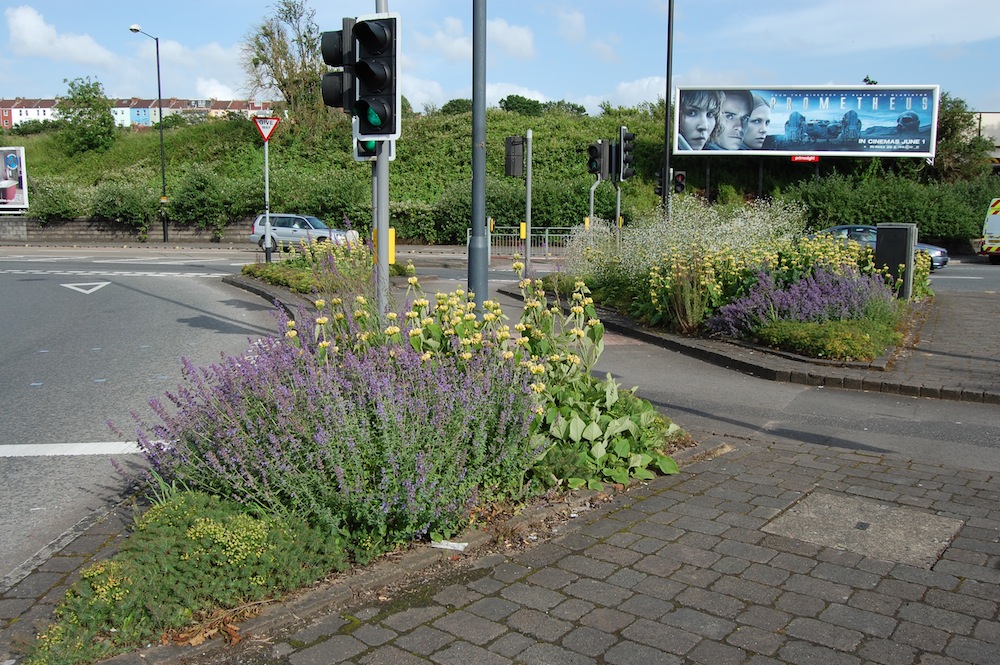
Malago Lane, Bedminster
A triumph over adversity this. Nasty place to be a plant: salt, poor soil. A limited selection of toughies were planted, ALL species have survived. Rudbeckia fulgida greatly reduced but Euphorbia cyparissias does a fantastic job of filling spaces. Crambe cordifolia makes impact.

All very encouraging. The socialist in me loves doing this. Beautify the city. There are so many silly little patches of green all over Bristol, which all need mowing. They could all be planted up. It doesn't cost much. For a fraction of the money spent on the new gardens that our kleptocratic financier class seem to be busy making you could 'do' the whole city.

**********
Have you read the unique soap opera for gardeners – Dig, Plant and Bitch. Recently described by a colleague as 'Jilly Cooper meets Geoff Hamilton' (translation for non-Brits: sharp-nailed chicklit crossed with gardening advice from favourite uncle).

Saturday, June 9, 2012

Colourful thoughts about German gardening and art history


Hermannshof (in Weinheim) in late September


Just had a piece in The Daily Telegraph about my long-standing love of the German gardening scene. Rather funny for a rather Euro-sceptic paper, they published it on the Queen's Jubilee Weekend - nicely subversive.

This year it doesn't look like I'll be going, as so many other things on, but usually I look forward to meeting colleagues, seeing plants and new places. What I like about garden-visiting in Germany is the kind of disjuncture of seeing the familiar used in unfamiliar ways, often on a larger scale, which is a reflection of the emphasis on public horticulture I talk about in the article. Its like having the same set of ingredients but a different recipe for cooking them.

Of course, it being the Telegraph, I had to put in a dig - so the German love of the gnome (Gartenzwerg) seemed the obvious one. Yes, there are a lot of them. And you can even buy a murdered gnome (knife in back). Kitsch is a German word you understand.


I got an email back from my friend the landscape architect Anita Fischer who organizes the lovely Freising Garden Days, same time as Chelsea so consequently invisible to us. Anyway, she slightly ticks me off for suggesting that German gardens are untouched by modern garden design. Not true she says, as she thinks garden design is taking off. To be honest I am a bit out of touch so I'm sure she's right.


What started me off on writing the piece was a new book, by the new Prof of Planting Design and Plant Use at Weihenstephan- Swantje Duthweiler. It's historical, looking in extraordinary detail at the first half of the 20th century's perennials, the nurseries which grew them, the connections with garden designers, the use of plants in public space etc. Fascinating stuff and such a lavishly illustrated book with lots of old postcards, plans, nursery catalogues etc. Rather embarrassing that no-one has done this kind of research for Britain.What i found most interesting was the connections between early 20 century 'alternative' movements and flower colour. Lebensreform (life reform) was an important part of German cultural life in the first decades of the 20th century, mostly to do with diet and exercise, we in Britain had a similar although weaker movement, and of course the Steiner movement came over here; anyone who knows kids who have been to Steiner school will know about the emphasis place on colour in their teaching (and those rather wishy-washy paintings they all seem to bring home). There was an emphasis on pure colour  as an almost spiritual value as part of a healthy lifestyle, which influenced many artists, this also drove variety selection in perennials. Blue was seen as being a particularly spiritual colour by many artists; German breeders certainly produced lots of wonderful blue blue delphiniums.


All this talk of spirituality and colours seems a bit weird to us hard-headed Brits, but that's just one of the things which rather sets apart from German culture. Never underestimate the German ability to philosophize - which probably explains why none of the books of the great Karl Foerster, who dominated German gardening in the 20th century has ever been translated.  Our UK nursery trade did a lot of toing and froing with Germany in the 1900-1930 period, but we tended to be interested only in the colour as an end in itself. It might make a fascinating study to look at the differences between German garden designers and Gertrude Jekyll's theories of colour.

Phlox were a particular passion in the 1920s - so many variations on the theme of pink.


What was most fascinating was the level of connection between leading figures in the art world and gardening - and the consequent status this gave gardening and the nursery trade. I remember visiting the garden of the artist Max Liebermann (1847-1935) some years ago on the Wannsee (lake) on the edge of Berlin. His love of gardening and the artistic use he made of his garden reminds me of Monet and Giverny. Liebermann was involved with the Secession (Art Nouveau) movement and in reading Swantje's book, I realized he was associated with influential art historian Alfred Lichtwark (1852-1914), who wrote about gardens and colour theory in planting design

Those who can relate only to the horrors of 20th century German history will inevitably ask "what about the Nazi period?". Karl Foerster (a pacifist) ended up fleeing to Sweden, and returned to live in the communist east. Swantje points out that there was no specifically Nazi garden aesthetic, beyond a stress on native species, but that had little impact on the all-important public park plantings. The really interesting thing about the Nazi period is the links with the organic movement. I recommend Radical Gardening by George McKay if you want to follow this up. We tend to think of organic growers as being rather cuddly nice people - you won't do after reading this!


*****************

If you fancy some lighter reading why not try Dig, Plant and Bitch, the world's first soap opera for gardeners
Find out more here
Will Bonzo the gardener survive his fall off the Charles Jencks inspired mound?


Wednesday, May 30, 2012

The slimy menace


The garden still looks pretty good this spring, its mostly later-flowering species which are being damaged.


Until this spring I don't think I had understood just how damaging slugs and snails could be. I mean, like most gardeners, I have had to fight the little ******s off vegetable seedlings and the occasional emerging perennial, but never the wholesale onslaught the garden has suffered this spring. 
 
Prof. James Hitchmough, up at Sheffield, always went on about them, a bit obsessively, I thought. Now I see why. I remember Tony Kendle, an academic botanist who went on to work at the Eden Project in Cornwall, once telling me that he thought that localized extinctions of native species could be caused by molluscs. So, they really can have an ecological impact.

In my last garden, we had very little problem, and in this one, not much of a problem until last autumn when numbers began to build up. This spring the numbers of the things are incredible, and exacerbated by a long cold spring, in which the animals can operate, but many perennials are growly only slowly, so they can be continually grazed as they emerge. I am convinced now that they are capable of killing established perennial clumps in these conditions. 
 
They are highly selective, and in fact the number of vulnerable species is actually quite limited. I had already resigned myself to regarding some genera as almost ungrowable because of them – Helenium might be one, Asclepias certainly. Most of what I grow is actually unaffected. This year though they have really gone for Veronica austriaca, many asters, nepetas, aconitums, coreopsis, ligularia (well known snack) , baptisia, and most devastatingly, as it is an iconic plant in our garden, joe pye weeds – Eupatorium fistulosum/maculatum.

It is pretty obvious they can't eat anything with hairy leaves, but there must be chemical defences some plants have which means they don't get touched. Aquilegia and Thalictrum look very juicy and defenceless but seem ok. Aster are odd: A. laevis for e.g. is badly affected, but A. puniceus, novi-belgii, novi-angliae all look fine, Since some of these, like novi-belgii and a couple of odd American species I am trialling are very aggressive spreaders, they are going to have a clear ecological advantage here.

What to do? I'm very glad I did some research ages ago on good old-fashioned metaldehyde slug pellets, as they are far the simplest, cheapest and most effective way, and I can use them without feeling eco-guilt. Several years ago, at a time when I was also questioning the organic movement, I became suspicious that there was little evidence of them being harmful to wildlife, I had phoned round several conservation organisations, and none of them could come up with any real links to wildlife deaths, Government statistics on wildlife poisonings drew a blank too. Another eco-myth? James Hitchmough was pretty sanguine about using them too, having looked at the academic literature – he'd even done a research project which involved students catching and identifying them at night (the things you can make students do). Metaldehyde doesn't hang around in the soil either. So a few pellets (you don't actually need very many) in the crowns of vulnerable plants, leads to a satisfying array of dying slugs the next day. Best in dry weather so they dry out quickly and die 100%. Late evening slug hunts and lots of vindictive stamping are effective too. 
 
Longer term, I think we may have to get the chickens in. Once vulnerable seedlings are up and running, I'm hoping Jo will let the chickens have free rein of the garden, and they can go round and gobble up the next generation before they breed. But next spring I shall be ready and waiting.

Monday, May 21, 2012

Back from Chelsea


Cleve West's garden, very traditional, even to the extent of the lean on this topiarised yew. When the show is full of arty over-symbolic hype we long for gardens like this and when there is nothing but we moan about them Garden journalists are hard to please.


Just made my once every few years visit to the Chelsea Flower Show. It does all feel like deja vu and

Pepa's GArden celebrating Karst landscapes of Slovenia - inspiration for dry British gardens?
Part of Sarah Price's garden for The Telegraph, accomplished, but trouble is everyone was doing this this year, mostly natives.
I do basically go for the people, as the Monday press day is like a huge works party for the garden press. Its not easy to get tickets, unless you are actually writing about the show or are an F-list celebrity - so thank you to Joanna Fortnam at the Daily Telegraph for my ticket. Its almost a party atmosphere with a constant hum of networking. Amongst the people I bumped into was Stane Susnik of Slovene TV, and next thing I knew I was in the middle of a little garden - ‘Pepa’s Garden’ designed to show off the wildflowers of Slovenia’s karst (limestone) region, being interviewed for Slovene TV.


I love this kind of touch - Sarah Price again
Thomas Hoblyn design - very good for instant impact, but wouldn't last a year in garden conditions before they'd begin to compete each other out.

What is so odd about Chelsea is the way it illustrated the zeitgeist at work. It is almost as if all the designers sit down and decide what the theme is going to be, as so often gardens are remarkably similar. My first thoughts this year was ‘this is comfort gardening’, in a time of recession and uncertainty, everybody is making gardens which are safe and traditional, an impression reinforced by the muted colouring, the pastels, the lack of strong or vibrant colours. So many gardens featured intermingled naturalistic style planting - which made me feel very vindicated in having been promoting precisely this for so many years. Has the ‘New Perennial Garden’ finally come home? Maybe it has. Trouble is, after a while, it began to look a bit samey - this year’s plant seems to be Cow Parsley and as a grass substitute Carex muskingumensis. The problem is with timing, it’s actually too early to get many later-flowering plants in, so the plant palette feels a bit restricted. A lot of native wildflowers, for which the season is perfect, but since our flora is a limited one, that does not make for much variation. On the whole though planting was very well done, sophisticated and a lot of it would actually have worked in garden conditions.


Probably the tallest thing ever at Chelsea, this piece of nonsense from Darmuid Gavin, saved the show from being too worthy. Completely unfeasible as a garden it gives the show the pizzazz and absurdity without which it would not be Chelsea. The red things are Chelsea Pensioners (i.e. military veterans).

It is of course relatively straightforward to get the intermingled look with plants from nurseries, crammed in far more tightly than they ever would be in the garden. The garden is a greater test, as clumps expand, plants compete, some spread, some don’t. What would really be a trial of design skill would be this: to design a Chelsea Garden which looked like it had been planted three or five years ago.   

Sunday, May 20, 2012

Adding to a meadow


When we bought Montpelier Cottage seven years ago, we had no idea just how interesting our bottom meadow would be. We bought the place in the winter, moving in in July, and then slowly began to realise how species-rich the wetter areas of our three fields are. We planted some trees there in the autumn (all wetland species, mostly N. American), but I'm not sure now whether we would have put so many in, although they are so widely spaced, they will only shade a small proportion of the area. In fact I don't think we even realized our species diversity in that first year, as I think the person who sold us the house had had it all mown; our first guests (staying in our yurt) were a Berlin gardener (Christian Meyer) and a professor of applied ecology (Norbert Kühn) from TU Berlin; I don't even remember us discussing the flora.

During summer the place just buzzes with insect life. The flora is unusual, in that the further down (and therefore the wetter) the less and less grass there is – which is unusual for us, as grass dominates anywhere remotely fertile in southern Britain; sedges and rushes take over and various forbs (which UK ecologists still call herbs, despite confusion with things you stick in your cooking or make tea out of) including two strongly spreading species with grey folaige: fleabane (Pulicaria dysentrica), a daisy family sp. not particularly common and Silverweed (Potentilla anserina) which is a classic west of Britain plant. 
A grass strip 25cms wide is sprayed out with Roundup - in April this only kills grass/sedges and ranunculus, other forbs are still underground. It creates a strip in which plugs can be planted with a reasonable expectation that they will survive. It also makes it easier to see if they are spreading in future years.
 

The British flora is a very meagre one, something I constantly grumble about, and there is very little in flower after June. Apart from our meadow! Lesser knapweed (Centaurea nigra) is pretty dominant visually then, followed in August by the Fleabane, so it becomes a blaze of yellow. The lack of grass and the dominance of forbs is quite extraordinary, and reminds me more of continental European montane habitats. We have lots of Spotted orchid (Dactylirrhiza fuchsii); in fact their numbers increase massively every year, although I do not really understand why – what are we doing right? And Ragged Robin (Lychnis flos-cuculi) – this is a short-lived species which I suspect depends on disturbance for continued re-sowing – a good argument for getting in a heavy tractor to mow it and get a few ruts in where it can seed.
Diana, our one-day-a-week gardener with plug trays full of wildflower seedlings.

What we have I suppose, is an 'unimproved' grassland – 'improved' meaning made agriculturally productive, and so then very poor in biodiversity. I am no luddite, and have no objection in principle to farmers increasing their productivity; if I am to point the finger it is to consumers who expect cheap meat, and lots of it, which is the driver for so much habitat destruction. Most of the grassland around here probably used to be like this, but is now overstocked with EU-subsidized sheep so fat they are practically spherical, and horses - which since the Brits don't eat them (why not?) are simply for leisure. Horses by the way, are very destructive of species-rich grasslands. But I can feel guilty about this now, as we have just taken up riding!
We marked out one metre strips to help us work out how many seedlings to plant.

Back to our meadow. The odd thing about it, is the species which are not there, but can be found in some other nearby similar wet grassaland places. Two years ago, a friend (Sally Holterman )a bit further over into Wales gave me some wildflower seed she had collected from her land, species which were missing from ours: Devil's bit scabious (Succisa pratensis), Globeflower (Trollius europaeus), Valerian (Valeriana officinalis), Jacob's ladder (Polemonium caeruleum) and Betony (Stachys officinalis). I grew them in plugs last year, with fantastic Globeflower germination (much better than Jelitto seed!), and the pictures here, illustrate their finally being planted a few weeks ago.


Meanwhile Episode 3 of Dig, Plant and Bitch, the Soap Opera for Gardeners is now online - 
Mowing close to the edge
Petunia and Wayne Martin are getting ready to open their garden to the public on a commercial basis. In trying to think what to do with some disused farm buildings, Petunia has a brilliant idea, one which might upstage some garden restoration work that the grander folk up the hill at Mere Castle are busy with. The Castle’s gardener however has had to seek advice on his Japanese garden restoration from an unusual source, which has involved a secret trip he’s very anxious to keep quiet about. His secret advisor however has got a lot of grass to mow, with disastrous results - will he survive to tell the tale?

Monday, April 30, 2012

A recent interview

A couple of months ago I went to Switzerland to do a lecture for the Swiss equivalent of the Hardy Plant Society. Xavier Allemann, who runs a very interesting looking little nursery - Lautrejardin, did an interview with me. Here it is. http://www.scribd.com/doc/91873133/Interview-Switzerland

It was translated into French and German. Those versions are on the right-hand bar ----->>>>  under 'Für Deutsche Leser' and 'En Francais'.


Saturday, April 28, 2012

A gothic hunt for heirloom daffodils.


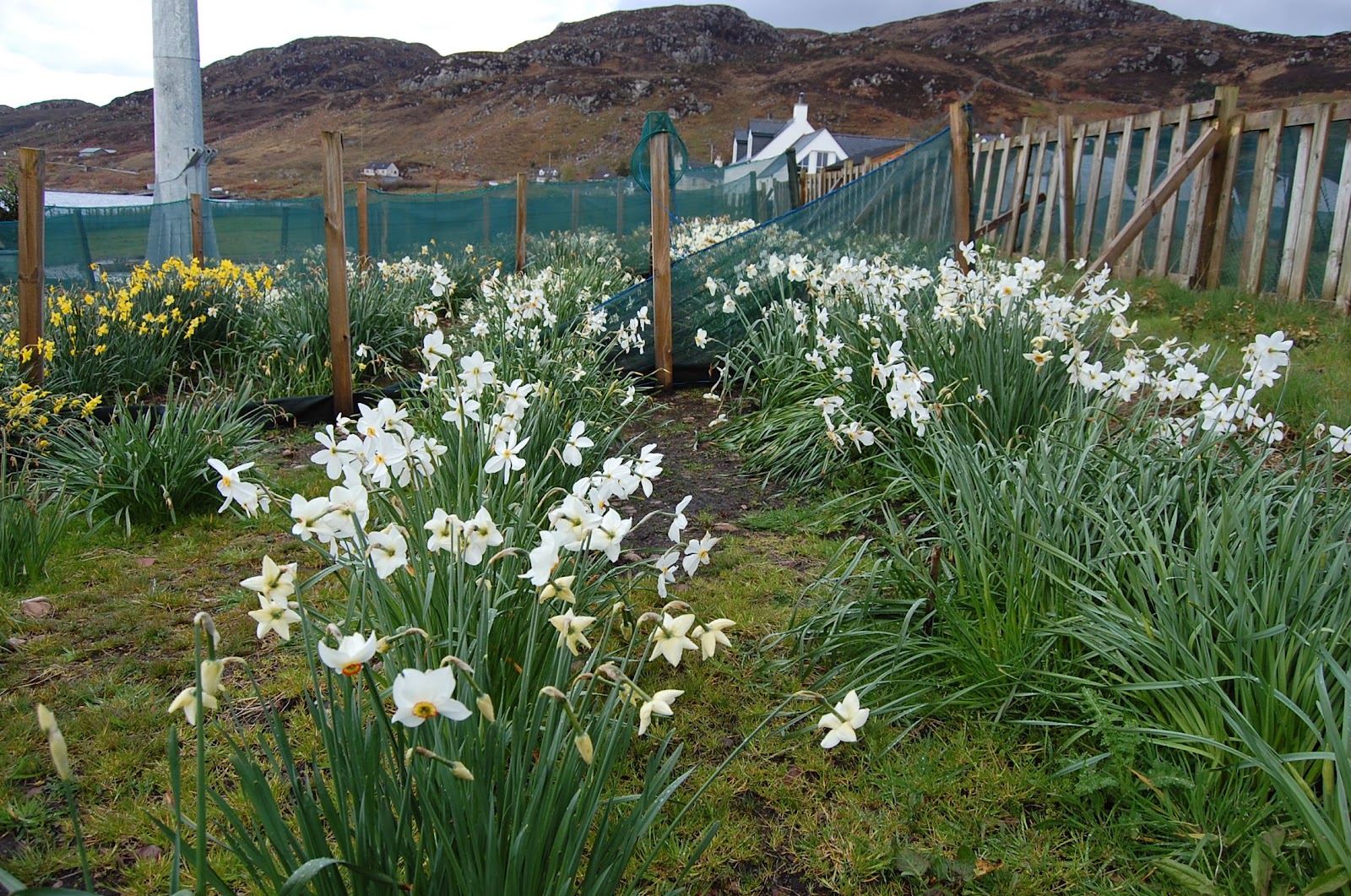
What am I doing wandering around a graveyard at dusk? In the little town of Ullapool in the north-west of Scotland. "I wonder if he'll put this in the book, that the Donalds are mad, spend their evenings in cemeteries" muses my companion. We had been out for supper, a surprisingly good meal in a most unpromising place (reek of stale beer, plastic wood paneled walls, a bizarre painting of bare-breasted women in ancient Egyptian headresses holding a submarine). Passing a graveyard I jokingly suggested we go and look for old daffodils. "This is what we do all the time" said Duncan and Kate Donald, who collect heritage daffodil varieties and are always stopping by the side of the road, old gardens, and churchyards. So in we go. It is a spectacular location, overlooking the loch and the mountains. Kate bends over a clump, cautiously names it, bends over another one - she runs the stem through her fingers - the smoothness or otherwise of a stem can itself be a key to identification. 'Ornatus' she suggests. Duncan says something about always keeping a spade in the back of the car. For one awful moment I wonder whether he is going to go and get it. I can already feel the eyes of the notoriously god-fearing folk of Ullapool upon us, suspecting us of digging up the Presbyterian dead.

Duncan and Kate Donald live and grow their plants in the incredible natural beauty of Loch Ewe on the north-west coast of Scotland. Rows of daffodil clumps are lined up around their cottage and an impressive wind turbine – a reminder that although the climate here is very mild, the wind is a constant. Kate had a childhood love of daffodils, which was rekindled by a scholarship year at Tresco Abbey Gardens on the Scilly Isles in the late 1970s. In 1983 she became RHS Daffodil Registrar, and because of this was asked by the National Trust for Scotland to create a National Collection of daffodils at Brodie Castle. Duncan adds “we got interested in making a collection of old daffodils in the 1980s... I was curator of the Chelsea Physic Garden in London... we had some bad storms then... a large tree blew over on top of a heritage daffodil collection... it really focussed our minds”.

Kate worked as RHS Daffodil Registrar between 1983 and 1986. “I was always more interested in the older varieties” she says, “old varieties which still come up in gardens decades after they have been planted shows they are survivors and therefore proven, unlike modern show varieties which are an unknown quantity”. “We made 1930-1935 our cut off point” explains Duncan, “why?... this was when 'Fortune' derived varieties began to become important... we don't like orange cups, they all look like each other, we don't care for the Fortune look”. That leaves around 7,000 named varieties of which the Duncans now have 400 plus. He went on to explain how “we began to spend a lot of time looking at derelict cottage gardens, and then to ask garden owners for bulbs, and started to build up a reference collection.... we targeted garden owners through our various contacts, for example, people were so often very generous”. 

In 1990 the couple moved to Scotland 1990, and as Duncan explains, “the children got used to the Easter holidays being daffodil time and endless garden visits”. Scottish gardens have often preserved the past better than English ones, and with the climate being a good one for daffodils, they have proved a fruitful territory for tracking down long-forgotten varieties. As time has moved on, and the daffodils have grown they are able to offer a number for sale – wide distribution is always aguarantee of survival. “We want to do for narcissus what Graham Stuart Thomas did for roses” says Duncan.
One particular property, Threave in Dumfries and Galloway, “has been a Rosetta Stone for us” says Duncan. The property had been owned by the Gordons, a family of Liverpool industrialists, who had used the castle as a summer residence. They had regularly bought bulbs over a long period and crucially kept good records. Additionally, in the 1960s an extensive set of notes were made of the old head gardener's knowledge. The Donalds were then in an excellent position to identify daffodils growing in the garden, so far they have named about ninety.

Over the years, the Donalds have worked out an effective methodology for identifying varieties in old gardens. They have systematically gone through old nursery catalogs, held by the RHS's Lindley Library in London, and assembled a database mapping the availability of varieties over time. “The collections for sale in the catalogs are particularly valuable” explains Duncan, “as these would have been bought in bulk and therefore most likely to still be around in gardens... if a garden is known to have been planted up at a particular date or between two dates, then it is possible to go to the catalogue database, and see what was available, narrowing down the possibilities... magazine articles (e.g. The Gardeners' Chronicle) can be a useful source of information about when a particular garden was planted up if the garden itself has no record”. Gardens which do keep archives may sometimes contain invoices from nurseries or bulb dealers, listing varieties, or there may be old catalogues with names marked up.

There is no doubting the rigour of the Donalds' approach. The changes in names resulting from the way daffodil classification systems have worked over the years and duplications in naming have resulted in much confusion. “We are very careful” says Duncan, “every clump is mapped, and has two aluminium labels with the name and accession number impressed onto them, one of which is buried with the bulbs”. He goes on to explain that flowers are systematically photographed, at different angles, and at different times – as flowers can change in appearance considerably over the period in which they are in flower. The eventual aim, apart from making as many varieties available for sale as possible, is a field guide to old daffodils, which will enable anyone with a garden which may have been planted up before the 1930s to identify their bulbs.
Sweetness - a 1939 Jonquil
The Donalds' daffodils are sold through Croft 16.
more to read on my Amazon Kindle page, including essays, interviews and Dig, Plant and Bitch, the world’s first Soap Opera for gardeners.