Tuesday, July 23, 2013

Global Gardeners explore northern Holland

Seed mix, sown last year, created by Piet Oudolf using seed from Cruydt Hoek

Garden tours are always special experiences, but our recent tour to the northern Dutch provinces, which Jo and I led for Gardens Illustrated readers (and run by Distant Horizons) was a particularly special one. We had ten garden designers from Argentina, most of whom had never been on a garden tour before, along with people from the US, Germany, New Zealand, Italy and the UK. It was a very special experience for the Argentinians, to visit somewhere where gardening is a mainstream activity, and where there is such a long history of growing plants and making gardens. They explored, photographed and discussed each garden with a passionate intensity. For them this was a very special experience, to come such a long way, to make a trip in difficult economic conditions – I was very moved that so many should choose to join us. They were a wonderful group to travel with.


The new meadow style area at the Oudolfs' - created three years ago: perennials with Dutch wildlflower mix sown between.


The three provinces of Groningen, Friesland and Drenthe were a very good choice. They make up the bump at the top of the country and form one of those regions which feel very remote. You get the feeling that not many people go there (apart from holidaymakers on the way to the sandy Frisian Islands. Its not on the way to anywhere else, and at first sight you wonder whether there is anything more than fields of potatoes. What it has are the big open skies typical of the Netherlands but with a much sparser population, and some wonderful historic villages and towns; in places there are remnants of traditional landscapes where small fields are bounded by hedges with rows of alder trees. There is also a lot going on culturally and Groningen is famous for its contemporary architecture.
Aruncus and Rodgersia at Kwekerij Jacobs
Some of the gardens we visited were made by people who had always lived in the area, but others by those who had moved out of the cities and the crowded Amsterdam to Rotterdam strip back in the 1980s. With cheaper property prices it was a good place to make gardens and open nurseries. The result is an area with a huge variety of private gardens to visit, and – frustrating for most of us, nurseries with very good ranges of plants. One of our party, a designer from Lake Como in Italy, kept us amused by constantly buying plants, which would all get crammed into her luggage and flown home.

Thermopsis carolina at Jacobs


We actually started off further south with a workshop at the Oudolfs, where it was interesting to see some new developments where Piet has been using seed mixes rather than only just planting. One was a seed mix based on the lists of a supplier of Dutch native species and the other was the old nursery area which is using native grasses/wildflowers amongst perennials and Calamagrostis Karl Foerster grass - so far so good - the sandy soil here is low fertility so it looks as if a good perennial-grass balance is developing.

The garden and nursery of Henk and Dori Jacobs in Drenthe was one of our first stops. This does not feel like a consciously designed garden, which perhaps is its secret. Perennials planted across wide areas, one area very much dominated by the house and some light shade and featuring many lush rodgersias, aruncus and geraniums and the other much more relating to the local landscape and a large pond. Views out into the landscape (always flat and mostly agricultural) were to develop as one of the themes of the week. Intimacy and openness combined.

 De Kleine Plantage is a wonderful nursery near the north coast, run by Fleur van Zonneveld and Eric Spruit, who I first met years ago. Here we first see the crisp hedging we get so used to on this tour but as a framework for lush perennial planting. Fleur's colour-themed arrangements of pots, of both annuals and perennials are always a special feature.

We like our group to colour co-ordinate - Amalia Robredo with one of the plant selections at de Kleine Plantage.
Sculpture exhibits are always a strong feature at de Kleine Plantage.
Aristolochia macrophylla on the magnificent late C19 Landhuis Oosterhouw.
Lunch at Landhuis Oosterhouw was an event. Beautifully presented food followed by a wander around the garden. A truly extraordinary place - formal, but getting pretty wild and unkempt in places, deeply mysterious, oddly decadent, deliberate faded glory?, creepy in places, a forgotten world. The house (in which you can apparently stay) stuffed with antiques and enigmatic paintings. "A monk came one day.... and never left" said the owner. One of the most distinctive places I have ever been. Unforgettable.
Very Mien Ruys this. Modernist quirky hedging at Tuinfleur.

Tuinfleur is a bravura performance of a garden created by a middle-aged couple, who obviously devote their lives to the garden. It's extraordinarily long and narrow, and you move from room to room, with a range of garden themes. The view above is of a watergarden with a bit of a slope displaying lush wetland plants with their leaves tumbling towards the water. The hedging here must be a major job to cut every year - it's crisp and (particularly compared to what we are used to in Britain, creative).
 A small garden made by Alie Stoffers, a garden designer, playing with colour schemes in the way people have rather given up on back home. What I was particularly interested in, and this applied to some of the perennial planting at Tuinfleur too, was how dense the planting was – this would have been unthinkable a few years ago, one impact of the naturalistic planting movement has been, I suppose, that people are much more relaxed about cramming plants in and letting them spread. A lot of perennials actually work better supporting each other and the result is a kind of generous quality to the planting, although there is an unpredictability to it which needs confidence in managing. One of the things I do bang on about in lectures and workshops is how much greater plant density is in nature, compared to garden conditions, so its good to see garden designers getting in more plants per square metre.

 A new prairie style garden, laid out three years ago, by Jaap de Vries, was good to see. Jaap is a keen member of a facebook gardening community who were in touch with each other before the trip. It's an incredibly ambitious garden, and will take time to fill out, but a good rhythm of planting has already been established. You need rhythm on this scale.

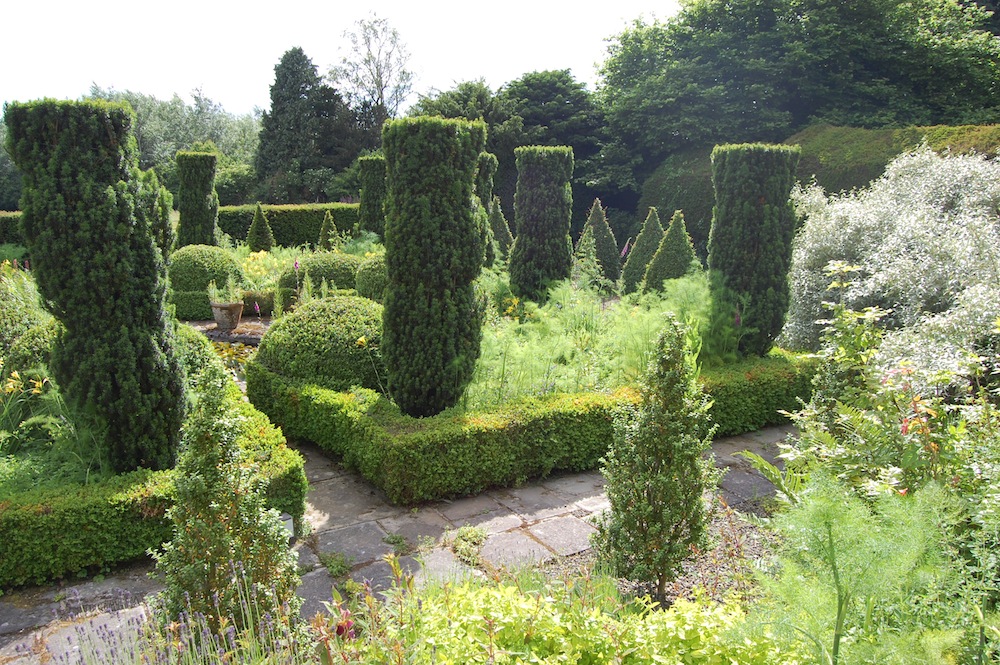
A day with Nico Kloppenburg, who is a well-established designer in the historic village of Mantgum. It is interesting to see his work, as it is more dependent on clipping foliage than on perennials. Very clever much of it: hedges that gradually taper, hornbeam drums to block a view rather than use a solid hedge, beautifully shaped columns, wavy-topped hedges, common enough material but endlessly re-invented into new forms. So exciting.


Roberta Ketzler discovers a hedge to lean on.
One of Nico's best inventions is a new way of treating lime to form a hedge, bending it around rather than cutting, so that you end up with a dense interwoven mass of branches. The result is very strong, so you can lean against it without either falling through or damaging it.

The Ton ter Linden garden

The prairie garden made by Lianne Pot, mostly lupins at this time of year.
 
Lianne Pot's prairie garden and Ton terLinden's garden were two more we visited. Both are actually at their best later. Ton's garden has particularly big views over the local landscape, with a pond making a romantic foreground. Tractors cutting silage purring away in the background – its amazing how fast modern agricultural machinery work. Lianne's prairie garden aims to show what can be done with later flowering prairie perennials - in combinations. This it does very well, with some good input too from Michael King.
 
Back just outside Groningen, we go to Hortus Haren, a botanic garden which I had heard was going through rather a rough time – shortage of funding. I'd chosen to go there though because of the Chinese garden, which is supposed to be one of the best and largest in Europe. One of our party had been with me in China a few years ago, and we agreed, it was pretty good. with all the various elements that makes Chinese gardens so distinctive in their use of space. Even its being a bit run-down didn't seem to matter, as the gardens we had been to in China were all a bit over-maintained. Surprising number of spontaneous marsh orchids popping up.


Not actually a member of the party turned to bronze.
Museum de Buitenplaats has a 'modern-baroque' garden where formality is given some real twists or segues into wild masses of ferns or lush Darmera leaves; lots of brick which contrasts so nicely with the foliage. Part of its function is as a backdrop for a collection of contemporary sculpture. Unfortunately, they have just lost their head gardener to financial cutbacks by the provincial government on cultural spending.Very imaginative design here, we all thought.

A small town garden in Groningen, we visited on our last night


We end on a high, the Mien Ruys gardenat Dedemswaart. This is about the third time I have been and I'm delighted to see some serious fund-raising has brought them a new study centre, and even some new areas of garden. The veteran 20thcentury Dutch garden designer worked and experimented here for all her adult life, the best part of 70 years. It feels like the birthplace of the modern movement in gardening, something which has made a real impact in the Netherlands, but which didn't in Britain. Its combination of obvious love of plants with a clear graphic sense made a fitting end to a remarkably stimulating trip.
Nico Kloppenburg explains

The group feeling generated on the tour was so good, a facebook page has even been made to share memories and information.

Next year, I am planning trips to gardens in mid-Devon and New York. Keep a look out!


Friday, July 12, 2013

The garden at Bryansground - better than ever!


We went to Bryansground the other day for the first time in years. Silly really, as it is only half an hour's drive away. Mind you, they (David Wheeler and Simon Dorrell) of Hortus fame, have never been to us. All too often we don't visit places that are just under our noses.


The last time we went it was August and looking distinctly worse for wear. I found Simon's retro-formal design a bit oppressive too. Things have changed in the intervening years. The garden has gotten really wild, but still held within a very formal framework, and so the classical formality feels easier, and better balanced. As Simon says it is the only “formal wild garden” he knows. It really does both at once, a very successful bit of creative tension. Borders burst with self-sowing and spreading geraniums, aquilegias and thalictrums. There does not appear to be too much for later flower, although some Anemone x hybridahave got predictably large and spreading. One major theme added since our last visit though is the junk. A whole array of objets have appeared: some rather classy like a row of gargoyles, some garden-relevant like a huge rusty old lawnmower, but many completely 'inappropriate' such as galvanised corrugated iron sheeting. The impact is surprising, at times almost shocking. Very effective, I loved it.


Bryansground has long had a tendency towards the playfully decadent. On earlier visits we had admired the 'sulking house', a gazebo which fronted a sultry border of dark flowers and foliage, and which was decorated with vast bunches of dried flowers. This tendency is now a big part of the garden's appeal, as urns tilt, shrubs lean over pathways making them all but impassable and seeding perennials take over borders. It reminds me of so many formal gardens in a state of decay, but the decay here is clearly meant and is carefully staged; I almost wondered whether the tilting urns were carefully set that way. It's fun, very theatrical, and a feast of discovery. The management is also very skilful. If you haven't already been - go!


Wednesday, June 19, 2013

Where have all the wildflowers gone? ..... (apart from the ones on the way to the airport).


We had a few days recently in Austria. One of the things I  had been looking forward to was seeing hay meadows. A long time ago (an embarrassingly long time ago) I had driven from Salzburg to Vienna over the mountains in early June and been blown away by the incredibly wildflower-rich meadows. One place I particularly remember, Iris sibirica was flowering amongst orchids and 'the usual' selection of ranunculus, knautia, lychnis, campanula etc. Traditional hay meadows have a high proportion of non-grasses to grass, many of which are very colourful wildflower species, so biodiversity is very high. The herb-rich grass makes for an interesting chemistry for the cows to eat, and is one of the main factors behind the very distinctive taste of Bergkäse - mountain cheese.

Where have all the flowers gone? Into plastic bags, every one.

This time I saw very few wildflowers - the reason being that farmers have largely gone over to silage rather than hay as a means of storing grass to feed to cattle over the winter. Hay is a nightmare to make as it needs several days to dry, and things can go badly wrong if it is stored too wet (like spontaneous combustion!). As one farming website says "All in all hay is a vale of tears".  <http://www.farm-direct.co.uk/farming/stockcrop/grass/silagedet.html > Silage is the stuff that is stored in those big plastic bags that can be seen lining the edges of fields, or it is stored in a big 'clamp' on the farm. It is essentially a fermented grass, with a higher moisture content than hay. Though it is difficult for us to believe, it is more palatable and digestible for the cows than hay.


Silage is cut earlier than hay, before most of the wildflowers in the grass flower and certainly before they seed. The bad news is: a huge drop in wildflowers and for biodiversity; it must be particularly bad news for pollinators such as bees. I discussed this with some Austrian colleagues who said that in some areas where conservation is more of a priority, there are subsidies for farmers who make hay rather than silage, but otherwise, no, over the last ten years there has been a huge increase in silage at the expense of wildflowers.

In Britain and the Netherlands farmers had done this for some time, and is part of the reason for the almost total disappearance of hay meadows - along with conversion to ryegrass monocultures and increased use of nitrogen-rich fertilisers (which include organic as well as synthetic fertiliser). Farmers have to make a living, so one can hardly blame them. In addition to which, not many farmers have any real interest in conservation (although more do now than in the past). There is no real difference between organic and non-organic either. The marketing departments of the organic food industry like to portray their products as being in tune with nature and conservation friendly, but the fact is that they are under the same economic pressures as anyone else - even more so, as organic farming is about 35% less productive per acre or hectare than non-organic, and is therefore a greater enemy of biodiversity than non-organic as it means considerably more land has to be farmed in the first place.

We have several acres of grassland on the England/Wales border, which has an interesting wildflower flora, in places very diverse indeed, and we try to manage it for wildflower biodiversity as well as we can. In this way we are very similar to many other middle-class people who have moved to the country and bought land which is now too uneconomic to farm. Some people (and a lot do this in Austria) get in a local farmer to cut their grass - mostly this means silage of course, although a few in our area still do hay. But trying to get a local farmer in to do anything is a complete nightmare - cutting a small field for not much economic return is hardly a priority for them, added to which is a completely different attitude to time and to commitment (a polite way of saying that they often seem to be utterly hopeless at getting things done, keeping you informed, and in the case of one local character never knowing what the weather is going to do - yes really! - to be brutally frank, I think a lot of small farmers are actually pretty bad at what they do).  There is of course no understanding of priorities for biodiversity management.

On the big scale, the preservation of hay meadows will only happen if farmers and landowners are given an economic reason to do so, i.e. subsidies. I am not generally a fan of subsidies, which are a vote-bank for politicians in many cases (just look at the farmers of the US Midwest, a great case of welfare-dependency if ever there was one), but here we can argue that through subsidies for conservation-friendly practices, we as taxpayers are paying for a product - biodiversity, which in turn can benefit tourism. On the small scale, an interesting example of people getting together is the Monmouthshire Meadows Group where people in the lower Wye valley, many of them with very small areas of hay meadow have banded together to share experiences and have bought an alpine hay baler so enabling them to make hay on a small scale and so preserve their wildflower rich meadows.

Actually in Austria, we did get to see some fantastic wildflowers, with one of the most biodiverse and colourful places I have ever seen in Europe - when we were on our way back to the airport. This has happened before - I remember Roy Diblik taking me to Chicago O'Hare Airport and stopping to look at the wonderfully named Shoe Factory Road Prairie on the way. Eichkogel, just south of Mödling, is a limestone hillock with a long history of management for hay cutting and a fantastically diverse dry meadow flora. Famous amongst Austrian botanists apparently. A wonderful way to end a trip.

Melampyrum arvense - a semi-parasite makes a dramatic splash at Eichkogel.


Saturday, June 15, 2013

Funky art-plant-human hybrids in Vienna make us look again at plant breeding


I was in Vienna last week to do a lecture as part of an exhibition on plant breeding as an art form. One of those events which displays the city's imaginative thinking and creativity at its best. Check out their website:http://www.landscapewithflowers.net/ - most of the entries on the website are bilingual German/English. It is interesting, beautiful and well-worth looking at in some detail.


Its not often that plant breeding is defined as an art. Here it is explored as such through both the exhibition, at the Vienna Botanic Garden and on the website and through some imaginative, almost whacky artworks. A painting by two artists and landscape designers - Anita Duller and Hannah Stippl merges with a planting in a downtown gallery which includes both real and plastic flowers both inside the gallery and immediately outside in a window box. Hannah (also the exhibition curator) and Anita have run workshops in London at last year's Chelsea Fringe where they get people to paint and then create plantings based on the paintings.


Their website is:
http://theflowerbeds.com

The opening event at the Botanic Gardens featured edible flower jelly (very Vienna) while the gallery includes a small petunia plant which contains a gene from an artist. In a country where attitudes to GM food are amongst the most hostile (and quite honestly most irrational) I would have expected the place to be bombarded with protesting biodynamic eco-warriors. But not a bit of it - no-one has objected - progress indeed!

Tuesday, May 21, 2013

Why I'm not going to Chelsea.


I usually go to the show every three or four years. Like a lot of people. Once you have seen two Chelseas you realise that one is much like another. Those who are going for the first time will have a fantastic time. No doubt about that. But after seeing a few of them, the appeal palls, and they begin to blur in the memory. I went last year, and as always these days, the main thrill is meeting people I have not seen in ages, a sort of big party really, and good networking. But the show itself, left me feeling vaguely depressed, and I came away feeling I would be quite happy never to go to another in my life. Which to be honest, I am sure won't not be the case, but I'll give it a few more years yet.

I don't think Chelsea is very much about gardening or garden design any more. It has been swallowed up as a big media event. Few people in the media understand gardening – all they understand is audience ratings and the money that depends on that. Media hype is guaranteed to distort anything it touches. In its trail follows money, which distorts everything even more. I'm not knocking the RHS or anyone who does anything there – if you can make it work for you, go for it!

Years ago, 1989-1991 I 'did' Chelsea, in that I had a nursery stand in the marquee (its called a marquee darling, don't you dare call it a tent). That was in the days when the marquee and its nursery stands were the core of the show and the gardens around the edge were not much more than wallpaper. I remember thinking at the time why the RHS bothers with the show. The site is ridiculously cramped, logistics are horrendously tight, and the numbers who can be let in has to be limited because it was getting so crowded – any more and there would be one of those terrible incidents like you get on Hindu pilgrimages when hundreds get crushed in a stampede. A lot of people don't go because of the crowds, although if you go at 8.00 when it opens you can have a good clear two hours before it gets too crowded.

Hampton Court Flower Show, the regional shows like Malvern and Tatton Park are much more pleasant experiences: room to breathe, space to lie on the grass (if weather agreeable), show gardens you can actually see, you can buy plants, all so much more civilised. No wonder so many in the nursery trade would rather go to these than Chelsea. The great marquee has been emptying over the years, even to the point where the RHS are subsidising nurseries to exhibit. The costs of showing, staying in London etc, at a time of year when most nursery people are über-busy anyway, are prohibitive. I remember talking to one last year, who gave me a cost breakdown of doing the show, swearing she would never do it again.

What has taken over of course, are the show gardens, whose significance has been hugely blown up by media hype. Garden design was blown up ridiculously as a profession some years ago by media hype (at the expense of gardenING, remember the -ING, it is very important). Having moved on to other things, they haven't let go of Chelsea, and continue to perpetuate the folly of thinking that what happens in show gardens is somehow relevant to what people might do in gardens at home. The problem is that these are gardens put on for a few days. The rules (as I understand them) allow for all sorts of plants to be put together that would not normally be put together in a garden. The constricted sites and viewpoints make for gardens that are generally completely impractical, as any one of the overpaid fools who is so stupid as to buy a Chelsea garden rapidly discovers. A friend once said to me that “Chelsea gardens are not about garden design, they are flower arranging”. They are just too high impact and too far removed from reality to do much to really inform the public about gardens that actually last the summer, let alone for a few years.

Show gardens are big money, at least £150,000, and that's probably out of date as a figure. Sponsors want returns, which means nothing less than a gold will satisfy them. So everybody is trying to please the judges, they are trying to hit a target, which tends to stifle creativity. A lot of the best work at Chelsea can be seen in the small gardens, the ones which have less investment riding on them.

What would work is a summer long show that has show gardens in a big park, where people can come and see, and perhaps make repeat visits and see how the gardens shape up through the season. A bit like the summer-long German garden shows (although, from my all-too limited experience in visiting these, there is not much of a show garden element) or the wonderful Chaumont-sur-Loire garden festival in France (although this verges on installation art too much to be really useful to most people). The German shows include a huge amount of garden related goings-on: temporary events, lectures, displays of summer bedding, big landscape interventions etc, etc. They act as a setting for a whole series of experiences which link the worlds of landscape, gardening and nature far more than the madness of a few over-hyped days on a cramped site can ever hope to do.

The other good thing about the German shows is that they move around, so one place does not get a show for at least another 10-15 years. And they are about urban regeneration. They are somehow much more public-spirited and democratic. There is media-hype and nonsense to be sure, but fundamentally they are about things that last and which work – good sustainable gardening and public landscape regeneration. We have a lot to learn from them.

As an alternative, there is of course The Chelsea Fringe.

Saturday, May 18, 2013

Making the most of native flora

Cow parsley (Anthriscus sylvestris) and other wildflowers in light shade in a garden in Suffolk. Paths mown through create a wonderfully romantic effect. All is mown down later in the summer and allowed to re-grow.
 

A recent blog on the Timber Press website has an extract about the native/non-native planting issue from my recent book with Piet Oudolf. If you haven't seen the book yet, here it is.

Red campion (Silene dioicia) and tulips, interesting experiment in bedding but the tulips get a bit swamped. Abbey Gardens, Bury St.Edmunds.


Sunday, May 5, 2013

Why does Robin Lane Fox have to drag his sexual fantasies into a review of a garden book?


Let's face it. If I had had a good review from Robin Lane Fox I would have been worried – a sign that I (and by extention Piet Oudolf) had sold out, joined the establishment, become a safe pair of hands, retired to planting petunias and pruning hybrid tea roses. Like the artists who cherish their rejection from the Royal Academy, we know that condemnation by particular people is a sign that we are doing the right thing. 

Robin Lane Fox is one of those treasures of British life, a long-standing, opinionated and conservative commentator on gardening. He is one of a kind – the 'crusty old fart', who we do particularly well in Britain, annoying, but in the end, rather lovable. The sort who hang around in gentleman's clubs in London or senior common rooms in exclusive Oxford colleges, with an intravenous drip of vintage port into their veins, fulminating at every opportunity about the silly mistakes of the young, the idiocy of letting women into the club, blah, blah, blah and blah. Lane Fox's day job is “Extraordinary Lecturer in Ancient History for both New and Exeter Colleges”. You get the idea – clever chap, just not very clued in to the modern world, the sort of person who when you say “estate” to, thinks of a friend of his with a big house and deer park and a couple of tenant farms 'on the estate', not a crap place to live on the edge of town with a library and swimming pool that's just been shut, and a rip-off bus once an hour into town and the job centre, where the only thing that makes life worth living are the fantastic drifts of flowers that the clever guys from Sheffield University have just done between the tower blocks – this is what 'estate' means to most people. 
 
A pasting from Robin Lane Fox is like a thrashing with a wet lettuce, a back-handed complement playfully received. But quite why he drags in “actress Rosario Dawson, full-frontally naked from head to toe” into a review of a gardening book, I completely fail to appreciate; for God's sake you old goat, leave your sexual fantasies out of reviews of our book – perleeze.

Reading in a bit more detail, Lane Fox is revealing his prejudices a little. He admits of course to subjectivity (what a relief that is); he clearly does not understand that some people want a vision of nature, either in their gardens or their public spaces – that is a big shift in the aesthetic, one of those world-changing paradigm shifts that the ol' boys in leather armchairs in their clubs and senior common rooms had better get used to, the guys who like their double roses and camellias, and peonies out in the quad spaced out neatly with bare earth between them, lined out politely around the outside of that beautifully lush hallowed green, striped grass that no-one is allowed to walk on. And which the rest of us can hardly ever even see, because we are not even allowed in past the porter's lodge.

Our book is addressed to all gardeners and designers of planted spaces: private gardeners, community gardeners, volunteer gardeners, professional gardeners, and of course landscape designers. It is about trying to communicate a vision of nature which may be small-scale and private or big-scale and public. That is quite a challenge to get into one book, but the principles are the same. But the public aspect is important. Lane Fox can sneer about “German garden shows” but the whole point of those German garden shows is that they are about regenerating places which will then give pleasure to the entire community, not just for one summer, but ever more. The whole thrust of the despised “German planting” is actually about making beauty democratically available. Public space has been too often overlooked and under-utilised. Isn't quality public landscape a democratic right? I would like to think that some of what we discuss and show will help bring alive those public spaces, so we can all benefit. 

Here's the book in question: Planting, a new perspective

If Robin Lane Fox is not careful he'll end up with a cameo performance in my ongoing soap opera of gardening life, the latest episode of which is just up on Amazon Kindle.