Wednesday, November 27, 2013

Perennial meadows - Piet pulls it off


Some time ago I did a post on growing perennials in grass, actually the second most read posting I have done. This is something of an unrealisable holy grail for many of us, the idea that you can have roughish grass with wildflowers and perennials growing in it. Our native grassland flora here in Britain and north-west Europe is very low on really bright ornamental species and there is so little that flowers after mid-summer. William Robinson suggested doing this in The Wild Garden, published in 1870, but he actually had very little experience of doing this when he wrote that book; in fact it was early in his career, and very much a rhetorical book rather than a practical one. It is a book which really does not deserve its reputation.

The tough reality is that in our maritime climate with its long growing season it is very difficult to get perennials established in grass. Most ornamental perennials originate from more continental climates and do not grow until temperatures reach a certain level; consequently they are dormant for the winter. Our native grasses and a few wildflower species like creeping buttercup grow at lower temperatures, which effectively means off and on through the entire winter. They inevitably take over so that any attempt at combining native grasses with ornamental perennials results in rough grass with steadily vanishing perennials. The only thing which can stop this happening is if they cannot get enough nutrients.

Three years ago, in April, I visited the Oudolfs (who live in the eastern Netherlands) on a radiantly sunny weekend. Piet was setting out a new planting, on the site of the old nursery sales area, where plants were lined out in pots. They had put down sand many years ago to provide good drainage and it was into the sand that some Calamagrostis 'Karl Foerster' and some perennials: heleniums, asters, eupatoriums, vernonias etc. were going. Piet told me he was going to sow the intermediate spaces with a wildflower seed mix i.e. mostly grass with a native forb element.


I must say I was a bit sceptical. If I tried this at home, the grass would run rampant and swamp everything. But - three growing seasons later, it looks fantastic. Really fantastic. Really super low-maintenance fantastic. Piet has pulled it off, again!


The perennials have all formed good clumps and flower well, although at a shorter height than they would do normally. The grass and wildflower mix has formed a dense sward but with a relatively low grass proportion. In fact a lot of it is yarrow (Achillea millefolium). It is very biodiverse - simply as a wildflower meadow it would be a great success.


The reason must be the sand. Despite many years of having nutrients washed into it from the container plants in the nursery, it must still be very too low in nitrogen and phosphorus for grasses to be able to dominate. The result is a true and very rarely seen balance between perennials, with their clearly defined growing season, and grasses and other wintergreen species, which can grow all year round.


It really is a triumph, and illustrates very beautifully and dramatically that we must not give up on trying to achieve perennial meadows. Substrate is clearly everything, which is good news for those on sand, or post-industrial waste! The rest of us, on the fertile and moisture-retentive soils which gardeners and farmers have traditionally regarded as desirable, if not essential, can only look on in admiration. Or buy several lorry loads of sand.
I am not sure of the sand depth here, my guess is probably 30cms  or so. This may be important; many perennials are able to get their roots down deeper than our native turf-forming grasses, which are very superficially rooted and are therefore unable to access deeper nutrient and moisture resources.

Another point on how to encourage perennials and forbs vis a vis grasses. I just saw James Hitchmough on a trip to Sheffield and he tells me that at the Olympic Park they had some marquees and other temporary structures covering ground over the winter. In the spring where the ground had been covered, the forbs grew very well, but much of the grass had died. Grasses have very little ability to store nutrients in their roots whereas most forbs do, and so they are at an advantage in this situation. Differential starvation. Mimicking, he says the effect of heavy winter snow, which is one reason why places like central European mountains and central Asia have such fantastic wildflowers and so little grass - so-called herb fields. Winter covers for wildflower meadows? Whole new market for geotextiles? Who knows. Try it and see.

More pictures here.


Friday, November 22, 2013

URGENT ACTION! The end of 95% of all nurseries?

I think the European Union is a good thing. It has promoted peace and prosperity for our continent for half a century. However it does have an intensely bureaucratic regulatory side however which can work against both prosperity and liberty. A good example is the insane set of regulations being currently proposed for ornamental plants.

You can read about it in the Telegraph here:

More information here from Plant Heritage, and a useful list of UK MEPs to write to. And more here from Plant Heritage, with MEP contacts for other countries.

It is very important that all of us who are EU citizens to act on this. And soon. There is only a week left for submissions.


Saturday, November 2, 2013

Mingling and mapping and autumn days

It feels a long time ago now (mid 90s) that I decided that the crucial issue in the planting design as an aesthetic issue was about mixing plants and getting away from block planting. The discussion is now very much  a live on, and Thomas Rainer has now pitched in with a piece in Thinking Gardens - to which I've made a response. You can read them both here.

Meanwhile back at the ranch autumn is setting in, in the slow backwards and forwards way that autumn does in these parts. Yellowing and falling alongside still vigorous blooming. Time for a growth assessment. I have some trial plots and other borders which I (rather irregularly) map to keep an eye on plant progress (or lack of it). Last week we had some colleagues come for a day workshop in the garden (two National Trust gardeners, a landscape architect, a garden designer and sky-diver trainer retraining as a garden designer). I got them all doing the evaluations on my research plots and doing some mapping of borders, all very basic plant ecology data collecting but almost never done in gardens. We had a good day amd everyone seemed to feel it was worthwhile. Perhaps I should make it a regular event.


This is a topological plan on an spreadsheet of the main border planting

Mapping a border using one metre squares. This one has a lot of filling up to do.
Autumn is such a great opportunity to get children looking at nature.

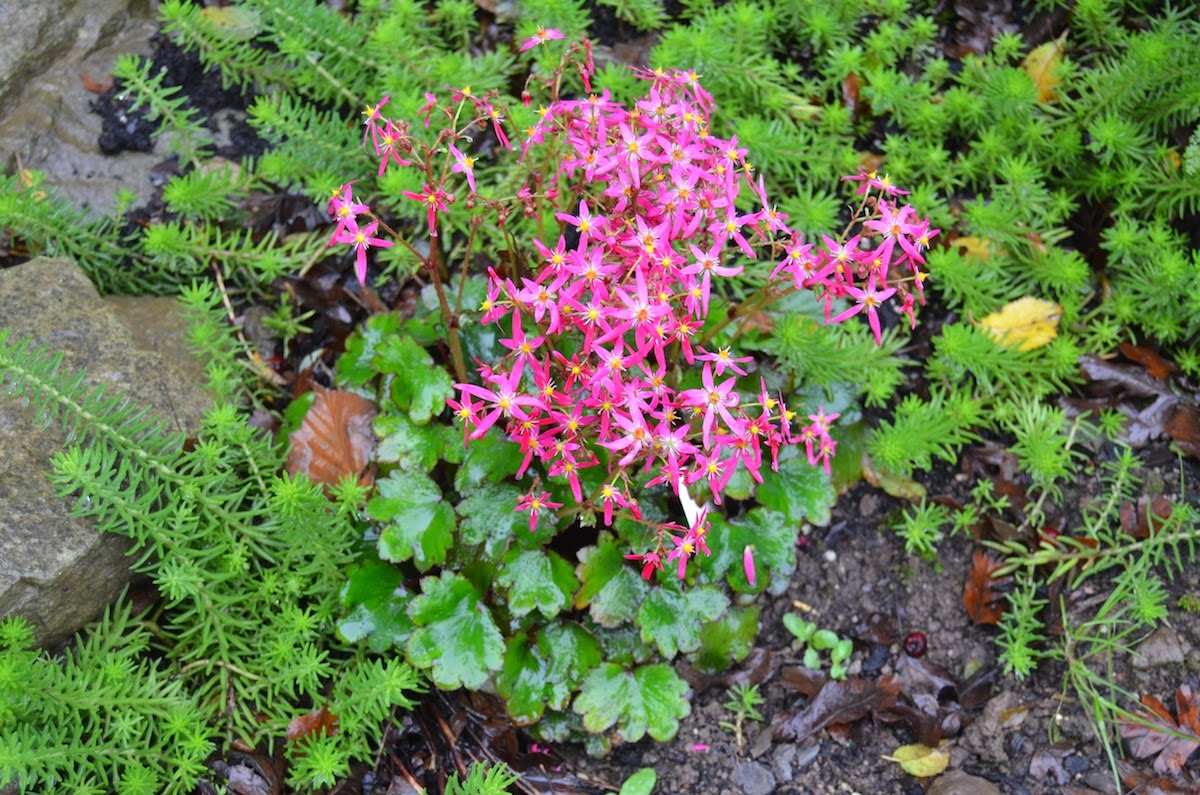
Saxifraga fortunei Sugar Plum Fairy - these late woodland Saxifrages are so good at the very end of the season, I see a great future for them.


Wednesday, October 23, 2013

Courson - c'est magnifique!


That woman's scarves, the jacket, the style!
Just been to Courson for the first time ever.
I first heard about this French garden show years ago, when I had my own nursery, and by all accounts it was very good. Since then, I hear nothing but good things about it – indeed 'Courson' is nearly always accompanied by the word 'wonderful'.

I got an invitation to lecture there at the weekend, so finally went. It is indeed wonderful, in fact so wonderful and I ask myself why I hadn't been before. Only so many hours in the day, days in the week etc plus the fact that years ago I made the decision that since so many of my colleagues went to often to France (part of that British middle-class love affair with France) I would leave them to it, and concentrate on the garden developments in the much less trendy Holland and Germany. Which I have no regrets doing, but time perhaps to spread my net a little more widely.

Ways of displaying asters

When I had the nursery (late 1980s) I did indeed make several plant-buying trips to France. I had the impression of a country which was just getting interested in plant-orientated gardening. Now I would say re-interested. Historically, France always led the way in fruit and vegetable production – absolutely no contest. In the late 19th century at the time that British gardeners were in the middle of the golden age of Victorian gardening, French growers were also extremely active. To be fair, it may be that they were even more active.

In the late 19th, British gardeners were still very focused on exotica and summer bedding, but about to make a shift to the great era of plant hunting. The latter brought in many trees and shrubs but arguably benefited large gardeners on acid soils more than anybody else. The French focus remained much more on garden plants. One man, Victor Lemoine of Nancy, bred a stupendous number of garden plants. No-one seems to have written a biography of him, which is a shame, as he was extraordinarily productive (I have written a little in Hybrid). During the 20thcentury I get the impression that French gardening went into a bit of a slump by comparison. British gardening did too, but by the 1960s Adrian Bloom, Beth Chatto and a few others were doing their best to liven things up. French interest seemed to lag behind.
Its not often now I really lust after a plant, but Salvia regla was just amazing. None left :(  From Fleurs et Senteurs of Brittany

Since the 1980s however there has been an explosion of new nurseries, plantsman-gardeners and interesting gardens. Indeed, walking around the nursery stands of Courson and reading through the accompanying catalogue, I almost feel like saying that perhaps there are now more interesting nurseries selling interesting plants than at home.
This year's theme was 'wind' and there were some interesting diagrams about the way various winds affect different parts of France. Never seen anything like that for the UK
 The lovely thing about Courson, is that the nurseries who go to sell plants are expected to make a real effort with their stands. Many do, and the results are beautiful, their asters, salvias and autumn leaf colour plants contrast with the greens and emerging reds of the trees of the expansive and lovely Domaine de Courson. Some, mostly Dutch and Flemish, seem to just bang out crates of plants in a utilitarian way though. Most exhibitors though seemd to get a real pleasure out of designing their stands. One Flemish 'plant supermarket' nursery however had a fantastic array of very unusual shrub and trees, in 9cm pots at around 5 euros – grow them on for a year or two and plant out. Since we'd normally expect to pay four or five times this amount for a plant in a two or three litre pot, this struck me as a very good way of selling plants. British nurseries, with their currently woeful selection of woody plants, please note.

On the Barbour stand for that must-have British fashion
Courson is a great place for people watching, many of them, needless to say, wonderfully stylishly dressed. French garden people look a very anglophile lot: nice cords, Barbour jackets and those leather knee-high boots that no working gardener could possibly afford. Good food too of course, and a nice librarie. Talking of which, there is now a garden bookshop right next to the Place de Concorde at the western end of the Tuileries – a sure sign that gardening in France is now very fashionable. When can I come back?

Great idea for a green wall unit from Citéflor
The chateau itself, many wonderful trees in the park. Our room was the one on the right.


Tuesday, October 15, 2013

Ireland - gardening climate and culture


Helen Dillon's exuberant garden in its current cheerful incarnation

A brief trip over to Ireland to run a workshop for the Garden Landscape and Design Association. A good bunch, lively, friendly and asking good questions. I always feel vaguely ashamed I don't come over to Ireland more often, given that it is so close – its always brief work-orientated trips. There are some very good gardens here and the place is famous for gardens, but there are not actually many of them, and they are not really part of the culture – and that raises some interesting questions. It is a fantastic gardening climate: mild winters and cool summers, so it is possible to mix and match an extraordinary range of flora. Except that this is not San Francisco, every now and again there is a cold winter. This summer was the sunniest and warmest in 70 years but often the summers are very cool, “too cool for barbecues and not enough sun to make goldenrod flower” someone complained on my previous trip. Generally though, a lot of Southern Hemisphere plants, New Zealand and Chilean, do incredibly well.

This trip was a great opportunity to catch up with the new generation of gardens in the Dublin area and down the east coast. I say 'new generation' because the gardens that established the country's reputation for lush gardens were generally made a long time ago, often late 19th or early 20thcentury, by the Anglo-Irish landowning class, so they were on the grand scale; everyone else just grew potatoes. Ireland looks so much like England, you often have to do a double-take that it isn't. The history however is so utterly different, and anyone who doesn't realise this is travelling blindfold – and far too comfortably. And there is the fatal British (and more specifically English) misunderstanding that because everyone talks English there must be a common culture. Er, no.
Dahlia Admiral Rawlings and Salvia Phyllis's Fancy at Carmel Duigan's garden in Shankhill, Dublin
A part of traditional English (and I mean English here, not British) self-centredness is the belief that everyone with a half-decent gardening climate gardens, and that if they don't there's something wrong with them, a sign of foreign irrationality - “why don't they garden?” I remember my father asking of the French/Swiss/Italians (my parents, BTW, would never have dreamt of setting foot in Ireland). Historically, most places - everywhere, gardened only to grow veg, fruit and herbs – flowers were a luxury for the elite (and in the British Isles, that generally meant the English elite). England, and the Netherlands, are pretty special in that those outside the elite started flower and ornamental gardening a few centuries back, in a very small way, but enough to start a widespread gardening culture. Wealth, and with it, the opportunity to garden got distributed pretty early. In Scotland, despite the ethnic cleansing which the country shared with parts of Ireland and Wales, a similar thing happened – the Scots had their own elite who soon learnt enough English ways to pass, including gardening, and it got passed on.
Autumn colours at The Bay
The same did not happen in Wales or Ireland, “why don't the Welsh garden?” is another English whinge, often following on from some moan about bilingual signposts. The elite here were essentially English, i.e. ethnically different, and one thing you don't do if you are a near-starving rural dweller on a tiny patch of land between the gorse bushes is copy your colonial masters, particularly if their foibles include pointless activities like growing things you can't eat (or indeed hunting animals you can't eat). So, the historic great gardens of Ireland were made by an Anglo-Irish (and Protestant) ruling class, many of whom found themselves being burnt out of house and home by Sinn Fein in the independence struggle. The gardens wouldn't burn however, so they generally were left alone to get covered in laurels, rhododendrons and sycamore.
Grasses linking with the landscape at The Bay
Sitting down to tea and raspberries and cream with Helen Dillon on Sunday was a far cry from my first visit to Ireland, many many years ago, staying in a squat in Belfast with a group of friends, one of whom was later jailed for running an IRA arms dump. With Helen, the subject of historical divisions soon arose, as she told me about when she first came to Dublin (42 years ago) “there were lunches, which were definitely Protestant lunches, and when people found out I was a gardener they would give me plants, but on the understanding that I wouldn't give them away, they didn't want the Catholics (i.e. the native Irish) to have them”.

So, by “new generation of Irish gardens” what I actually mean is gardens made by the locals, although there are also some good gardens made by “blow-ins” as I gather immigrant Europeans are called. Some of these gardens are fantastic, but a casual peering over the garden gates shows that it hasn't really sunk into the culture yet. For lovers of good, bold, exotic, looking foliage, this is heaven. Carmel Duignan's garden in Dublin includes so many of those wonderful Araliaceae (ivy family) species which we, with just a few degrees of frost more, cannot grow. So, plenty of really good leafy structure for perennials, grasses and ordinary shrubs, and at this time of year, dahlias, and South American salvias. The salvias are another group which we struggle with at home, unless you are committed to treating them as half hardy, but here they just grow. Their colours are intense and there is a huge range of species, and a great range within species or groups of cultivars.
Love those pink chairs, Jimi Blake's Huntingbrook garden.

Helen Dillon's garden was as electric as her personality with dahlias and salvias, although a big re-think was clearly going on. I suspect this is a garden that gets a lot of re-thinking. There were numerous gaps where it looked like she was going to replant, but a basic structure of some wonderful foliage and structure plants, including what were to be one of the theme plants of the weekend – Aralia. Aralia itself however, unlike the southern hemisphere members of the family, are hardy, so plenty of ideas for using this dramatic, leafy, highly distinctive, but occasionally viciously spiny, genus. “I'm giving up colour theme gardening” announced Helen, “I'm going for the box of smarties approach”. From the drawing room, where you get a spectacular view over the garden, this looked like it was just that, but down at ground level, as I went around photographing plant combinations, it looked like so many were actually very cleverly balanced.

More aralias in Jimi Blake's garden - Huntingbrook, where the drive has a whole forest of A. echinocaulis, whose seed he collected in China; they cast little shade so he can grow masses of perennials beneath them. Just at the end of its season, this garden still had plenty of late colour from dahlias, salvias and lobelias, and some wonderfully frothy persicarias as did his sister June's at the bottom of the hill, where coppiced Paulownia tomentosa made a backbone for a very varied range of perennials. June's garden is a good, and actually quite rare example, of a garden which combines a lot of quite formal contemporary hard structure with exuberant planting. In fact I think it is exceptionally skillful.
Pinus montezumae, a Mexican species, at Mount Usher and the biggest eucalyptus i have ever seen.
More contemporary planting at The BayGarden, where an area of very simple planting of various grasses and late-flowering perennials looks out over the surrounding landscape, the grasses a good link to the farmed wild, the repetition of a limited number of late perennials made for an effective, and probably quite low-maintenance mix. Otherwise this is largely a spring and early summer garden.
The house at Kilmacurragh, one of many ruined memories of a class system swept away by independence, but one day a visitor centre?
So, what about the 'old' gardens. Many were lost or got overgrown, but some which have survived have matured into very rich collections of plants: trees and shrubs in particular which have benefited from Ireland's soft climate. Mount Usher, an upscale shopping mall and over-priced café with a nice garden attached is one such example; a shame that the profits from the shops couldn't pay for a bit more thinning out and above all some decent labelling. Another is Kilmacarragh, where the curator, Seamus O'Brien took me on a whirlwind tour. This vast estate, with a long and complex history, was allowed to become almost completely overgrown during the 20th century, with its house becoming a ruin in the 1980s; parts were sold off to local farmers who promptly set about felling trees, while the forestry board still hang on to other areas. “Its like Heligan” says Seamus. A lot better, I would add. An extraordinary heritage of trees, many of them South American, or Chinese in origin, many very rare in cultivation, can be found here, often enormous. It is the most unbelievable botanic treasure trove. Seamus reports that funding is pretty good and under the wing of the National Botanic Gardens, continued restoration, development and even buying back lost acres, is proceeding. His must be one of the nicest jobs in the garden world right now.
Cordyline indivisa
Garden design is clearly a lively profession here, although the glory days of the 'Celtic Tiger' will not come back. On my last visit here, three years ago, several garden designers I met reported how they had been making money hand over fist from clients, who just wanted a garden, no questions asked, and who signed cheques with abandon. There was no doubt a bit of a generation of 'bling' gardens, with a lot of Italian-import semi-mature trees (many of which can still be seen languishing in landscape projects in Dublin's outer suburbs, still the same size as when they went in) and hardy exotics. Today there are horror stories of gardens in central Ireland which caught a cold winter particularly badly where practically the whole garden died.
The very stylish June Blake garden, with aralias from brother Jimi
After some tumultuous years, the future of the Irish garden looks good, with some very high quality gardens and world-class gardeners, there is plenty to inspire and learn from. This applies as much to British gardeners as much as Irish ones. Time to travel over more often?

My last sight of Ireland as i left the ever-so-swish Dublin airport where I ate possibly the best meal I have ever eaten at an airport, I spotted a sales display of singing leprechauns. Glad to know that the old values still hold. I feared Ireland might have fallen victim to too much good taste.
Grasses and lobelias at Huntingbrook


Thursday, October 10, 2013

Powis Castle garden revisited


A lot of people in the garden world list Powis Castle as their favourite garden. I have at times. I went several times many years ago (like - a long time ago!) but then although it isn't that far I haven't been for ages. Having hugely enjoyed it, I know I shall be going back more. It really is very special. It's that location for one thing, that huge drop down, the view, the horticultural extravagance on one level after another. It's also one of those gardens that makes you feel like you are in a separate, self-contained world where everything is a little more perfect than reality.

What always made Powis special was always the half-hardy stuff, always pushing the boat out as to what would work. Jimmy Hancock started all this playing with hardiness zones. He was the previous head gardener, retiring in 1996  And he got a obit in the Times too. He was one of the National Trust's great head gardeners, always fun to talk to, as he was so full of ideas and knowledge. He obviously had a rather combative relationship with Graham Stuart Thomas, the Trust's Gardens Advisor for many crucial years (1955-75) and by all accounts, rather full of himself. I remember Jimmy telling me some stories of Thomas turning up and telling him what he could do and not do. Jimmy had no time for his advice, which he dismissed as irrelevant, pointing out the climatic differences between the south-east of England (Thomas's natural habitat) and the Welsh borders.
Although Powis is a great garden, full stop, it is the half-hardy planting which has always been the high point. Jimmy's work had been continued and built on superbly by the current team, headed by Gardens Operations Manager David Swanton. The top slope is now a towering border of half-hardies, almost hardies and hardies which look like not-hardies. It is a triumph.

Reproductions of old photographs are dotted around showing you what the garden was like at various points in the twentieth century. Emptier of plants for the most part.


The pots here are fantastic, some of the best filled containers I've seen, exuberant, exotic and using a huge range of plant material.

One of the things which gives Powis its really special atmosphere is the sense of antiquity which oozes out of the stone walls, the statues and these extraordinary overgrown yew topiaries. We were slightly of the attitude that they looked a bit too much like obese flesh, and perhaps in need of a little restorative pruning.
The 'ordinary' i.e. not full of half-hardies, borders are pretty spectacular too, but very old-fashioned. There is a great deal of traditional support given with canes and twine which must take up a lot of time, and for some plants, like Knautia macedonica just does not work, which led to much thinking on my part as to how I might do things differently, as the frame of a traditional border is very tight.  I'd forgotten just how wide a range of plants there are here, very much with a late summer focus.


Some of the border plantings are contained within box low box hedges, which is a traditional way, and looks distinctly odd now, makes it look like all those dangerous perennials have to be kept in a cage. Mostly however they spill out over the paths - that was probably quite daring back in the day.

This is one of those places that combines innovation (primarily the half-hardies) with traditional skills. Unlike in Graham Stuart Thomas's day, the garden staff here have plenty of autonomy. It always used to be said that the NT used to make every garden look the same. I was never sure about this, but it certainly is not true now, as there is apparently very little central direction. For new ideas it can only be good, and it was new ideas that put Powis Castle on the map and made it such a favourite.

Monday, September 30, 2013

James van Sweden - a memoir


James van Sweden, who has died at 78, after a long illness, will be remembered as one of the great revolutionaries in the landscapeworld. With his long-time business partner, the late Wolfgang Oehme he turned the tide (or perhaps I should say began to turn the tide) of one of the worst aspects of the American landscape - the tyranny of the lawn. He was one of the most creative minds in the landscape business, incredibly influential, a true visionary. He was also great fun, and a lovely guy.
Jim was not a gardener though, but an architect by training. His plant knowledge was not great, and he never really grew anything himself. But he had realised early on in his career that he was, as he told me once "more interested in the spaces between buildings and around them than the buildings themselves". What changed everything was his meeting Wolfgang Oehme, the nerdy, awkward, brilliant, maddening plantsman and garden designer. Together they formed an extraordinarily successful partnership. Neither could have achieved anything much without the other, and yet they could not have been more different. Wolfgang was simply the worst lecturer anyone had ever heard, while Jim was the consummate people person, to our European eyes, the classic American - confident, expansive, charming. His professional genius was to see the potential of Wolfgang's plant knowledge (gained in Germany from where had emigrated in the 1950s) and how that would fit into American suburban and urban landscapes.
Jim was a good businessman, he invested in property, he bought good art, and sold them both when necessary. Without his business skills he and "Wolfie" would have still be humping plants and paving slabs out of the back of a VW station wagon like in a wonderful old picture of them both in their hippy gear taken way back in the early days. Wolfgang's complete lack of business acumen eroded their relationship in the later years, but Jim always kept it in perspective, and managed to laugh off Wolfgang's increasingly eccentric behaviour.
 The two men got their big break with the garden of the Federal Reserve Bank in 1978. It is one of the great stories of landscape planting and deserves retelling in some detail. Chairman David Lilly knew their work from a colleagues' garden Wolfgang had designed. Staff however were horrified - they were expecting the usual crap that passed for landscaping and civilisation in 1970s USA - mown grass and evergreen shrubs. What they got were lots of big grasses and drifts of flowering perennials. The Indians or the hippies or something were clearly on the war path. Jim always said to me that he had learnt to love grasses because he had been brought up in Grand Rapids on the edge of the prairies and remembered as a kid the remnants of the wild landscape running along the edge of the railroad.
Never afraid of facing his public, Jim (probably with Wolfgang in tow rather than in the lead) made a presentation to the staff, explaining about the plants and why they had used them. Grudgingly they were accepted, and as they grew, they became acclaimed and loved, with FRB staff realising that their office looked distinctively different and therefore distinctively better than all the other boring mown to death grassscapes of DC. So, the New American Romantic Garden was born! Soon, everyone in the DC area started to see the beauty of grasses and perennials and realise the potential of these plants to create something new and distinctive, alive and seasonal in the American urban landscape.
Over the next decade Jim and Wolfgang began to make big changes around DC. Wolfgang tested plants to destruction in his chaotic garden. Only the boldest and the bravest and the deer-proofest made out onto the street. It was a limited range, but in 1970s and 19802 Washington, Rudbeckia 'Goldsturm' and Sedum spectabile were revolutionary material. It was a good way to start using plants in a plant-cautious place. Wolfgang had that wonderful German ability to make things work technically. Jim had, he liked to say from his Dutch ancestry, an artistic vision. He made everything work aesthetically. Although he helped the birth of a new consciousness in planting, he coudn't take untidy plantsman gardens - I remember on the Horticulture magazine tour when we first met, we visited Sean Hogan's garden in Portland, and mid-visit, noticing he was not there, I went to find him; he was standing alone in the rain on the other side of the road - "I can't stand this mess" he hissed.
While it was the public plantings that got the limelight, it was the private garden clients who enabled the two to really refine their style. Initially they got a lot of the liberal art collector crowd; the tribe of people who are the heart of the forward-looking and globally-aware community who are behind so much of what is good and progressive in the country. I got to visit several of them in the late 1990s researching stories for garden magazines - without them there would have been no landscape revolution. Jim got quality landscape and garden design out there - his hardscaping and landforming a foil for Wolfgang's planting. The Oehme and van Sweden look began to make waves. Just last week Roy Diblik, a pioneer of containerised native plant production in Wisconsin, was telling me that it was their work which began to change attitudes to perennials in the Midwest. Almost the whole perennial-growing world owe these men an immense debt.

Jim was a fantastic guy, with a great sense of humour and joie de vivre. I met up with him around a dozen times and stayed at his house on Chesapeake Bay or in Georgetown. We had first met in somewhat trying circumstances - and as so often when people meet at a time when things are less than ideal, every time we met conversation would return to that awful evening and we would laugh ourselves hoarse. It concerns the late Rosemary Verey. I had been invited by Horticulture magazine to be part of a lecture tour across the US, with a number of colleagues, four of us in all, one of them Jim. I had heard he was visiting England about a month before the tour, so I contacted him, and he suggested that I join him at Rosemary's Barnsley House. "Typical" I thought, "invite a near stranger to someone else's house, no Brit would do that". I phoned Rosemary to check this was ok, and yes it was. Arriving, I realised that all was not well, as she was clearly very drunk. Rosemary then proceeded to be as rude, as patronising as offensive to me as possible; quite honestly it was simply one of the worst experiences of my professional life. This was normal for Rosemary; in the garden at Barnsley she was very generous with her time with visitors; but she was also a notorious drunk and noted for her abusive behaviour to staff and colleagues. "Rosemary" I can still hear Jim admonishing her; I can also remember the acute embarrassment he was feeling - it was so palpable. He and his companion had clearly decided to take control of the evening, finishing off cooking and serving, Rosemary being completely incapable of anything other than rambling more or less incoherently, letting slip incidentally that she was spending Christmas with Ross Perot (yes really). So, when we met, Jim and I would laugh about many things, but that dreadful evening in particular, we had to relive it every time.
 Jim loved to talk about Japan, which had clearly made a huge impact on him. Not that his work was in any sense Japanese in style, but he had got something deeper from the experience, a sense of proportion, honesty to materials and the feeling that Oehme van Sweden designs were, to use that ungainly German word, Gesamstkunstwerk - holistic and consistent and thought through all of a piece (you see the English is even more ungainly). Not that I wish to lower the tone, but there was a story about a sexual encounter with a monk in a Zen monastery which he liked to tell as well. For him, there was nothing sordid about the encounter, it was all part of the same rich authentic experience. Japanese food was a great love too - we always seemed to eat Japanese when I came to town.
I count myself lucky to have seen the site of Jim's house on Chesapeake Bay before it was built, when it was just a patch of overgrown soyabean field on the flat shores of the flat water of one of the most minimalist landscapes I have seen. Native plant expert Darrel Morrison helped him integrate Wolfgang's plant selections into the wild flora, and his friend the architect Suman Sorg designed a house, in a style he liked to describe as 'unresolved' - unfinished, raw, open to suggestion. Later, when it was built, complemented by its almost wild but not quite garden I remember visiting and watching ospreys feed their chicks on a nest in a tree down by the water.
Jim was not an Anglophile (thank god, and do not mention Downton Abbey in my presence) but the idea of an Englishman driving him unsettled him, as if I might suddenly, somehow atavistically swerve his Mercedes onto the wrong side of the road. Several times I drove him out to the country, and he would always at some stage start singing "drive on the right, drive on the right, pray to Jeeesus". He always wanted to get a commission in England though, somehow it would set the seal on his career as garden maker not just as an architect in the landscape – now it turns out the practice have got a commission – the American Museum in Bath. I am sorry to say I have not seen him for several years, as my travels in the US seem to have been less frequent, so I did not get a chance to tell him how 'prairie' has recently become a buzzword in British gardening circles. He would have enjoyed the irony.