Monday, January 13, 2014

A window into the past

A friend gave me this for Christmas, a little book published in 1955, which includes a whole year's worth of a cartoon strip from the 1950s from The Sunday Express. The strip illustrates gardening operations for the week using this character - Adam, who must have been based on a real person I suspect.

 Adam, with the same set lugubrious expression on his face, unsmiling, sets about showing Express readers what to do. A lot is pretty advanced stuff, unthinkably so for a popular information sources on gardening today. On one page there is some material on grafting, going over crown, cleft, saddle and tongue. There is even a reference to grafting cacti!

Some of it leaves me with the feeling that there is nothing new under the sun. There are references to using herbs to keep insects away from other plants (saves having to douse them in DDT), to growing dandelions as a spring salad, and for using marigold flowers in salads.

Express newspapers sold to the middle class and aspirational working class, i.e. people who could not afford a gardeners - unlike a lot of the folk who took The Times and The Daily Telegraph. Or the Observer, where the aristocratic Vita Sackville-West would boom on, her readers perhaps arranging a few pots, for their weekly help to actually plant. This is serious skills-based, craft gardening. It makes me think about just how many skills we have actually lost - an enormous amount of knowledge which once would have been much more widespread. So there are things we can learn from here. I liked the tip about digging up parsley roots in autumn and growing them on in pots in the greenhouse as a winter herb. There is far more knowledge here than you'd get from the bunch of dilettante lightweight presenters who currently grace our TV screens, or write columns for newspapers. There is no dumbing down; no fear of things being difficult.

There is some additional material at the back, which does include some design stuff, such as this b/w rendition of the colour wheel.
And some borders which show what aspirational gardeners might be making. By 1955 wartime rationing would have ended 3 years ago, so the food situation would have been getting better, and a lot of people would have been giving up their vegetable plots and wanting to make ornamental gardens again. The model is very much Arts and Crafts.

This looks so basic by today's standards. Plant availability was pretty low - something I shall be touching on in a future post.

The 1950s was the high point of the chemical warfare approach to gardening. Notice the reference to 'the safe insecticide' - organochlorines like DDT were safe, compared to a lot of the mercury and arsenic based compounds that had been used before! In one strip Adam recommends using mercuric chloride as a wormkiller - apparently people didn't like worm casts ruining their velvety lawns! Another horror was a technique to encourage fruit trees to grow, by ring barking them on one side and painting with lead paint!

In some ways at least we have gotten wiser.

Monday, December 23, 2013

How green is our winter


The tents of an invading army of Hobbits? The emergency accommodation put up to welcome the army of Romanian guest-workers our idiot government are trying to convince us are about to descend?
No, the leaves of Gunnera manicata all heaped up by Wisley staff to protect the crowns. Just in case we have a hard winter.

I was down at the RHS garden in Surrey last week to do some work in the library and had a quick look around the garden. So far we have hardly had temperatures below freezing, and I have never known trees hang on to their leaves so close to Christmas. It really feels like a phoney winter.

The inner part of the seed cases of Lunaria rediviva. One of the best seedhead plants.


Fruit - mini-apples, on Malus hupehensis. Berries/fruit and seedheads are the classic elements of the early winter garden, now joined of course by seedheads and grasses. This stroll around Wisley however is a reminder of how green winter can be, especially if temperatures do not dip too much.  A good opportunity to reflect on just what sort of a climate we have and how that impacts on plant selection. You see, for some time, I have realised the rather counter-intuitive notion that we have more in common with a Mediterranean climate than a continental one even though most of our garden plants are from regions with the latter climate. Mediterranean winters are cool and wet, a bit like ours are a lot of the time, even before the current run of mild winters started in the 1980s. We can have the luxury of green foliage for quite a lot of our winters as a result.

 Things like Acanthus mollis, Mediterranean perennials which make a great leafy show right now. The paradox is that many (all?) Mediterranean plants will make active growth at lower temperatures than those from continental climates - the risk of growth being zapped by hard frosts is low. A walk around a garden now can tell you a lot about what climate zones plants are from.

Blechnum chilense, a Chilean fern also used to mild winters. A great winter foliage plant if you can get away with it.

Geranium palmatum, from the Canaries. We can do well with these plants from the middle Atlantic Isles, with their moderate climates, not too cold or hot.


And a libertia - foliage still fresh and green - indeed evergreen in most winters. From Chile and New Zealand - again that moderate, equable, climate.

Looking a bit ropey, but not completly dormant, Gerananium macrorrhizum from the Balkans, an area which gets cold winters and a lot of snow but which sometimes has milder spells, so it helps being able to photosynthesise in warmer periods.


A nepeta (catmint), another genus with quite a few from the Mediterranean. We tend to think of plants from the Med as being not hardy, but much of the region gets occasional severe winters, especially the eastern part when cold air masses can come down from Russia and central Asia via Turkey.


Now, the borders which Piet Oudolf designed in 2000, looking fantastic right now, but hardly any green. These are plants from continental climates for the most part; for their own protection they have to totally shut down for the winter, and not come out of hibernation until temperatures are relatively warm which means all danger of frost is past. I find these grass, seedhead combinations incredibly beautiful, all the more so for their stark contrast to the amount of green elsewhere at this time of year in a garden like Wisley.

But what is this? Greenery amongst the not-anymore-Oudolf borders. Piet is no longer involved with overseeing these borders, which is a shame, as they do need a very particular kind of guidance -
certain people on the RHS General Council have expressed disatisfaction with the way things are maintained here too "they just don't seem to get it" she said. And new plants - such as Pennisetum macrourum, a South African species with nice heads but an aggressive spreader. Didn't anybody know that once this plant is in, it will run and run and completely blur whats left of the design? Good plant - wrong place. One of many South Africans that seem to be doing very well here, like the Diearamas that seed madly in my own garden.


Box and grasses - I think this was Anemanthele lessoniana - don't they look good together? Surprised you don't see this more often, very much the old and the new together. Again, box and most other evergreen broadleaves are part of that flora of 'Atlantic' Europe (actually we should include north-west Africa in here too) , plants of mildish winters, species of the western Mediterranean, hardy enough in normal circumstances but not so capable of taking the constant very cold winters of central Europe. Ivy is another one, the semi-evergreen bramble another.

Being aware of all this winter greenery gives me a strong sense of geographically where we are, on the fringe of Europe, with connections to all those other places our plants come from where winters are mild and occasions to grow (albeit fitfully) rather than hunker down and hibernate.

Having 'the holly and the ivy' is something of a luxury for us, living where we are. A green element in our gardens I wouldn't want to live without.

Sunday, December 1, 2013

Updates - EU legislation and Oudolf meadow


Two updates: one on the EU proposed legislation on plant cultivars, and the other on the perennial meadow at Hummelo.
Miscanthus 'Yaku-jima', in our garden last week, a good small miscanthus, but still growing a lot bigger than it does with many - that high level of phosphorus in the soil i suppose!

First, I've had detailed responses from two UK Members of the European Parliament, who are very well aware of this issue, and trying to change it. Thank you to Julie Girling and Anthea McIntyre.

I have also been in correspondence with Dutch nurseryman Coen Jansen who writes: Since the article in "The Garden" and yours in the newspaper, things are changing here too: after your article I received a mail from a rather worried Belgian nurserywoman, who had read your article, and she also asked her MP what is going on really. He answered that a lot of MP's are working on it, asking mainly for exceptions for small nurseries with a turnover under € 2 million a year, and/or for nurseries  employing less than 10 people.
Last week our horticultural magazine "De Boomkwekerij" -for the trade, not for the general gardening public- also picked it up... at last there seems to be something happening, one MEP i wrote to said she had had 200+ emails on the subject. We can hope for some common sense.”

Secondly, Piet Oudolf's meadow - the mystery deepens. Piet and Anja are back from their trip to visit their son and family in Ecuador, and Piet has corrected me on the soil below the wonderful perennial planting featured in my last posting. It is actually soil, NOT sand, some soil was actually imported to make up the ground here, although it looks very sandy and has a high sand content.

I have been comparing annual weather statistics between Arnhem and Hereford too, not much difference: Arnhem region has a more continental climate (i.e. warmer summer and colder winter) but there is not much in it, and they have quite a lot less rain, maybe 50% less, but still around 1000mm a year. The more continental the climate, the more that forbs (flowering perennials) are competitive vis a vis grasses.

The answer may still lie in the soil. This article here by Ken Thompsonpoints out the importance of phosphorus in determining wildflower diversity. I know we have a very high level of this plant nutrient, as indeed do many soils in Britain. Next time I go to Hummelo, a soil testing kit goes with me.

Wednesday, November 27, 2013

Perennial meadows - Piet pulls it off


Some time ago I did a post on growing perennials in grass, actually the second most read posting I have done. This is something of an unrealisable holy grail for many of us, the idea that you can have roughish grass with wildflowers and perennials growing in it. Our native grassland flora here in Britain and north-west Europe is very low on really bright ornamental species and there is so little that flowers after mid-summer. William Robinson suggested doing this in The Wild Garden, published in 1870, but he actually had very little experience of doing this when he wrote that book; in fact it was early in his career, and very much a rhetorical book rather than a practical one. It is a book which really does not deserve its reputation.

The tough reality is that in our maritime climate with its long growing season it is very difficult to get perennials established in grass. Most ornamental perennials originate from more continental climates and do not grow until temperatures reach a certain level; consequently they are dormant for the winter. Our native grasses and a few wildflower species like creeping buttercup grow at lower temperatures, which effectively means off and on through the entire winter. They inevitably take over so that any attempt at combining native grasses with ornamental perennials results in rough grass with steadily vanishing perennials. The only thing which can stop this happening is if they cannot get enough nutrients.

Three years ago, in April, I visited the Oudolfs (who live in the eastern Netherlands) on a radiantly sunny weekend. Piet was setting out a new planting, on the site of the old nursery sales area, where plants were lined out in pots. They had put down sand many years ago to provide good drainage and it was into the sand that some Calamagrostis 'Karl Foerster' and some perennials: heleniums, asters, eupatoriums, vernonias etc. were going. Piet told me he was going to sow the intermediate spaces with a wildflower seed mix i.e. mostly grass with a native forb element.


I must say I was a bit sceptical. If I tried this at home, the grass would run rampant and swamp everything. But - three growing seasons later, it looks fantastic. Really fantastic. Really super low-maintenance fantastic. Piet has pulled it off, again!


The perennials have all formed good clumps and flower well, although at a shorter height than they would do normally. The grass and wildflower mix has formed a dense sward but with a relatively low grass proportion. In fact a lot of it is yarrow (Achillea millefolium). It is very biodiverse - simply as a wildflower meadow it would be a great success.


The reason must be the sand. Despite many years of having nutrients washed into it from the container plants in the nursery, it must still be very too low in nitrogen and phosphorus for grasses to be able to dominate. The result is a true and very rarely seen balance between perennials, with their clearly defined growing season, and grasses and other wintergreen species, which can grow all year round.


It really is a triumph, and illustrates very beautifully and dramatically that we must not give up on trying to achieve perennial meadows. Substrate is clearly everything, which is good news for those on sand, or post-industrial waste! The rest of us, on the fertile and moisture-retentive soils which gardeners and farmers have traditionally regarded as desirable, if not essential, can only look on in admiration. Or buy several lorry loads of sand.
I am not sure of the sand depth here, my guess is probably 30cms  or so. This may be important; many perennials are able to get their roots down deeper than our native turf-forming grasses, which are very superficially rooted and are therefore unable to access deeper nutrient and moisture resources.

Another point on how to encourage perennials and forbs vis a vis grasses. I just saw James Hitchmough on a trip to Sheffield and he tells me that at the Olympic Park they had some marquees and other temporary structures covering ground over the winter. In the spring where the ground had been covered, the forbs grew very well, but much of the grass had died. Grasses have very little ability to store nutrients in their roots whereas most forbs do, and so they are at an advantage in this situation. Differential starvation. Mimicking, he says the effect of heavy winter snow, which is one reason why places like central European mountains and central Asia have such fantastic wildflowers and so little grass - so-called herb fields. Winter covers for wildflower meadows? Whole new market for geotextiles? Who knows. Try it and see.

More pictures here.


Friday, November 22, 2013

URGENT ACTION! The end of 95% of all nurseries?

I think the European Union is a good thing. It has promoted peace and prosperity for our continent for half a century. However it does have an intensely bureaucratic regulatory side however which can work against both prosperity and liberty. A good example is the insane set of regulations being currently proposed for ornamental plants.

You can read about it in the Telegraph here:

More information here from Plant Heritage, and a useful list of UK MEPs to write to. And more here from Plant Heritage, with MEP contacts for other countries.

It is very important that all of us who are EU citizens to act on this. And soon. There is only a week left for submissions.


Saturday, November 2, 2013

Mingling and mapping and autumn days

It feels a long time ago now (mid 90s) that I decided that the crucial issue in the planting design as an aesthetic issue was about mixing plants and getting away from block planting. The discussion is now very much  a live on, and Thomas Rainer has now pitched in with a piece in Thinking Gardens - to which I've made a response. You can read them both here.

Meanwhile back at the ranch autumn is setting in, in the slow backwards and forwards way that autumn does in these parts. Yellowing and falling alongside still vigorous blooming. Time for a growth assessment. I have some trial plots and other borders which I (rather irregularly) map to keep an eye on plant progress (or lack of it). Last week we had some colleagues come for a day workshop in the garden (two National Trust gardeners, a landscape architect, a garden designer and sky-diver trainer retraining as a garden designer). I got them all doing the evaluations on my research plots and doing some mapping of borders, all very basic plant ecology data collecting but almost never done in gardens. We had a good day amd everyone seemed to feel it was worthwhile. Perhaps I should make it a regular event.


This is a topological plan on an spreadsheet of the main border planting

Mapping a border using one metre squares. This one has a lot of filling up to do.
Autumn is such a great opportunity to get children looking at nature.

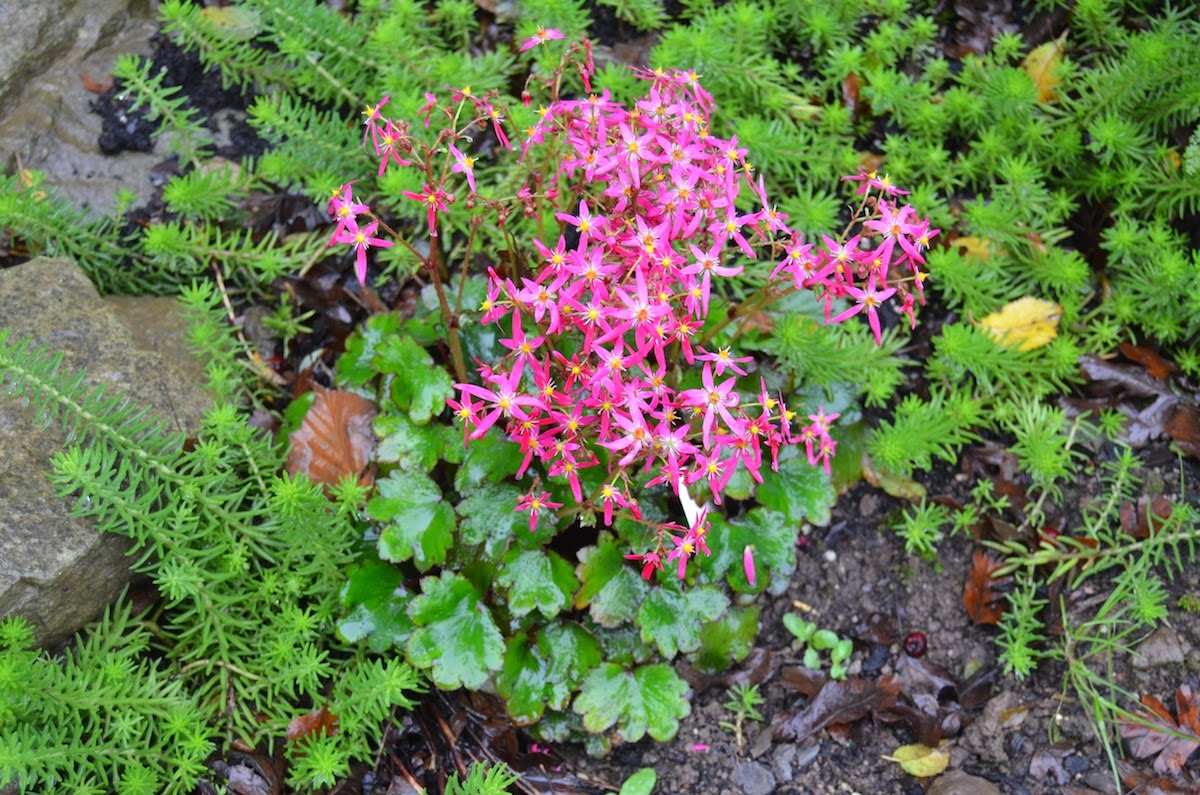
Saxifraga fortunei Sugar Plum Fairy - these late woodland Saxifrages are so good at the very end of the season, I see a great future for them.


Wednesday, October 23, 2013

Courson - c'est magnifique!


That woman's scarves, the jacket, the style!
Just been to Courson for the first time ever.
I first heard about this French garden show years ago, when I had my own nursery, and by all accounts it was very good. Since then, I hear nothing but good things about it – indeed 'Courson' is nearly always accompanied by the word 'wonderful'.

I got an invitation to lecture there at the weekend, so finally went. It is indeed wonderful, in fact so wonderful and I ask myself why I hadn't been before. Only so many hours in the day, days in the week etc plus the fact that years ago I made the decision that since so many of my colleagues went to often to France (part of that British middle-class love affair with France) I would leave them to it, and concentrate on the garden developments in the much less trendy Holland and Germany. Which I have no regrets doing, but time perhaps to spread my net a little more widely.

Ways of displaying asters

When I had the nursery (late 1980s) I did indeed make several plant-buying trips to France. I had the impression of a country which was just getting interested in plant-orientated gardening. Now I would say re-interested. Historically, France always led the way in fruit and vegetable production – absolutely no contest. In the late 19th century at the time that British gardeners were in the middle of the golden age of Victorian gardening, French growers were also extremely active. To be fair, it may be that they were even more active.

In the late 19th, British gardeners were still very focused on exotica and summer bedding, but about to make a shift to the great era of plant hunting. The latter brought in many trees and shrubs but arguably benefited large gardeners on acid soils more than anybody else. The French focus remained much more on garden plants. One man, Victor Lemoine of Nancy, bred a stupendous number of garden plants. No-one seems to have written a biography of him, which is a shame, as he was extraordinarily productive (I have written a little in Hybrid). During the 20thcentury I get the impression that French gardening went into a bit of a slump by comparison. British gardening did too, but by the 1960s Adrian Bloom, Beth Chatto and a few others were doing their best to liven things up. French interest seemed to lag behind.
Its not often now I really lust after a plant, but Salvia regla was just amazing. None left :(  From Fleurs et Senteurs of Brittany

Since the 1980s however there has been an explosion of new nurseries, plantsman-gardeners and interesting gardens. Indeed, walking around the nursery stands of Courson and reading through the accompanying catalogue, I almost feel like saying that perhaps there are now more interesting nurseries selling interesting plants than at home.
This year's theme was 'wind' and there were some interesting diagrams about the way various winds affect different parts of France. Never seen anything like that for the UK
 The lovely thing about Courson, is that the nurseries who go to sell plants are expected to make a real effort with their stands. Many do, and the results are beautiful, their asters, salvias and autumn leaf colour plants contrast with the greens and emerging reds of the trees of the expansive and lovely Domaine de Courson. Some, mostly Dutch and Flemish, seem to just bang out crates of plants in a utilitarian way though. Most exhibitors though seemd to get a real pleasure out of designing their stands. One Flemish 'plant supermarket' nursery however had a fantastic array of very unusual shrub and trees, in 9cm pots at around 5 euros – grow them on for a year or two and plant out. Since we'd normally expect to pay four or five times this amount for a plant in a two or three litre pot, this struck me as a very good way of selling plants. British nurseries, with their currently woeful selection of woody plants, please note.

On the Barbour stand for that must-have British fashion
Courson is a great place for people watching, many of them, needless to say, wonderfully stylishly dressed. French garden people look a very anglophile lot: nice cords, Barbour jackets and those leather knee-high boots that no working gardener could possibly afford. Good food too of course, and a nice librarie. Talking of which, there is now a garden bookshop right next to the Place de Concorde at the western end of the Tuileries – a sure sign that gardening in France is now very fashionable. When can I come back?

Great idea for a green wall unit from Citéflor
The chateau itself, many wonderful trees in the park. Our room was the one on the right.