Sunday, May 17, 2009

Some good nurseries

I haven’t bought many plants from nurseries for ages, but I’m now so aware of gaps in the planting in key areas around the house and the fact that so much of what has established is ‘tried and tested’, that it is time to try some new material.

Nurseries in Britain have got pretty boring of late. An explosion of small nurseries mostly selling perennials in the early noughties has meant that new and ‘ordinary’ gardeners now have lots of choice. Trouble is – they sell nearly all the same stuff and the plantsman gets increasingly frustrated in their search for the new and unusual. “They all sell the same plants because they buy them all from me” is the comment of one of the country’s leading supplier of small plants – in other words they are buying in, not propagating themselves.

Derry Watkins of Special Plants near Bath www.specialplants.net was, is and, inshallah, will continue to be a great source of the new and good. She still does a few plant sales, as much as to pounce on new plants from other nurseries, as much as to sell, I suspect. Walking around her sales area her transatlantic whoops and screams of enthusiasm about her new plant varieties makes customer heads turn. For example, she has a form of Ranunculus aconitifolius ‘Flore Pleno’ which she says, “doesn’t just die out, but is really vigorous”. Derry has always done a lot of tender/half-hardy species – and her range is just as lively as it always was. On the edge of a wonderful stretch of country too.

Kevock Garden Plants <www.kevockgarden.co.uk> I have not been to yet, but their plant selection online looks really good. Lots of stuff I’ve not seen before, and of course many which thrive in cooler northern climates. Particularly good on Himalayan primulas, with quite a few recent introductions. Can’t wait for a trip up to Edinburgh and get to see them.

Beeches Nursery in Essex www.beechesnursery.co.uk appears whenever you do an RHS Plant Finder search – their list is absolutely ginormous. But I have always been sceptical about how much of it they actually have, so on the way back from Stansted airport last week I dropped in. Still not sure about how much of their list is actually available on the nursery, but it is a huge selection and the site is nice and tidy, a pleasure to look around. I found a lot which was totally unfamiliar. Well-established plants too. From now on, every trip abroad via. the infamously inconvenient airport will include a visit here.

Blogged with the Flock Browser

Tuesday, April 14, 2009

Thoughts on visiting Suzhou, China


Looking around classical Chinese gardens in Suzhou has been utterly fascinating. They are so different to any other garden spaces I have seen. What I love about them is the way that the challenge the axial symmetry, the obsession with perpendicular geometry and the perspective-focus of the European and Islamic garden tradition. If you like the sound of established paradigms being ripped up, and accepted notions being trampled underfoot, you will love these gardens.

Enclosure is a key part of the visual appearance of the Suzhou ‘scholar’ gardens, most of which date to the Ming dynasty -1368 – 1644.
Many western visitors are put off by the sheer unfamiliarity, the passion for extravagant rockwork, and the apparent artificiality and contrivance of much garden design and structure; to say nothing of a lack of grounding in the basics of Chinese culture.


The ‘rockery’ in The Mountain Retreat Garden is so vast that it includes a cave halfway up.

In fact, I think these gardens have an enormous amount to teach us, which is not to say we should all start building little pavilions with upturned roofs and heaping up rocks. What we can learn is a lot more fundamental, in particular about spatial relations, which, given that more and more of us are living in places with only tiny garden areas, is actually jolly important. There are also important lessons for a more integrated garden-as-art practice, as classical Chinese garden making was part of a rounded artistic practice which also involved poetry, painting, and often music too. They were created by a highly cultivated scholar-bureaucrat class, for whom an appreciation of landscape was central to their artistic interests.
A pavilion in The Mountain Retreat Garden – such places might have served either individual contemplation or a more social artistic activity.

Gardens are dominated by buildings, but very light, almost ‘transparent’ ones: pavilions with lots of windows or openings, and covered walkways, which play a major role in guiding garden exploration and understanding.
A covered bridge in The Garden of the Humble Administrator


Examples of window openings, and one door in the walls of covered walkways. The windows appear to be made of stucco.


Buildings often offer highly complex multiple viewpoints – the effect is often breathtakingly clever, and very tantalising, as you don’t know which one of the several proffered vistas to go and see. Covered walkways physically guide the viewer, and control how different garden areas are seen, which often means that an area will be seen from several different angles. Since the same elements tend to be repeated, the multiple viewpoints and the multiple pathways from point to point often induce a feeling of mild disorientation – the visitor is brought into a dreamworld.

A series of vistas in the Xian Yuan, Mudu, showing how multiple glimpses of different parts of a garden are visible from one point, using door-openings, window-openings, and spaces between pillars in walkways. The following shot of a model of this part of this garden illustrates this non-perpendicular spatial complexity.
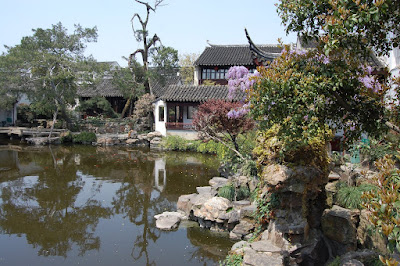


The above two pictures are in the Master of Fishing Nets Garden, and show the centrality of water to garden areas. Water is not necessarily the centre of the whole garden, but is often found at a the centre of discrete and definable garden areas - it serves to link different garden features and to provide a way of seeing across areas without interruption. In fact in many ways it serves a similar function to lawn in conventional western gardens - but a lawn you don't walk on!
Bridges are nearly always ‘staggered’ – in fact it seems to be a fundamental rule of garden-making that you never go directly from one point to another; the effect is to slow down progress, enhancing the illusion of greater space, and encouraging observation of the surroundings.

‘Dreamworld’ is a key to understanding Chinese gardens. Much Chinese landscape-related art is about encouraging the viewer to imagine themselves somewhere else – the classic landscape art of mountains, forest, lakes and little buildings is designed to make the viewer imagine themselves to be in the image. The garden, with its rockworks evoking the extravagant shapes of the various mountain ranges dotted around the country and fragrant vegetation, is designed as space to help the viewer be transported somewhere else.


The Chinese love of rocks is something which we simply do not share – but it is very important. Single specimens are regarded almost as if they were pets, or friends, endowed with personalities, or seen as almost spiritual entities. Fine rocks are even set on tailor-made wooden pedestals and used as ornament in the home; I saw specimens priced at =£5,000 in antique shops. Rocks may also be combined to make miniature landscapes; at one location in Suzhou (Tiger Hill) there are several dozen such examples. Planted up with ‘bonsai’-trained trees they become true living miniature landscapes.

Right - one of the largest individual specimen stones in a Suzhou garden, the Lingering Garden.


'Bonsai' originated here, and you can't help feeling that some Chinese feel a bit annoyed that we think of them as Japanese. But of course, the period during which bonsai became popular in the west is the period when all traditional arts in China were under sustained attack; Mao Zedong is known to have denounced the growing of potted plants as a sign of bourgeois ideas. Seeing all these magnificent, and no doubt very ancient, bonsai, does make you wonder how they survived the destruction of the Cultural Revolution period, when anything old was liable to be destroyed or vandalised.

The bonsai collection here is at Tiger Hill, Suzhou.
Right - there are also 'giant bonsai'.


Left - and substantial dry miniature landscapes.
Most dry mini landscapes are tray size though:


Planting – liriope rules!
Plant interest in the gardens is actually pretty low. It may well have been greater in the past, but nearly all these gardens have been changed extensively since they were created, and have undergone periods of neglect. Restoration has been meticulous, but with little attention to diverse planting – landscape and amenity planting in China tends to be extensive but uninteresting in the extreme.


What the Americans call ‘lily-turf’ – species of liriope and ophiopogon, are used extensively in public spaces as ground-cover, often to great effect. I’m certainly going to start exploring their use much more. I do not know if they were used originally in the Suzhou gardens – possibly not.
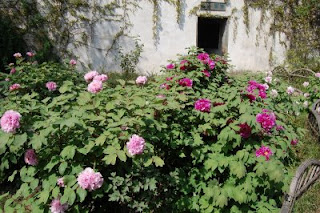
Peonies are the classic perennial for these gardens, but they were generally grown in separate dedicated beds.

Conclusion
I would argue that the complex sub-division of space and creation of micro-habitats in the Scholar gardens is ideal for creating interesting planting spaces, so the lack of interesting planting in these gardens is not to be held against them. The Suzhou-style garden in Portland, OR, shows how plantsmanship and Chinese design work very well together.

Thanks to travelling companions, my partner Jo and friend Yue Zhuang, who has been with us on her annual trip home and has been a brilliant guide. My photos are on flickr:

http://www.flickr.com/photos/36856545@N02/

IS IT ALL WILLOW PATTERN?

    This has taken a long time to post - all my efforts to blog in China didn't work. One can get paranoid about the 'Great Firewall of China'!
    I have always been  puzzled by Chinese gardens. We don’t have any in UK, but there are some very good ones in Germany, Switzerland and Portland OR – the latter built by craftspeople from Suzhou, the garden city of China with which the lovely Portland is twinned.
    The aesthetic is very unfamiliar, and we westerners are all too likely to be offended by the piles of rocks which we find grotesque. We also find it difficult to approach a lot of Oriental sensibilities because of an intervening layer of interpretation  which sees so many classic elements: bamboos, willow trees, pavilions, as clichés – it is as if Chinese people, on seeing a herbaceous border, an urn, or pergola draped in roses immediately think “chocolate box” and switch off. You do really have to learn to look – appreciating other culture’s aesthetics is actually quite hard work (don’t mention the Peking Opera!)
    What interests me about the Chinese  garden is its totally different aesthetic to ours, particularly in the way the gaze is directed, an aesthetic which I believe is very good at maximising the use of visual space in a confined area – making it immensely useful for urban plots. Forget all that classical axis stuff, this is about  complex multi-directional perspectives, ‘transparent’ buildings, peeks through windows, a strong sense of a circular journey, and a rapid change of view from the macro to the micro. Its all so much more fluid, more intimate, more poetic than I am used to.
    Today we visited the Garden of Harmonious Interests at the Summer Palace in Beijing which illustrates all this beautifully. It still felt like winter, but the bareness was good for appreciating basic structure – isn’t it always. There was very little interesting plantlife visible, or likely, given how trampled a lot of the ground was, but the fact that these intimate Chinese gardens are actually very good for displaying interesting plants is brought home strongly by the Portland garden, where all the planting was supervised by Sean Hogan, who is an obsessive a plantsman as it is possible to get.
    There’s a lot to learn here.

My pictures are on:
http://www.flickr.com/photos/36856545@N02/sets/72157616066377968/

There are also a lot of other good shots of this garden on Flikr too, taken by folks at other times of year.

Blogged with the Flock Browser

Thursday, March 19, 2009

Border Order

My very first blog (I think) was about a big new border at my new home. I had planted it in lines, one metre apart, basically as plants came out of the back of the van. I’ve moved plants around every year since, in particular to break up the obvious lines of the same thing, but I have kept the basic idea of the lines. It is only in the early spring that it is obvious that things are in lines – the rest of the year everything blurs in together.

Now, some three years later, the rows are still there, and I realise just how practical they are, but also a very good research and documentation tool. They make weed control easier, which is a great relief – you can hoe or spray off whatever comes up between the rows – allowing for some self-seeding and spreading.

In terms of documentation, the lines make for very easy recording – simply number each row with a low profile numbered peg, and then stretch a tape measure from the fence at the rear to note where everything is. The results can then be recorded on an Excel spreadsheet. In theory I’m going to redo this every year – in fact, this year, it didn’t take very long at all. Anything which self-seeds or spreads into the areas betweent the rows can be allowed to do so and recorded – a useful measure of spreading ability. I might also start planting some plugs of certain species as well in the gaps.

So, here is the ‘plan’ of a border which is still very much in the process of development.
The numbers along the top are metres from the fence at the rear (which is the left), indicated by the numbers of the rows, which also represent the number of metres from the other end (at the bottom). You can see in more detail by toggling the little rectangle symbol in the top right hand corner of the Scribd window.

I hope this makes sense! It took me a whole evening to work out how to turn an Excel file into something I could blog.


Big Border Data 2 Big Border Data 2 noelk57

Big Border Data 1 Big Border Data 1 noelk57

Sunday, March 8, 2009

Penelope Hobhouse at Vista.

    Penelope Hobhouse was our guest at Vista (London’s Garden Museum) last month. The podcast is now up on the Gardens Illustrated website:

http://www.gardensillustrated.com/podcast_vista.asp

    Penelope talked to us about her life and career, which has been a varied one. She has made several gardens (Hadspen and Bettescombe), written about colour, design, garden practice, garden history and Islamic gardens. The breadth of her knowledge and experience is huge, which makes her very interesting. She can also be irreverent and funny – which surprises people; just before we started she whispered to me that we should make some jokes to lighten the atmosphere up – I think Tim and I obliged, its remarkably how one can produce humour when the pressure is on. The Vista audience were a bit overawed – there is something about Penelope which pushes a “girl school headmistress” button in a lot of people which is shame, because she isn’t actually like that.
    The previous week I had spent a morning with her at her new home back at Hadspen, going over the ground for the Vista evening. So much of what she spoke about rather sent me off down memory lane – the height of her career was when I was just starting out running a nursery, doing some garden design and beginning  to write myself. Things have moved on so much though: garden history has had its moment (in Britain at least), and Americans are no longer interested in hanging on to every word from British gardeners (thank goodness). Penelope’s interest in the US garden scene in fact waned before they really declared independence though. Part of the reason for this is something I really warm to about Penelope, a distrust of clients with only money to spend – for her there has to be something deeper and more meaningful in garden making. From USA to Iran was an interesting change in loyalties, but the Islamic garden tradition (which is actually pre-Islamic) offers a spiritual/aesthetic exploration of space and a set of intellectual challenges.

Next month at Vista – James Hitchmough

Blogged with the Flock Browser

Sunday, March 1, 2009

On galanthophiles and perennials

A trip to Scotland to go to Cambo House, famous for its snowdrops, although I’m writing about the garden in September. The snowdrops are pretty spectacular, along with snowflakes (Leucojum vernum) and other woodland goodies. It feels like a pretty remote spot to me, but I guess there must be a lot of golf widows wending their way down from St. Andrews; and it’s only 1.5 hours from Edinburgh. The sales area, snowdrop gift shop etc. is all very understated and tastefully done.

Despite the reputation for snowdrops, I’m not sure Catherine Erskine of Cambo really wants to be known as a galanthophile. Over lunch she tells me about new varieties selling for what seem like absurd sums of money, then appearing on Ebay next year after having been split. And snowdrops from gardens disappearing. The truth is that any genetically varied population of snowdrops is going to show quite a lot of variation  in the flowers. BUT Brit snowdrops are genetically limited, as they are not natives, so we see little variation – any that does occur seems to cause a galanthophile rush. A colleague at the Ljubljana Botanic Garden did  a research project on wild populations in Slovenia – showing the level of variation. He should probably have split them all up and sold them to gullible galanthophiles over here for some easy research funding. Catherine’s opinion is that there is no point adding to the list of cultivars (apparently 1,000 and growing) unless something is really distinctive.

Meanwhile, the rest of the garden at Cambo.
Having been banging on about naturalistic planting for years (since about 1996 I reckon) I sometimes wonder just how much impact I, and other proponents of ecology-inspired planting have had. There is a terrible tendency for people to take things up in a very superficial way – plant a couple of miscanthus in their border and rename it a ‘prairie’ border. Wyevale garden centres are handing out a glossy leaflet which tells you how to plant up a prairie border too; it recommends planting in clumps. AAARRGH. They have clearly paid no attention.

So, pure joy to be at Cambo where head gardener Elliott Forsyth has clearly done his homework, and been to Germany to visit Westpark and Hermannshof, and is planting big borders with perennials and grasses, diffusing varieties through and trying lots of ways of combining and juxtaposing  varieties. His wife Sue is an artist, so he has been swotting up and putting into practice some art theory too. I long to see it all in summer, but winter was convincing enough, as they had left all the seedheads up for me to see. This spring a huge 90 species prairie is going in, with thousands of plants which have been grown from seed over the last year.
Wonderful that someone has been listening!
 
The article about Cambo will be in the September Gardens Illustrated.
Cambo House is open daily. www.camboestate.com

Blogged with the Flock Browser

A cue for Kew

    Quite a historic occasion at Kew last night. The first time in nearly a century that the directors of the Royal Botanic Gardens Kew and Edinburgh  and the Irish National Botanic Garden are on the same public platform – along with the director of the new Welsh botanic gardens. And I’m chairing it, along with Denis Murphy, Professor of Biotechnology at Glamorgan University. The format evolved out of the series of evening public conversations that Tim Richardson and myself have been having with figures in the garden world at the Garden Museum in Lambeth.
    I was nervous about the event, a bit beyond the safety zone. That inferiority complex that gardeners have about botanists and botanic gardens. Denis and I probed them on a number of issues, such as the possibly negative impact of the Convention on Bio-diversity on research and plant exploration, how the gardens relate their mission to the public, and how they see their mission conserving plants in the face of climate change. Two hours were hardly long enough. Everyone seemed to enjoy the event and find it interesting.
     The ‘Vista Debates’ at the Garden Museum are great fun, a bit like running a private dining club. We have an onstage discussion with a guest/s (last month it was Penelope Hobhouse), followed by a jolly good meal cooked in the museum kitchen – often quite adventurous cooking  - I shall never forget the delicious cardamom-flavoured polystyrene noodles we had on the first night we did. A lot of the success of the evening centres on the rapport Tim and I have with each other, coming as we do from different ends of the spectrum of what makes people interested in gardens. Lila Das Gupta on her blog recently called us the “John Bird and John Fortune” of the gardening world. 
    You too can listen on a podcast, generously hosted by Gardens Illustrated.
http://www.gardensillustrated.com/podcast.asp

www.gardensillustrated.com/podcast_vista.asp

Blogged with the Flock Browser