Showing posts with label herbaceous. Show all posts

Friday, July 23, 2010

Visionaries and ground elder


A visit to Waltham Place in Berkshire is a good opportunity to confront some of the dilemmas of the nature-inspired garden. Owner Strilli Oppenheimer employed the late Henk Gerritsen to help her ‘naturalise’ parts of the 1920s Percy Cane layout, all pergolas and walled and hedges and walled off garden rooms. Henk’s own ‘Priona Garden’ in eastern Holland had been her inspiration to get him over, as he was obviously good at gardening without making war on nature (although I don’t recall much food growing at Priona, I think it grew in the local supermarket where there was no nature to go to war with). Priona was wonderful for the balance between wildness and hedged and trimmed and mown order – a very Dutch balance, so it was right he should be involved at Waltham.
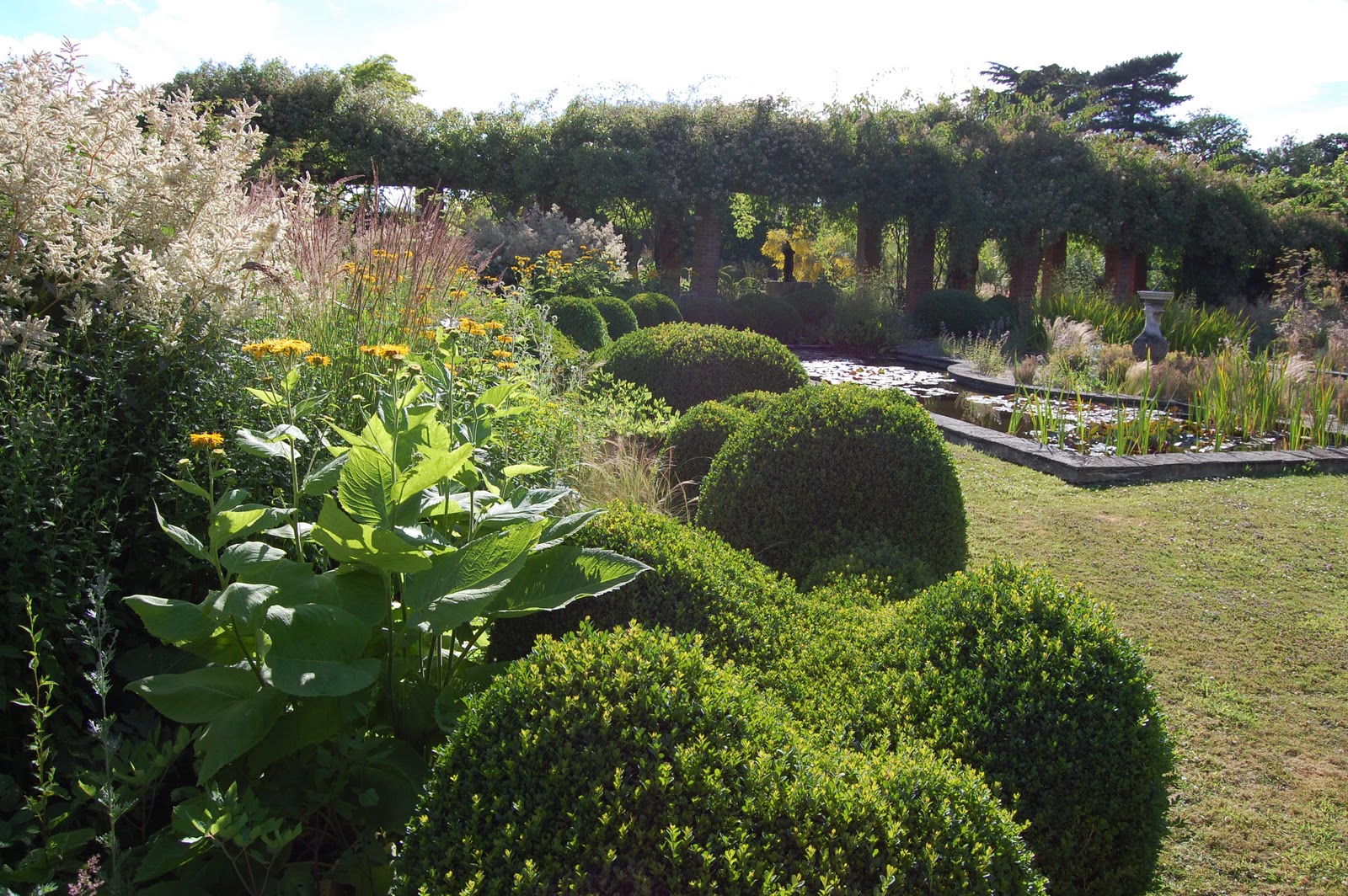


Ground-elder is a problem at Waltham, and since the garden staff cannot rid the garden of it using the bio-dynamic methods they are instructed to use (chemical warfare is actually little better either in my experience) the pragmatic decision has been taken to accept it. In one big courtyard area it is allowed in part (but heavily suppressed by lots of seriously big perennials) but kept from spreading by a cordon sanitaire of box, ingeniously Henk-clipped into a caterpillar shape – so much more fun than self-consciously trendy cloud pruning. In another garden it is allowed free-rein, but has to face vigorous perennials and so is too kept in check; earlier in June I think this is a very effective naturalistic perennial blend but by July it has gone over. A gravel garden is a riot of self-seeding, whilst the most successful part of the garden as far as I was concerned was an allee edged by walls, where shrubs and climbers had been allowed to spread just so, perennials to spread and intermingle and self-sow – the whole looks just so perfectly on the edge of tumbling into wildness. Head gardener Beatrice Krehl and her staff have managed to create a perfect embrace of the wild and the formal here.


Not all works, or has achieved such balance yet. A perfectly good terrace has been almost entirely lost to cistus and lavender and much other shrubbery in the final stages of the rangy senile decay to which many Mediterranean species seem to suffer, while a long border seems a long way from having a successful mix of species (nothing in flower in early July!). All in all, though, an immensely brave experiment in letting formality go to seed skillfully and gracefully.

Radical idea..... plant out some wildflowers in turf, maintain by "grazing like a cow" (Henk Gerritsen) - pulling up tufts of what you don't want and the add definition by deep edging between the wildy bits and the mown lawn.

Sunday, July 19, 2009

GREEN PORRIDGE


There is no getting away from the fact that it is difficult to photograph many wild-style plantings – like my garden. I sneak around with the camera and I always seem to end up with the yurt in the shot. It adds scale and a focal point. Without it, so much seems to be, well, green porridge. There is very little formal structure in the garden, and although there is a variety of foliage shape, texture etc. there clearly isn’t really enough to make obvious focal points, which photographs seem to need. And there aren’t great blobs of colour, as in many more conventional gardens.

The fact is that wilder gardens are very experiential – they need to be seen in three dimensions to be appreciated; the experience of actually being there is even more impossible to convey with a photograph than with a conventional garden. Which is frustrating as we have come to rely so heavily on photographs to convey our experience of gardens. Maybe video?

So many strongly structural plants look so gardenesque, or suburban, or exotic, by definition if you are trying to create a garden that fits into the Herefordshire (Wales/England borders) then so much of this stuff isn’t going to fit in. The ethos here is to create a garden which whilst very global in its plant origins belongs in a very unspoilt rural landscape. Things like Sanguisorba species or Telekia speciosa are consequently very useful for their ability to provide foliage structure/texture but not stand out like a sore thumb - or a Phormium in a hedgerow.

Sunday, March 1, 2009

On galanthophiles and perennials

A trip to Scotland to go to Cambo House, famous for its snowdrops, although I’m writing about the garden in September. The snowdrops are pretty spectacular, along with snowflakes (Leucojum vernum) and other woodland goodies. It feels like a pretty remote spot to me, but I guess there must be a lot of golf widows wending their way down from St. Andrews; and it’s only 1.5 hours from Edinburgh. The sales area, snowdrop gift shop etc. is all very understated and tastefully done.

Despite the reputation for snowdrops, I’m not sure Catherine Erskine of Cambo really wants to be known as a galanthophile. Over lunch she tells me about new varieties selling for what seem like absurd sums of money, then appearing on Ebay next year after having been split. And snowdrops from gardens disappearing. The truth is that any genetically varied population of snowdrops is going to show quite a lot of variation  in the flowers. BUT Brit snowdrops are genetically limited, as they are not natives, so we see little variation – any that does occur seems to cause a galanthophile rush. A colleague at the Ljubljana Botanic Garden did  a research project on wild populations in Slovenia – showing the level of variation. He should probably have split them all up and sold them to gullible galanthophiles over here for some easy research funding. Catherine’s opinion is that there is no point adding to the list of cultivars (apparently 1,000 and growing) unless something is really distinctive.

Meanwhile, the rest of the garden at Cambo.
Having been banging on about naturalistic planting for years (since about 1996 I reckon) I sometimes wonder just how much impact I, and other proponents of ecology-inspired planting have had. There is a terrible tendency for people to take things up in a very superficial way – plant a couple of miscanthus in their border and rename it a ‘prairie’ border. Wyevale garden centres are handing out a glossy leaflet which tells you how to plant up a prairie border too; it recommends planting in clumps. AAARRGH. They have clearly paid no attention.

So, pure joy to be at Cambo where head gardener Elliott Forsyth has clearly done his homework, and been to Germany to visit Westpark and Hermannshof, and is planting big borders with perennials and grasses, diffusing varieties through and trying lots of ways of combining and juxtaposing  varieties. His wife Sue is an artist, so he has been swotting up and putting into practice some art theory too. I long to see it all in summer, but winter was convincing enough, as they had left all the seedheads up for me to see. This spring a huge 90 species prairie is going in, with thousands of plants which have been grown from seed over the last year.
Wonderful that someone has been listening!
 
The article about Cambo will be in the September Gardens Illustrated.
Cambo House is open daily. www.camboestate.com

Blogged with the Flock Browser

Sunday, September 28, 2008

To stake or not to stake


Whether to stake or not? Or give it the Tracy Chop.
This is our so-called big border, with in the centre of the pic, the plant that everyone always asks about. It is a form of Eupatorium fistulosum, originally from North Carolina. It always grows to 3.4m every year and never blows over or flops - wonderful architectural plant. But the Sanguisorba tenuifolia to the left is embarassingly over - which it always does, and did in the last garden too. I have decided that it is one of those things for whom border conditions are simply too good, and it grows too well and cannot support its own weight. This winter I intend to dig it up and move into the meadow and see what happens; I assume competition will reduce its growth and height and it should stay upright.
The sanguisorba is probably not a candidate for the Tracy (DiSabato Aust) chop, as I think it would just produce lots of flower heads lower down and look a mess. The infamous flopper Campanula lactiflora however has done very well with a Tracy chop, bushing out and flowering for more than 2 months. But the rain will have helped.