Monday, September 20, 2010

Mob rule in Bexhill

It is not often I have to face a baying mob whilst planting. But I did last week in Bexhill – a small and quiet town on England’s south coast, one of those middle-middle places between the better known bohemian/down-at-hill Hastings and trendy Brighton. The town’s chief claim to fame is the De La Warr Pavilion, a superb early modernist building; it’s just had a refurb and of course it is now the surrounding landscape, including a section of seaside promenade which is getting some attention from the local council.

There has been local opposition – there probably has been a failure of community consultation (a mixed blessing at the best of time, see below), but you can’t help but feeling that there are a lot of folk here who just dislike any change - Bexhill does not feel like a go-ahead with-it kind of place. The planting in question was right behind the walkway that runs along the top of the beach – right in the teeth of salt-laden winds and spray. I’ve looked at a fair number of coastal gardens over the years, with varying aspects, and got a good feel for the tough wiry sorts of plants which survive, a lot of them Mediterranean sub-shrubs like lavenders and cistus and grasses. And I took advice from Naila Greene, a garden designer in Devon, whose garden is in a very similar location on the south coast – and is a superb mix of intermingled perennials and low-growing shrubs.

The Bexhill locals who gathered on the other side of the Harris fencing where we were setting the plants out maintained that nothing would survive here. I went out to meet “the local residents”; some of them were prepared to engage in a discussion about what would work and what wouldn’t, but one woman got into a total frenzy and started to shout at me about the whole development, with her gang adding in their halfpenny’s worth in the background.  She was just short of abusive. You end up feeling like a scapegoat for everything they don’t like about the new development, which by the way includes play areas, seating, shelters and shower points - scarily trendy stuff - replacing grass, a low wall and strips of annual bedding.

I suspect there could have been more ‘community consultation’. But this does cost a lot of money  to do properly – which means less to spend on the actual development, and you will never satisfy all ‘the community’. Besides which ‘the community’ have a variety of views, and many of these are conservative, unadventurous and driven by prejudice. I think many of us felt sympathy with the well-known garden designer at a Vista evening who declared “f*** the community”. If all landscape designers were led by ‘the community’ we would never get anywhere further than beds of petunias and grass. My own feeling is that it is important to listen to people: their ideas, experiences of the locality and fears, but at the end of the day, a landscape designer has to be allowed to be creative, without which there will be no innovation.

Friday, September 17, 2010

Awarding Rewarding Plants


I got invited to an interesting meeting the other week, a gathering at the Royal Horticultural Society garden at Wisley to take part in a ten-year re-evaluation of the plant trials system. An interesting gathering – felt good to be amongst so many people who just know so much stuff, mostly members of one RHS committee or other, and a few from the nursery trade. I think I was the only one there who didn’t fit into either category. Felt a bit like I’d joined the grown-ups.

 The RHS awards an ‘Award of Garden Merit’ to plants which it deems “outstanding excellence for ordinary garden decoration or use” after subjecting them to a trial – usually at the Wisley garden. The AGM’s credibility tends to decline the further away from Wisley you go – which is perhaps not entirely fair, as a lot of the characteristics for which something gets the AGM are genetically-determined factors, which will show up wherever the plant is hardy enough to survive. Actually, life beyond Planet Surrey is recognised - to answer an obvious question – a hardiness rating is integral to an AGM award.

As part of some research I did earlier in the year (of which more later in a future blog) I did a comparison between the very different RHS and German systems. They are actually very different, with different objectives; there’s more money for trialling in Germany  I think – how else could you trial something in 14 different places (which include Switzerland and Austria), and the German system is not aimed at an award but a grading (3 stars, 2 stars, 1 star, “for collectors” (i.e. second rate plants for nerds) and then a final grading which I understood to be a polite way of “to the compost heap”. I liked the objective set of criteria which was used to judge the plants in Germany, and was rather puzzled by the lack of anything like this for the RHS system. A certain amount of prejudice as well perhaps – visions of RHS committees of blazer-clad old buffers voting in a post-Jolly Good Lunch stupor are, to be honest, rather a thing of the past. The RHS system seems to be entirely relative, but the reports are thorough and are in fact the very best sources of information on garden plants available.

So there we go. Invigorating to be amongst so many experts, and to have our opinions really respected. Let’s see if this  actually very useful system can be fine-tuned and made even more useful.

Pic above by the way is of ‘Uchiki Kuri’, a Japanese winter squash, a group which does not appear yet to have been trialled; bred on Hokkaido and at 150m up in the Welsh borders the only squash worth growing. Its flavour is also really good  - I suspect its dry matter content is higher than any of the others. 21 fruit from 8 plants and more to come.

Thursday, September 9, 2010

I don't usually do this kind of thing


I don't usually do this kind of thing – summer bedding that is, but with some empty beds in front of my office building I thought I'd give it a go. Specifically I wanted to do something with a Mexican theme; having made a couple of visits to the country over the last few years I wanted to play with some colours I'd got to particularly associate with the place, in particular a very strong carmine pink which you see a lot, in fact my Mexican friend, Dr. Cruz Garcia Albarado, describes it as the national colour. We wouldn't dream of combining it with yellow, but the Mexicans love to.

So, with a backdrop of corn (a sweet corn variety) and amaranthus, two of the crops which fed Aztec and other Mesoamerican civilizations, I splurged out with some outrageously colourful flowers, all bred by the Aztecs (dahlia, tagetes, tithonia, zinnia), or of Mexican origin, nicotiana and bidens. Mostly started off in plugs sown March or April in the polytunnel and planted out May.

A few lessons for if I ever do it again. One is that it is almost impossible to get hold of a tagetes marigold which isn't ridiculously compact, although my friend Blair Priday saves seed every year of a very loose-growing one which would have been better. Same problem with the tithonia, but that might have been my problem choosing the variety. What happens is that compact plants get swamped by the sprawling bidens and nicotiana, quite apart from the irritating parks department look of compact annuals.

Everyone LOVES the zinnias, they don't seem to be a particularly fashionable flower right now, but the colours are so intense, and brings together that real Mexican pink and yellow.

sweet corn
Amaranthus 'Marvel Bronze
Amaranthus 'Autumn Palette'

Bidens ferulaefolia 'Golden Goddess'
Tithonia rotundifolia 'Fiesta del Sol'
Agastache mexicana 'Sangria'
Tagetes 'Legion of Honour'
Zinnia 'Scabious flower mix'
Nicotiana affinis
and although you can hardly seem them in this pic: Dahlias Dahlia 'Gallery Art Deco', 'Princesse Gracia', Bishop of Auckland, 'La Recoleta', ‘Ellen Huston’.


Wednesday, August 25, 2010

Northwind

A little while ago I had my second visit to Northwind Perennials in a year, they are just outside Lake Geneva in Wisconsin. Run by three people who all take different roles in the company, it is Roy Diblik who is known as the plantsman - he was a real pioneer in the containerised production of native perennials.

Colleen Garrigan does some wonderfully artistic or even wacky assemblages of old tools, architectural salvage etc. 
  
Roy has developed a sophisticated take on the art of putting together native and non-native perennials - all explained in a neat little book - 'Small Perennial Gardens: The Know Maintenance Approach'.                                                                                                                                                                        The pun is based on the fact that what so many (American) gardeners seem to want is NO maintenance, but Roy is keen to stress that if you KNOW your plants then you can reduce maintenance - and this is key, without smothering the ground with wood chip mulch.               

The plant combinations are very much about creating a complete canopy so grasses shoehorn in between flowering forbs like liatris and echinacea and sprawly (but not actualy spreading) low things like calaminthas can fill in the gaps. The display gardens around the nursery are very accomplished with a good 'field' type effect, and nicely integrated with shrubs and small trees.

Now - the wood chip. A good example of how a 'good thing' becomes a 'bad thing'. Not so long ago mulch was seen as solving  a lot problems - like reducing moisture loss and smothering weeds, but of course like all good things (chocolate cake, beer etc.) can be overdone. Wood chip has become one of Roy's pet hates, and I can see why - a lot of folk around Chicago seem to think that wood chip is an end in itself, any plants standing out looking rather lonesome. The stuff is dumped on every year, so not surprisingly plants underneath can be completly buried, and in the hot humid summers, all sort of diseases get going. What's more, a lot of the wood chip gets shipped up from Georgia, so the transport miles are pretty crazy.


Sunday, August 22, 2010

Jim Archibald


Jim Archibald, who died last week, was one of the 'last of the great plant hunters'. This is what I wrote about him for an obituary to be published in The Daily Telegraph.

    For those of us in the gardening world who enjoy the challenge of growing unusual and rare plants, the annual arrival of a seedlist from Jim and Jenny Archibald was keenly awaited. Unillustrated, and consisting of A4 sheets stapled together, it would inevitably list scores of intriguing plants, mostly offered as seed collected in the wild. Some would be new forms of familiar species, some species of groups we know and are familiar with, but many would be completely unknown. However it was the introduction that many of us would read most keenly. Who would be Jim Archibald’s target this year: a botanist whose opinions on plant naming he disagreed with, the Royal Horticultural Society, Kew Gardens, or someone being holier-than-thou about the ethics of collecting seed in the wild? The introduction was always erudite, well-informed, witty and often very hard-hitting; in the world of gardening, where there is little openly-expressed disagreement they were a true tonic.
    Archibald’s career as a freelance plant hunter and seedsman extraordinaire began, appropriately, with another plant catalogue. That of Jack Drake, a famous grower of perennials and alpines in Aviemore. As a teenager Archibald was a keen gardener, and it was the listing of some plants grown from an expedition to Nepal in 1954 which fired his enthusiasm. His holidays were spent working at Drake’s nursery, and even at university (Edinburgh), where he read English Language and Literature, he continued to grow, and even sell, unusual plants. Early trips to look at plants growing wild and collect seed followed, to Corsica and Morocco.
    Travelling, often in out of the way places, looking for plants was soon established as a lifestyle. He would make light of the process, I remember him telling me once that “seed collecting in the past might have involved intrepid hikes or perilous adventures on donkeys but these days the road system makes it a lot easier, we rarely need to go anywhere more than a few hours from at least a track”. But soon he would talking casually about collecting alpine plants from the “mountains of the Iran/Iraq border region”. Then there is the story, legendary amongst alpine plant enthusiasts, of ‘the van to Van’, when he and Jenny towed a caravan to eastern Turkey, to use as a base for seed collecting.
    The only period Archibald was not spending at least part of the year travelling, it was running a nursery – The Plantsman, near Sherborne in Dorset, from 1967 to 1983. Working in conjunction with Eric Smith, it was the forerunner of the great many small specialist nurseries which make the British gardening scene so vibrant. The Plantsman was famous for its hellebores and hostas, many varieties bred by Smith. Unable to make a success of the nursery as a business, Jim turned to his first love, of travelling.
    Usually accompanied by Jenny, who he had met in the early 1970s, Archibald established an annual cycle of summer and autumn seed collecting, selling the seed in the winter and spring. With a clear focus on alpines and small bulbs, JJA Seeds sold primarily to enthusiastic amateurs, but also to botanic gardens (at least until the restrictions of the Convention on Bio-Diversity made this difficult) and nurseries. Some of his bulb introductions were used by Dutch breeders to produce new varieties for the general public, but it was commercial growers of alpine and rock plants who relied on him for a constant supply of interesting plants; it is reckoned that almost anyone growing such plants today will have some which originated as JJA seed.
    Famed for his memory, Archibald seemed to have an almost photographic memory for the plants he collected, even able to take fellow travellers back to the exact rock where he found a particular plant, many years after he first visited the spot. His favourite hunting grounds for the plants he loved were the mountains of Iran and Turkey; occasional run-ins with military check-points or secret police did little to dent his enthusiasm. In later years he spent more time in the mountains of the western USA, often working alongside the growing number of local botanist-gardeners who were passionate about both seeing their native flora in the wild and growing it.
    Archibald was resolutely not commercial. Many times I tried to persuade him to pay more attention to collecting seed from larger herbaceous plants – apart from anything else they could have been more remunerative, but he stuck to what he loved.
     Many of us also wished that Archibald had taken up journalism. Those seedlist introductions were always worth re-reading – barbs flung (but always politely) at the pomposity of botanists who concealed data (supposedly in the name of conservation), at the effects of political-correctness on horticulture, at the dogmatic application of ill-thought out quasi-legal concepts like the Convention on Bio-diversity or Plant Breeders Rights.
    Archibald’s knowledge and ability to communicate it was recognised by the Alpine Garden Society, who in 2003 gave him their highest award – the Lyttel Trophy, given annually in recognition of a lifetime of achievement in contributions to the growing of alpine plants, their culture and botany. His incredibly wide circle of friends and colleagues in the garden and botanical worlds will remember a man of great intellectual integrity, enormous and infectious enthusiasm, who combined real erudition and learning with an ability to communicate it, and great personal warmth. Eloquent too, one seedlist introduction ended -  “we sell dreams to ourselves and hope to pay for their reality by work and knowledge…what are seeds but dreams in packets?”

Wednesday, August 4, 2010

Great prairies.............but stick to the smoothies

All pictures are of Shoe Factory Road prairie, near Elgin, IL. A dry to mesic site.

When Europeans go to the USA 99.99% of them do the same three things: go to NYC and go "ohmygodohmygod, look at those buildings" or the Grand Canyon and go "ohmygodohmygod, isn't it big, you could fit the whole of London/Paris/canton of Zurich in there" or they drive from San Francisco to NYC and all you ever hear is "ohmygodohmygod it is so boring driving across Nebraska". But we all complain about the coffee.

The other 0.01% tend to have a nerdy interest in something American like those people who know every single Indian tribe or every single Civil War battle. But there is a growing number who get obsessive about prairie. Personally I love it. This is the most fantastic habitat. It sums up what I love about being in the Midwest. It and the wooded surrounding landscapes are familiar enough to make you feel at home, but foreign and exotic enough to be give you a real thrill of excitement and novelty.
Silphium terebinthinaceum leaves

A dry habitat form of Phystostegia virginiana


Prairies are like Euro-wildflower-meadows but more diverse, with richer flora and an incredible level of difference between them. They are very beautiful but over a surprisingly long time, with flushes of different wildflowers from May to September. There are wet prairies, big and lush, right across to dry prairies, often on sand or gravel moraines - where the vegetation is short and sparse. Exploring any of them is an extraordinarily rich aesthetic/ecological experience, as it seems like every single bit is actually different to every other single bit, with different species or combinations of species.


Spotting mighty bright yellow silphiums with their sandpaper-textured leaves or deep purple/violet Dalea purpurea is like meeting old friends, and they always look so much better in nature than in the confines of a border. Bit like having a proper cup of coffee instead of the stuff that comes out of the tub the size of an oil barrel which says 'makes 240 cups'.

I only had a  day and a bit to look around this time but you can pack a lot in. Roy Diblik of Northwind Perennials in southern Wisconsin took me round to look at some of the local wildflower sites. Hot and humid, so a bit like walking around in mosquito soup, but who cares. At Kettle Moraine you can see how the Wisconsin Dept. of Natural Resources is trying to buy up parcels of land to create a 30mile long prairie corridor. Its places like these that make give you a feeling about what this country looked like before fields of soybeans, highways, malls and as-far-as-the-eye-can-see suburbia took over. And on the way to the airport we scrambled through a fence to look at a fantastic site at Shoe Factory Road.


Its just a shame about  the coffee. But then if it got better I might be tempted to emigrate.


Check out Shoe Factory Road Prairie, at:
http://chicagowildernessmag.org/issues/spring2004/weekendexplorer.html

Friday, July 23, 2010

Visionaries and ground elder


A visit to Waltham Place in Berkshire is a good opportunity to confront some of the dilemmas of the nature-inspired garden. Owner Strilli Oppenheimer employed the late Henk Gerritsen to help her ‘naturalise’ parts of the 1920s Percy Cane layout, all pergolas and walled and hedges and walled off garden rooms. Henk’s own ‘Priona Garden’ in eastern Holland had been her inspiration to get him over, as he was obviously good at gardening without making war on nature (although I don’t recall much food growing at Priona, I think it grew in the local supermarket where there was no nature to go to war with). Priona was wonderful for the balance between wildness and hedged and trimmed and mown order – a very Dutch balance, so it was right he should be involved at Waltham.


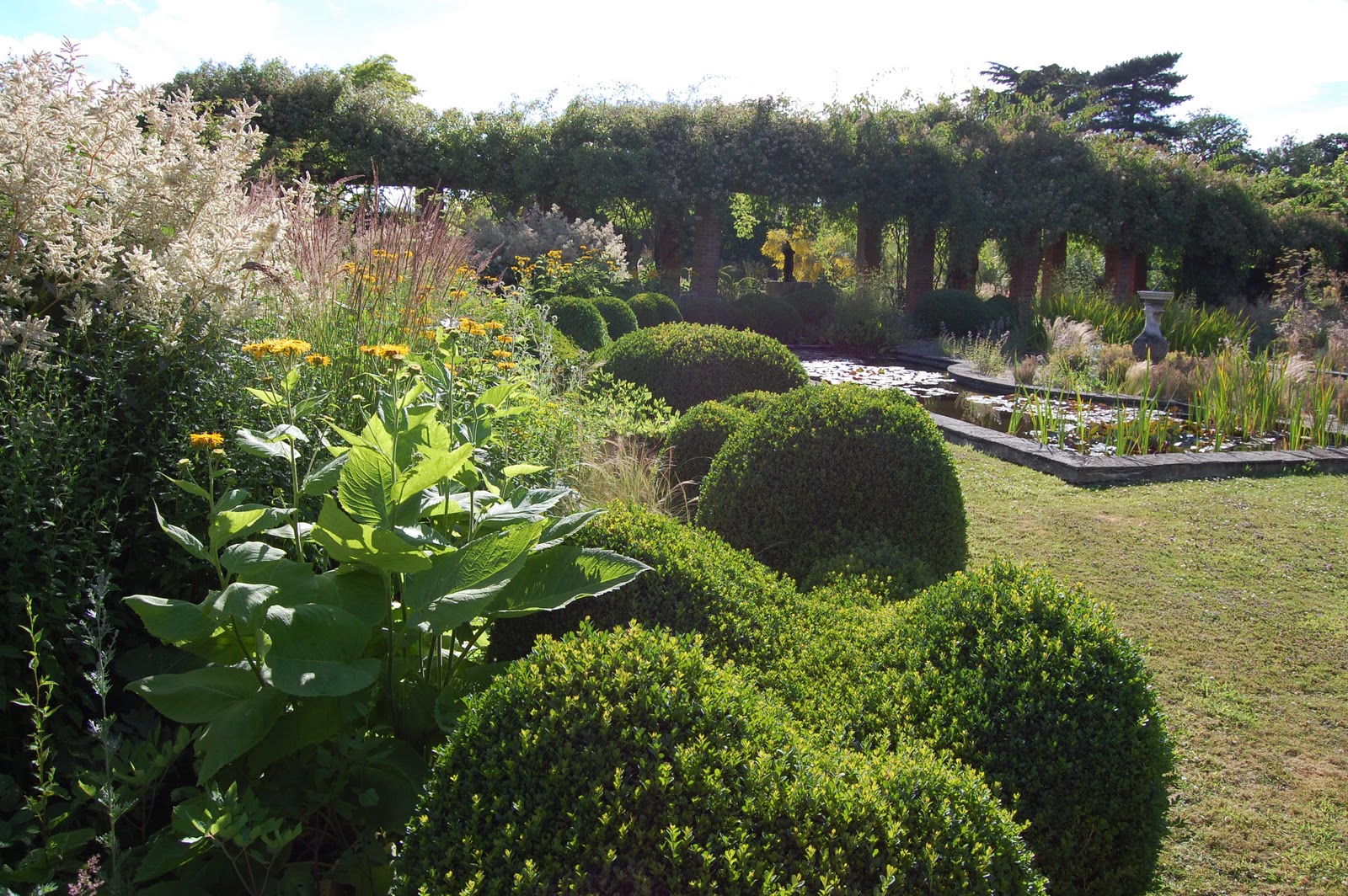
Ground-elder is a problem at Waltham, and since the garden staff cannot rid the garden of it using the bio-dynamic methods they are instructed to use (chemical warfare is actually little better either in my experience) the pragmatic decision has been taken to accept it. In one big courtyard area it is allowed in part (but heavily suppressed by lots of seriously big perennials) but kept from spreading by a cordon sanitaire of box, ingeniously Henk-clipped into a caterpillar shape – so much more fun than self-consciously trendy cloud pruning. In another garden it is allowed free-rein, but has to face vigorous perennials and so is too kept in check; earlier in June I think this is a very effective naturalistic perennial blend but by July it has gone over. A gravel garden is a riot of self-seeding, whilst the most successful part of the garden as far as I was concerned was an allee edged by walls, where shrubs and climbers had been allowed to spread just so, perennials to spread and intermingle and self-sow – the whole looks just so perfectly on the edge of tumbling into wildness. Head gardener Beatrice Krehl and her staff have managed to create a perfect embrace of the wild and the formal here.


Not all works, or has achieved such balance yet. A perfectly good terrace has been almost entirely lost to cistus and lavender and much other shrubbery in the final stages of the rangy senile decay to which many Mediterranean species seem to suffer, while a long border seems a long way from having a successful mix of species (nothing in flower in early July!). All in all, though, an immensely brave experiment in letting formality go to seed skillfully and gracefully.

Radical idea..... plant out some wildflowers in turf, maintain by "grazing like a cow" (Henk Gerritsen) - pulling up tufts of what you don't want and the add definition by deep edging between the wildy bits and the mown lawn.